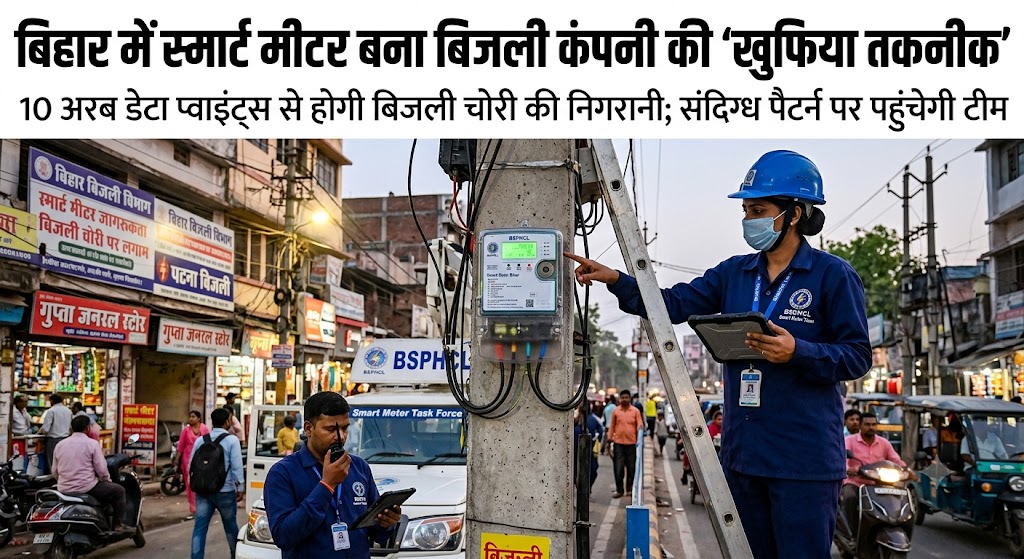
Smart Meters Become a “Surveillance Technology” for Bihar Power Companies, 10 Billion Data Points to Help Monitor Electricity Theft
Patna: Smart meters in Bihar are no longer limited to recording electricity consumption and generating bills for consumers. They are increasingly functioning as a form of data-driven intelligence technology for power distribution companies. By technically analysing data generated by smart meters, power companies are working to understand consumer consumption patterns, identify unusual electricity usage and flag possible cases of electricity theft or misuse of connections.
According to the power company, around 10 billion data points have been collected through smart meters so far. This massive volume of data is providing detailed information about consumers' electricity usage. The data is being used not only to monitor the existing system but also to formulate strategies for electricity supply and revenue improvement in the future.
Smart meters can help power companies understand how much electricity is being consumed through a connection at different times and what the normal consumption pattern looks like. If a significant change occurs in the usage of a particular connection, it can be flagged for further investigation.
Changes in Consumption After 9 PM Also Under Watch
According to officials of the power company, smart-meter data can help identify certain types of unusual consumer behaviour.
Officials said that in many cases, commercial establishments allegedly obtain electricity connections in the names of domestic consumers and subsequently use those connections for commercial activities. Such use is against the applicable rules.
Smart-meter data can help identify such cases. If electricity consumption through a domestic connection appears significantly different from normal household usage or shows a pattern associated with commercial activity, the connection may be flagged for investigation.
Changes in electricity consumption after 9 PM can also be examined as part of the data analysis in certain cases. If an unusual change is detected in the consumption pattern of a connection, a field team may visit the location to verify the actual situation.
However, a reduction in electricity consumption at night alone does not constitute evidence of wrongdoing. Consumption can change for several legitimate reasons. Therefore, physical verification is necessary after a connection is identified as potentially suspicious.
Identifying Commercial Activity Through Domestic Connections
Power companies have long faced the challenge of detecting the misuse of domestic and commercial electricity connections.
If a connection intended for domestic use is being used for a shop, office, workshop or another commercial activity, it may constitute a violation of electricity regulations.
Previously, such cases were primarily identified through inspections and complaints. With the introduction of smart meters, power companies can now access more detailed electricity consumption data.
If a domestic connection shows a sudden and unusual increase in consumption after maintaining a relatively stable pattern for a long period, the system can potentially flag the connection for further investigation.
10 Billion Data Points Create a Major Database
According to the power company, approximately 10 billion data points have been collected through smart meters so far.
This data provides information about electricity consumption and consumption patterns at different times.
Analysing such a large dataset can help the company understand when electricity demand rises in different areas and how consumption patterns are changing among different categories of consumers.
The information could be useful not only for detecting electricity theft but also for improving the overall electricity distribution system.
Technology Helps Prevent Electricity Theft
Electricity theft has long been a major challenge for power distribution companies. It results in revenue losses for the companies and can indirectly affect consumers who regularly pay their electricity bills.
With the help of smart meters and data analytics, potentially irregular connections can be identified in advance.
This could allow inspection teams to focus their efforts on connections where unusual patterns have been detected instead of physically checking every connection.
Consumer Consumption Profiles Are Being Developed
Smart meters do more than record total electricity consumption. They can also reveal consumption patterns over different periods.
Data analysis can examine when electricity consumption is high, when it falls, when changes occur and how consumption develops over a longer period.
This can help power companies better understand consumer electricity-use behaviour.
However, the use of such data must also take into account applicable regulations and consumer rights.
Data Can Help in Future Electricity Planning
The data collected through smart meters is not limited to current monitoring. Power companies can also use it to formulate future strategies.
Data can help answer questions such as which areas are experiencing rapid growth in electricity demand, when peak loads occur and where additional capacity may be required.
Such information can support future decisions related to electricity supply, transformer capacity, feeder management and distribution planning.
Sudden Increases or Decreases in Consumption Will Also Be Analysed
A sudden change in a consumer's electricity consumption can also be analysed by the system.
However, a change in consumption should not automatically be treated as evidence of electricity theft.
For example, electricity consumption may increase during summer because of greater use of air conditioners and coolers. Similarly, consumption may suddenly decline if a house remains vacant.
Therefore, consumption data should be treated as an indicator rather than conclusive evidence. The actual circumstances need to be verified before any action is taken.
Role of Inspection Teams Will Remain Important
Once smart-meter data identifies potentially suspicious connections, physical verification will remain an important part of the process.
Inspection teams can determine the purpose for which a connection was obtained and how electricity is actually being used at the premises.
If commercial activity is found to be operating through a domestic connection, further action can be taken according to the applicable rules.
Maintaining a balance between data analysis and ground-level verification will therefore remain important.
Consumers Also Need to Be Careful
With the increasing use of smart meters, consumers will also need to remain careful about the category of their electricity connection.
If a consumer has a domestic connection but later begins commercial activity at the premises, the connection category should be changed according to the applicable rules.
Using an incorrect connection category could result in the connection being selected for investigation in the future.
Data Can Improve Efficiency of Electricity Management
One of the major advantages of smart meters is that they can provide power companies with detailed consumption information at frequent intervals.
This can help identify electricity distribution problems more quickly and potentially speed up the process of resolving them.
In the coming years, a data-driven system could help power companies forecast electricity demand more accurately and use available resources more efficiently.
Transparency Is Also Essential Alongside Technology
Smart meters and data analytics can be useful technologies for preventing electricity theft and improving electricity management. However, transparency in their use is equally important.
A change in a consumer's electricity consumption should not automatically be treated as proof of an offence.
Appropriate verification and due process should be followed before any final action is taken.
This can ensure that technology is used effectively while also maintaining fairness for consumers.
Smart meters in Bihar are increasingly becoming an important data-driven monitoring and strategic planning tool for power distribution companies rather than simply a billing technology.
According to the company, approximately 10 billion data points have been collected so far.
Analysis of this data is helping identify potential electricity theft, incorrect connection categories and consumer electricity consumption patterns.
Particular attention is being given to cases where commercial establishments allegedly obtain domestic electricity connections and use them for commercial purposes.
Changes in consumption patterns after 9 PM may also become an indicator for investigation in certain cases, although a reduction in consumption alone would not be sufficient grounds for action against a consumer.
In the future, data generated through smart meters could be used to prevent electricity theft, improve revenue collection, forecast electricity demand and strengthen the distribution network.
In this way, smart meters are playing an important role in transforming Bihar's electricity system into a more technology-driven, data-based and targeted monitoring system.


