
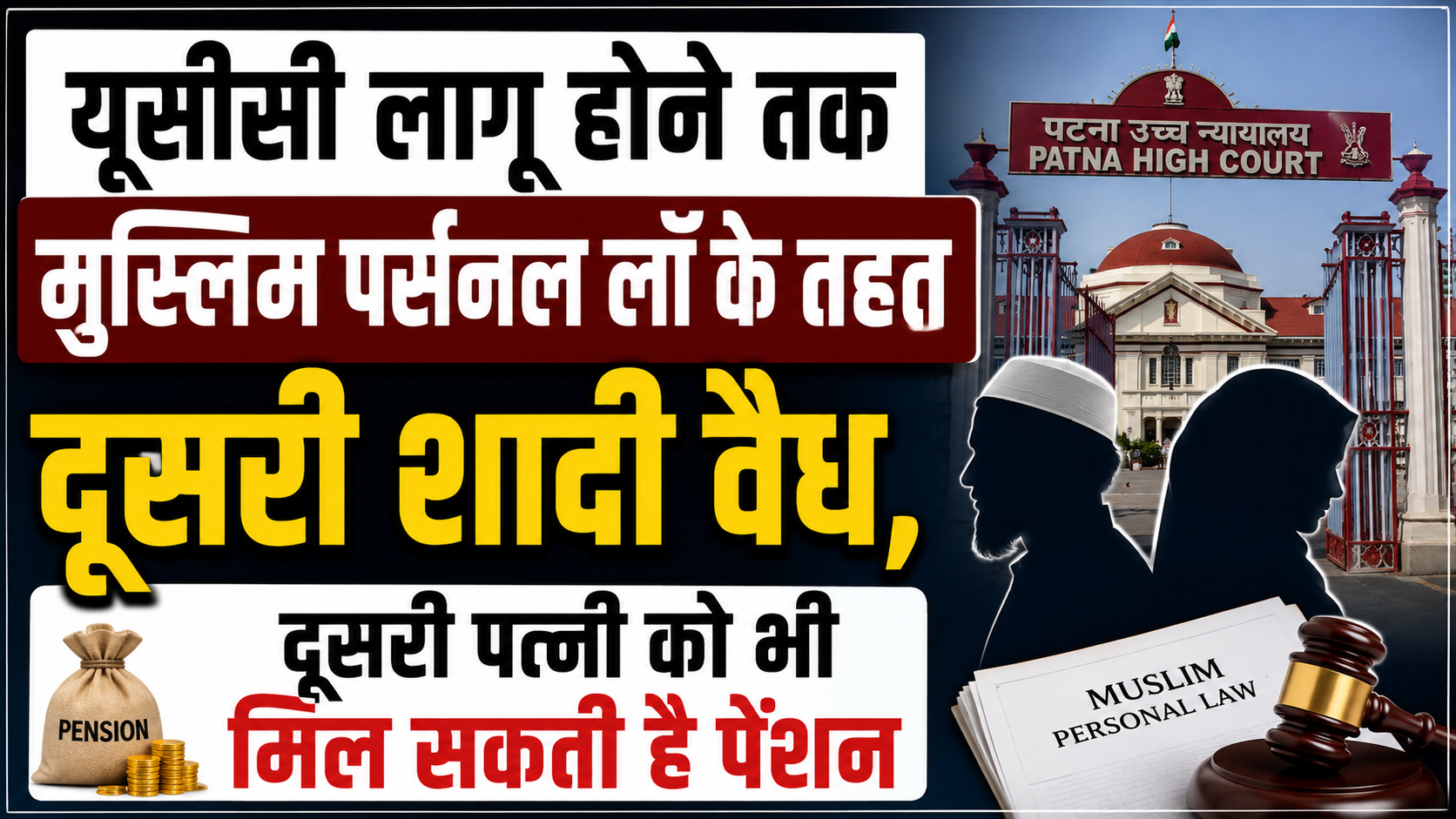
Second Marriage Under Muslim Personal Law Valid Until UCC Is Enacted, Second Wife May Be Entitled to Pension
Patna: In a significant judgment concerning the family and service rights of Muslim government employees, the Patna High Court has ruled that until the Uniform Civil Code (UCC) is implemented in India, a second marriage performed in accordance with Muslim Personal Law will remain legally valid. The court observed that if the second marriage complies with the provisions of Muslim Personal Law, the second wife cannot be denied statutory benefits such as family pension solely because she is the employee's second spouse.
The ruling is being viewed as an important development in matters relating to Muslim Personal Law, family rights, and service regulations. Legal experts believe the judgment could serve as an important reference for similar cases in the future.
Background of the Case
The case arose after the death of a Muslim government employee, whose second wife sought family pension benefits. She argued that her marriage had been solemnized in accordance with Muslim Personal Law and was therefore legally valid, making her eligible to receive the pension.
The concerned government department, however, rejected her claim, stating that the employee's first wife was still alive and that service rules created legal obstacles to granting pension benefits to a second wife. The dispute eventually reached the Patna High Court.
What the High Court Said
In its judgment, the Patna High Court noted that the Uniform Civil Code has not yet been implemented in India. Therefore, matters relating to marriage within the Muslim community continue to be governed by Muslim Personal Law.
The court held that if a second marriage has been legally contracted under Muslim Personal Law, it cannot be treated as invalid. Consequently, denying the second wife family pension or similar statutory benefits solely because she is the second spouse would not be justified.
The court also clarified that every case must be decided on the basis of its own facts, evidence, and applicable legal provisions.
Significance of Muslim Personal Law
Under Muslim Personal Law, a Muslim man may, under certain conditions and subject to the applicable legal and religious requirements, contract more than one marriage. The court observed that until Parliament enacts a new law, the existing personal laws governing such matters cannot be disregarded.
Legal experts note that balancing personal laws with government service regulations remains an important judicial responsibility.
Court's Observation on the Uniform Civil Code
The judgment emphasized that since the Uniform Civil Code has not yet come into force, the personal laws applicable to different religious communities continue to remain effective.
The court indicated that the legal position regarding marriage and family rights may change if the UCC is enacted in the future. However, the present case was decided solely on the basis of the laws currently in force.
Clarity on the Rights of the Second Wife
The ruling provides important clarification regarding the rights of a second wife whose marriage has been validly performed under Muslim Personal Law. If the marriage is legally valid and all required conditions have been fulfilled, the second wife may be entitled to claim family pension and other statutory benefits.
However, legal experts have pointed out that each case will depend on the validity of the marriage, documentary evidence, and the relevant service rules applicable to the employee.
Views of Legal Experts
According to legal experts, the judgment attempts to strike a balance between personal laws and government service regulations. They believe the court has reaffirmed that until Parliament introduces a new legal framework, the existing legal system must continue to be followed.
Experts also believe that the decision is likely to serve as persuasive guidance in future cases involving similar legal questions.
Social and Legal Significance
The impact of the judgment is expected to extend beyond pension disputes. It may also influence future discussions involving Muslim Personal Law, inheritance rights, family benefits, and other service-related matters concerning government employees.
Several social organizations believe that the ruling could provide relief to women whose legal rights have remained uncertain due to prolonged disputes.
Impact on Government Departments
Legal experts suggest that government departments may now need to examine similar pension claims in light of the principles laid down by the High Court.
Where a second marriage is found to be legally valid under Muslim Personal Law and all other legal requirements are satisfied, the competent authorities may be required to consider pension claims in accordance with the law and the court's interpretation.
The Patna High Court's ruling is being regarded as an important judicial interpretation concerning the relationship between Muslim Personal Law and government service regulations. The court has made it clear that until the Uniform Civil Code is implemented, a valid second marriage performed under Muslim Personal Law will continue to enjoy legal recognition, and a second wife cannot be denied family pension or similar statutory benefits solely because of her status as the second spouse.
At the same time, the court emphasized that the final outcome in every case will depend on its specific facts, documentary evidence, and the applicable service rules. As a result, the judgment is expected to become an important legal precedent for similar disputes in the future.


