
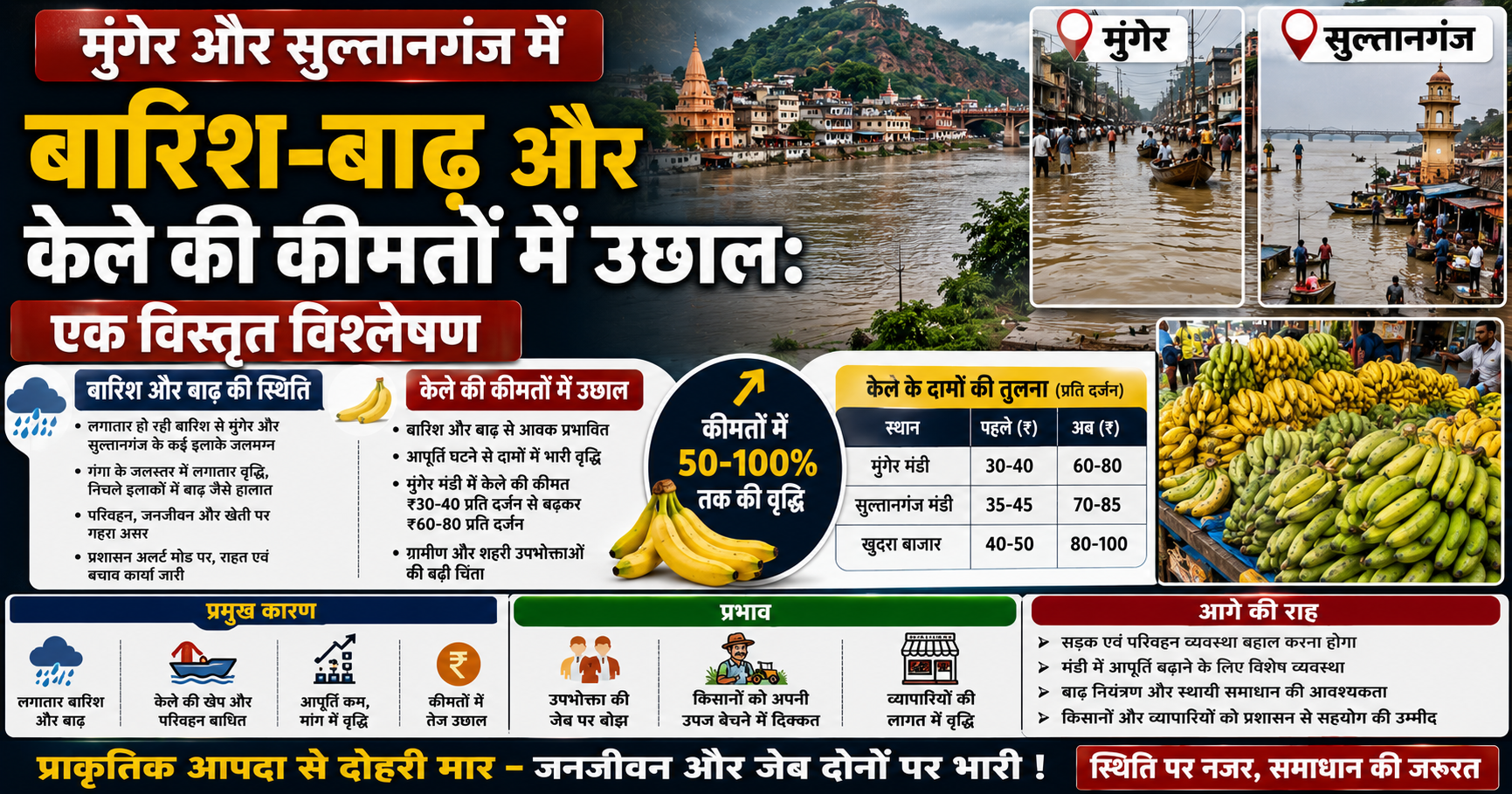
Rise in Banana Prices Caused Solely by Rains and Floods: Munger and Sultanganj
Munger/Sultanganj: Regions like Munger and Sultanganj in Bihar are known throughout the state for their agriculture, geographical location, and especially fruit production. The diara (floodplain) region and the coastal areas of the Ganges here are quite famous for banana cultivation. However, whenever the monsoon becomes active and natural disasters like heavy rains and floods occur, it directly impacts local life as well as agricultural produce. In particular, the skyrocketing increase in banana prices due to rain and floods has become a common problem, placing a heavy burden on the pockets of ordinary consumers.
Geographical Location and Importance of Banana Cultivation
The plain and diara regions of Munger and Sultanganj have soil fertility considered extremely favorable for the banana crop. Farmers here engage in banana horticulture on a large scale, which is supplied from local markets to neighboring districts and states.
Economic Backbone: For thousands of farmers in this region, bananas are the primary means of livelihood.
Local Trade: Bananas are dispatched daily from the mandis (markets) of Sultanganj and Munger to other major cities via trucks and other vehicles.
Employment: From farming to transportation and sales, a large number of laborers and traders are connected to this business.
Direct Blow of Rains and Floods on Crops
When monsoon rains are at their peak and the water level of the Ganga River crosses the danger mark, floodwaters spread across the diara regions of Sultanganj and Munger. This flooding proves to be the biggest curse for the banana crop.
Destruction of Plants: Banana plants are weak and sensitive to water. Prolonged waterlogging in the fields causes the banana plants (stems) to rot, destroying the entire crop.
Havoc Caused by Strong Winds: Heavy-duty banana plants are uprooted or broken in the middle due to strong storms and winds blowing during the monsoon rains, causing massive financial losses to farmers.
Paralysis of Transportation Systems: Due to floods and heavy rains, rural roads and national highways (such as NH-80) get submerged, disrupting traffic. With transportation systems disrupted, it becomes impossible to harvest bananas from the fields and transport them to the markets.
Key Reasons Behind the Skyrocketing Increase in Prices
When supply is completely disrupted while demand remains constant in the market, prices shoot up according to the rules of economics. The following main reasons are responsible for the surge in banana prices:
Massive Decline in Local Production: Due to the destruction of the local crop by floods, local bananas from Munger and Sultanganj stop arriving at the markets.
Reliance on Other States: Due to low local supply, traders are forced to procure bananas at expensive rates from other states or distant districts.
High Transportation Costs: Transportation costs increase significantly due to damaged routes and the use of long detours during flood days, which directly impacts retail prices.
Black Marketing and Hoarding: During times of crisis, middlemen and traders often exploit artificial scarcity to inflate prices excessively.
Problems Faced by the General Public and Farmers
This entire process brings a two-pronged blow—on one hand, farmers reach the verge of destitution due to the destruction of their crops, while on the other hand, ordinary consumers are forced to buy fruits at exorbitant rates.
The Pain of Farmers: With their year-long hard work washed away, farmers face a crisis of sustaining their families. Government compensation often proves inadequate.
Burden on Consumers' Pockets: Bananas, consumed as a nutritious fruit during fasts, festivals, or normal days, begin to go beyond the reach of the common man.
Solutions and Administrative Measures
To deal with this problem, both long-term and short-term measures are required:
Better Drainage Systems: A proper drainage system should be established in agricultural areas to deal with waterlogging situations.
Crop Insurance Schemes: Farmers should receive the benefits of transparent and effective crop insurance to compensate for losses caused by floods and natural disasters.
Alternative Transport Routes: Timely repair of roads and the construction of elevated roads are necessary to keep traffic smooth even during flood-affected periods.
The rise in banana prices due to rain and floods in Munger and Sultanganj is not merely a seasonal change; rather, it is the result of challenges existing before the agricultural system with which farmers and the general public have to grapple every year. Unless the agricultural sector is equipped with flood protection and modern technologies, this cycle of helplessness against nature will continue, and the common man will keep bearing the brunt of inflation.


