
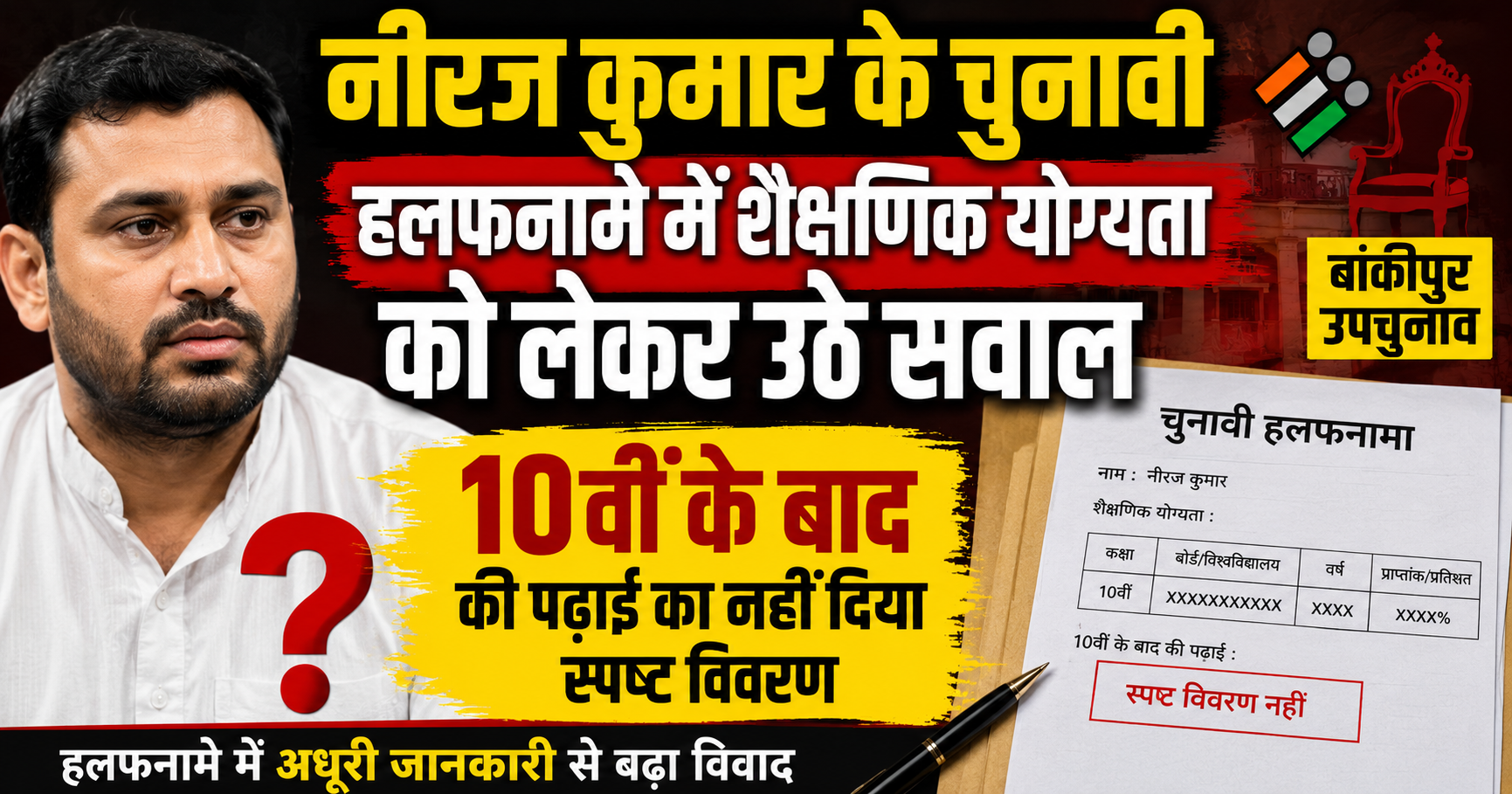
Questions Raised Over Neeraj Kumar’s Educational Qualifications in Election Affidavit; No Clear Details Beyond Class 10
Patna, July 15: The election affidavit submitted by Neeraj Kumar, a candidate in the Bankipur Assembly by-election, has sparked public and political discussion over the details of his educational qualifications. On July 13, Neeraj Kumar filed his nomination papers along with the mandatory election affidavit before the Election Commission. However, attention has now turned to the educational information disclosed in the document.
The discussion centers on the fact that while the affidavit mentions his educational qualifications, it reportedly does not clearly specify his academic record beyond Class 10. The issue has triggered debate among political observers, voters, and on social media. As of now, no official authority has concluded that there is any legal irregularity, and the matter remains part of public discussion.
Affidavit Submitted Along with Nomination Papers
Under election rules, every candidate is required to submit an affidavit along with the nomination papers. The affidavit contains information regarding the candidate's personal background, educational qualifications, assets, liabilities, criminal cases (if any), and other mandatory disclosures.
Neeraj Kumar submitted his affidavit in accordance with this requirement on July 13. Following its publication, questions were raised regarding the educational details mentioned in the document.
Why Are Questions Being Raised?
According to the affidavit, Neeraj Kumar has disclosed his educational qualifications. However, public attention has focused on the absence of clear information regarding his education after completing Class 10.
Some observers argue that if a candidate has pursued further studies, those qualifications should be clearly mentioned in the affidavit. Others point out that if no higher formal education was completed, the affidavit should be interpreted based solely on the information officially disclosed.
It is important to note that the existence of public questions or political criticism does not, by itself, establish any legal violation or wrongdoing.
Importance of an Election Affidavit
An election affidavit is an important transparency document in the democratic process. It enables voters to access essential information about candidates before casting their votes.
Typically, an election affidavit includes:
Educational qualifications
Movable and immovable assets
Income and liabilities
Criminal cases, if any
Family details
Other mandatory declarations required under election law
The objective is to ensure transparency and informed decision-making by voters.
Election Commission Rules
The Election Commission requires candidates to provide complete and accurate information in their affidavits.
If questions arise regarding any disclosure, concerned parties may raise objections through the legal procedures provided under election laws. Any determination regarding discrepancies or omissions is made by the appropriate authority or court after examining the relevant facts and legal provisions.
Political Reactions
The educational details disclosed in Neeraj Kumar's affidavit have become a subject of political debate.
Some opposition leaders have questioned the information provided, while supporters have argued that the affidavit was filed in accordance with the prescribed procedure and that no conclusions should be drawn without proper examination of the facts.
Legal Experts' Opinion
Legal experts note that an election affidavit is a sworn declaration, making the accuracy of the information provided highly significant.
However, they also emphasize that any alleged omission or discrepancy must be evaluated based on documentary evidence, applicable election laws, and due legal process. Public allegations alone are not sufficient to establish legal liability.
Why This Information Matters to Voters
According to election experts, affidavits help voters understand a candidate's background and make informed choices.
For this reason, the Election Commission makes such affidavits publicly available to promote transparency in the electoral process.
Discussion on Social Media
The issue has also generated considerable discussion on social media, where users have expressed differing opinions. While some have questioned the educational disclosures, others have called for restraint until official clarification or legal scrutiny takes place.
Experts have advised the public to rely only on verified information and avoid spreading unconfirmed claims.
What Could Happen Next?
If any individual or organization believes that the affidavit contains incomplete or inaccurate information, they may pursue remedies available under election law.


