
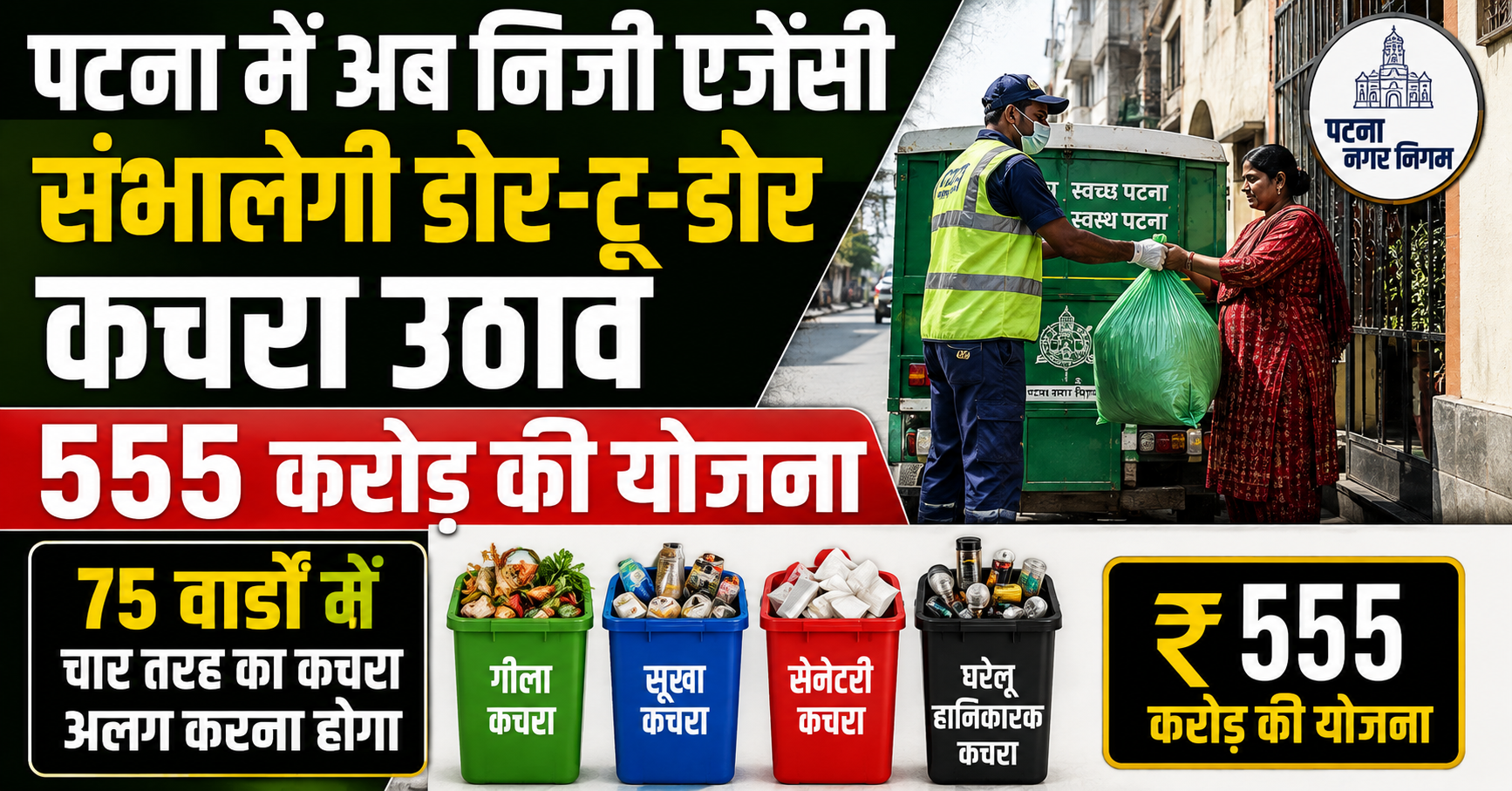
Private Agency to Handle Door-to-Door Garbage Collection Under Rs 555-Crore Plan
Patna: The Patna Municipal Corporation is preparing to introduce a new integrated solid waste management system in the state capital. Instead of purchasing a large fleet of vehicles for door-to-door garbage collection, the civic body will seek the assistance of a private agency to manage the entire waste collection and cleaning operation.
Under the proposed system, a private agency will be assigned responsibility for garbage collection, transportation, waste processing and road cleaning for a period of four years. The estimated cost of the contract is around Rs 555.32 crore.
The Patna Municipal Corporation has already issued a tender for the project, and the new system is expected to become operational soon after the selection process and other formalities are completed.
The new arrangement will cover all 75 wards of Patna. Residents and commercial establishments will be required to segregate waste at the source into four categories, including wet and dry waste.
The selected agency will collect the segregated waste from homes, shops and other commercial establishments and transport it to designated Garbage Transfer Stations (GTS). From there, the agency will also be responsible for transporting the waste to processing facilities.
After segregation and processing, the waste will be transported to the dumping yard at Ramchak Bairiya, where a waste-to-energy plant is proposed to be developed.
The new system will not be limited to garbage collection. Road cleaning across the city will also come under the responsibility of the private agency.
Private Agency to Get Four-Year Contract
According to the proposed plan, the selected private agency will be responsible for waste management operations for four years.
The estimated value of the contract is approximately Rs 555.32 crore. The objective is to create a more integrated system in which waste collection, transportation, processing and road cleaning are managed under a coordinated framework.
The municipal corporation expects the private agency to bring modern equipment, vehicles and trained manpower into the system.
Instead of the civic body having to independently arrange large numbers of garbage collection vehicles and other resources, the private operator will manage much of the operational infrastructure.
New System to Cover All 75 Wards
The new integrated waste management system will cover all 75 wards under the Patna Municipal Corporation.
This means residential colonies, markets, commercial areas, shops and other establishments across the city will come under the new system.
Garbage collection vehicles will visit residential and commercial areas according to a fixed schedule. Residents will be expected to hand over their waste to the designated collection vehicles rather than dumping it on roadsides or in open spaces.
Commercial establishments such as shops, restaurants, hotels and markets will also be expected to follow the waste segregation rules.
Wet and Dry Waste to Be Segregated at Source
Source segregation will be one of the most important components of the new system.
Residents will be required to keep different categories of waste separately rather than mixing all garbage together.
Wet waste generally includes food leftovers, vegetable and fruit peels and other biodegradable material. Dry waste can include paper, plastic, metal and other recyclable materials.
Separating waste at the source can make recycling, composting and other processing activities more efficient.
However, the success of this system will depend heavily on public participation. If residents mix different types of waste, the efficiency of the downstream processing system could be affected.
Door-to-Door Collection From Homes and Shops
Under the new system, private agency vehicles will collect garbage directly from homes and commercial establishments.
The collected waste will then be transported to designated Garbage Transfer Stations.
The purpose of the arrangement is to create a structured system for waste collection and transportation.
Regular monitoring will be important because delays in garbage collection can quickly affect cleanliness in residential and commercial areas.
The municipal corporation will therefore need to closely monitor whether collection vehicles are reaching each locality on schedule.
Waste to Be Transported From GTS to Processing Facilities
The responsibility of the private agency will not end after collecting waste from homes and shops.
The agency will also be responsible for transporting the collected garbage from GTS facilities to designated processing locations.
By placing collection and transportation responsibilities under one operational system, the municipal corporation hopes to improve coordination and reduce irregularities in waste movement.
The agency will have to ensure that waste is transported according to the prescribed routes and delivered to designated facilities.
Waste-to-Energy Plant Proposed at Ramchak Bairiya
The dumping yard at Ramchak Bairiya will play an important role in the proposed waste management system.
A waste-to-energy plant is planned at the site. Such plants are designed to process suitable waste and recover energy from it.
If implemented effectively, the system could help reduce the amount of waste being sent directly to landfill or dumping areas.
It could also contribute to more scientific waste management and reduce the long-term pressure on dumping grounds.
However, proper waste segregation and processing will be essential for the effective operation of a waste-to-energy facility.
Road Cleaning Also Included in Agency’s Responsibility
The new contract will go beyond door-to-door garbage collection.
The selected agency will also be responsible for cleaning city roads.
This will include regular sweeping and removal of garbage from roads and designated public areas.
The municipal corporation hopes that assigning both garbage collection and road cleaning to the same agency will improve coordination and reduce gaps in service delivery.
Focus on Modern Equipment
Another expected benefit of involving a private agency is the increased use of modern machinery and technology.
Different types of vehicles may be deployed for door-to-door garbage collection depending on the requirements of individual areas.
Mechanical sweeping machines, smaller cleaning vehicles and other equipment could also be used for road cleaning.
However, machinery alone may not be sufficient for a city as large and densely populated as Patna. Adequate manpower will also be required to maintain cleanliness across residential areas, markets and narrow streets.
Public Participation Will Be Crucial
Even the most advanced waste management system cannot succeed without public cooperation.
Residents will need to segregate waste at home and hand it over to collection workers as instructed.
The municipal corporation will need to conduct awareness campaigns across schools, residential colonies, markets, apartment complexes and commercial establishments.
People will need to understand that separating wet and dry waste at source does more than improve cleanliness. It also increases the possibility of recycling and recovering useful materials from waste.
Aim to Reduce Open Garbage Dumping
A strong door-to-door collection system could help reduce the practice of dumping garbage in open areas.
At present, garbage is often found along roadsides, near vacant plots and around drains. Such dumping can create foul smells, block drainage systems and increase health risks.
If collection vehicles arrive regularly and residents hand over their waste directly to them, open dumping could be significantly reduced.
Monitoring and Accountability Will Be Important
The proposed Rs 555.32-crore project will require strict monitoring and accountability.
The municipal corporation will need to ensure that the private agency follows all contractual standards.
Important parameters will include the number of garbage collection vehicles, collection schedules, vehicle routes, road-cleaning frequency and the final destination of collected waste.
Technology-based monitoring could also be introduced. GPS tracking, vehicle monitoring, digital complaint systems and online performance tracking could make the system more transparent.
Complaint Resolution System Needed
A strong grievance redressal mechanism will also be essential.
If garbage collection vehicles fail to reach a locality on time or roads are not cleaned regularly, residents should have an easy way to register complaints.
Clear responsibility between the municipal corporation and the private agency could help ensure faster resolution of complaints.
The corporation could also link payments or performance assessments to service quality to ensure that the agency maintains the required standards.
Major Change Expected in Patna’s Waste Management
The integrated solid waste management system is expected to bring significant changes to the way garbage is collected, transported and processed in Patna.
Under the proposed four-year contract worth around Rs 555.32 crore, the private agency will be responsible for collecting waste from homes and commercial establishments, transporting it to GTS facilities, moving it onward to processing locations and maintaining road cleanliness.
Source segregation across all 75 wards will be the foundation of the new system.
The proposed waste-to-energy plant at Ramchak Bairiya could further strengthen the city’s efforts toward scientific waste disposal and energy recovery.
If the municipal corporation, private agency and residents work together effectively, the new system could make Patna’s waste management more modern, organized and efficient.
However, the ultimate success of the project will depend on several factors, including the quality of the agency’s services, regular monitoring by the municipal corporation, timely garbage collection, proper waste segregation and active participation from residents.
The upcoming system therefore represents a major shift in Patna’s approach to solid waste management, with the aim of creating a cleaner city and a more organized system for handling the growing volume of urban waste.


