

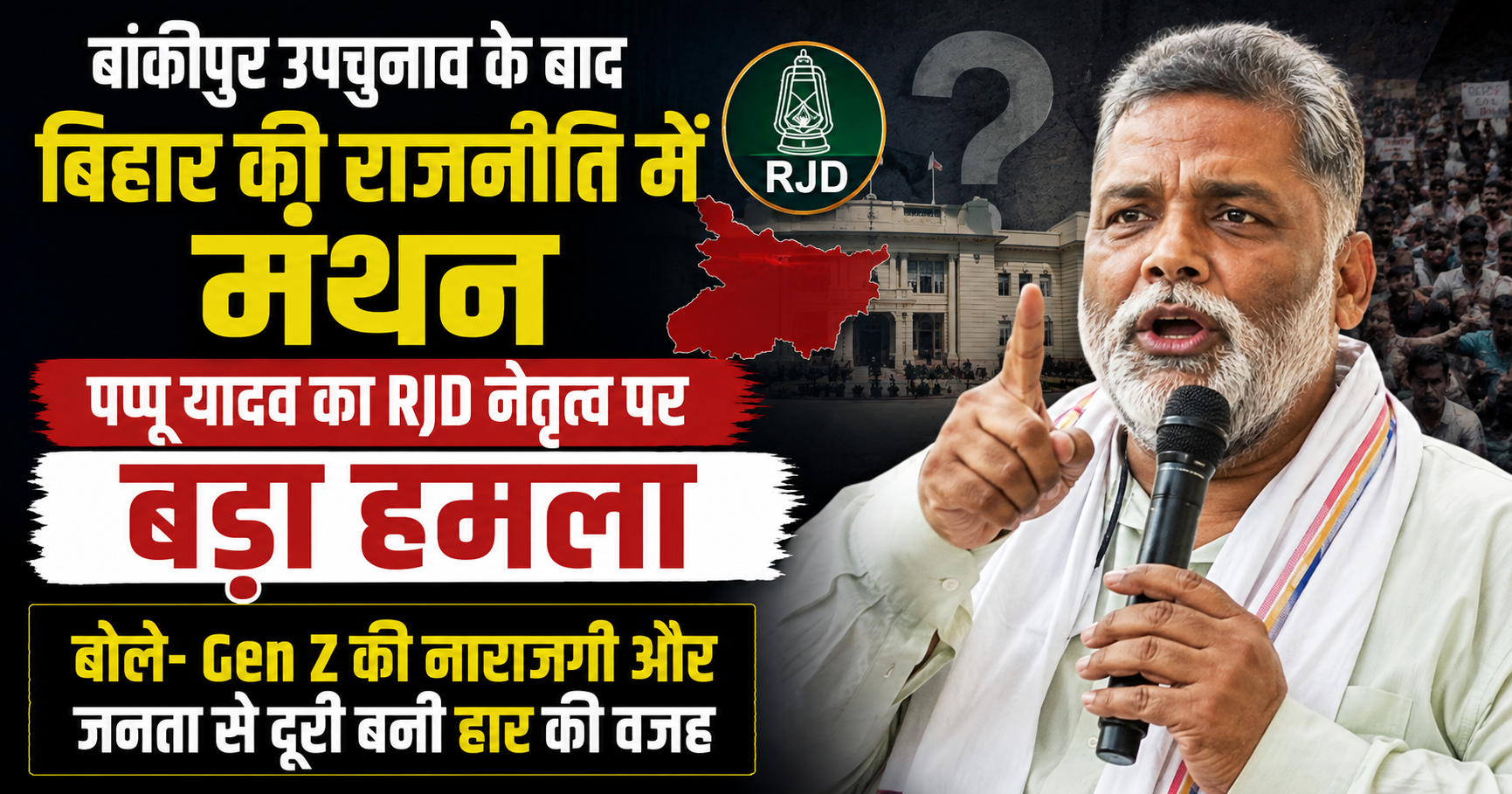
Political Churn in Bihar After Bankipur Bypoll; Pappu Yadav Targets RJD Leadership, Says Gen Z Discontent and Disconnect with People Led to Defeat
Patna: The results of the Bankipur Assembly by-election have triggered a fresh political debate in Bihar. While the Bharatiya Janata Party (BJP) suffered a significant electoral setback, the Rashtriya Janata Dal (RJD) also failed to make a major political impact. Following the results, almost all major political parties in the state have begun reviewing their performance and analyzing the reasons behind the outcome.
Amid this political introspection, Purnia Member of Parliament Pappu Yadav launched a sharp attack on the current RJD leadership. He claimed that the party's leadership has lost its social and political influence and has become disconnected from the concerns and aspirations of the people, particularly the younger generation. According to him, growing public dissatisfaction—especially among Generation Z (Gen Z) voters—was one of the major factors behind the BJP's defeat.
Bypoll Results Trigger Political Debate
The outcome of the Bankipur by-election has prompted political parties across Bihar to reassess their electoral strategies. The results suggest that voters are increasingly prioritizing issues such as employment, education, development, governance, and local concerns over traditional political equations.
Political analysts believe the bypoll has demonstrated that caste-based calculations and conventional vote-bank politics alone are no longer sufficient to ensure electoral success. Young voters, in particular, appear to be more inclined toward new political alternatives and issue-based politics.
Pappu Yadav's Criticism of RJD Leadership
Reacting to the election results, Pappu Yadav openly questioned the effectiveness of the current RJD leadership. He argued that the party has gradually lost its credibility and influence among the people.
According to him, the leadership has failed to understand the changing social landscape and the aspirations of the younger generation. He said that any political party that loses regular engagement with the public inevitably weakens its support base.
Emphasis on the Role of Gen Z
Pappu Yadav emphasized that Gen Z, comprising first-time and young voters, played a crucial role in shaping the by-election outcome. He said this generation has a different political outlook and tends to prioritize employment opportunities, quality education, technology, transparency, and better governance over traditional political narratives.
He argued that growing dissatisfaction among young voters was clearly reflected in the election results and warned that political parties could face similar outcomes in the future if they fail to address the aspirations of the youth.
Comments on BJP's Defeat
Pappu Yadav also commented on the BJP's electoral loss, stating that voters are no longer satisfied with campaign promises alone. According to him, people are increasingly expecting tangible development, employment opportunities, and concrete governance outcomes.
At the same time, he acknowledged that every electoral defeat is influenced by multiple local, social, and political factors, all of which require careful analysis.
Changing Political Equations
The Bankipur by-election has sparked discussions about changing political dynamics in Bihar. Political parties have reportedly begun revising their strategies in preparation for upcoming elections.
Political observers believe that greater emphasis will now be placed on strengthening party organizations, promoting new leadership, and expanding outreach among young voters.
Changing Priorities of Young Voters
Political experts note that the number of young voters in Bihar continues to grow. This demographic is increasingly focused on employment, quality education, digital infrastructure, entrepreneurship, startups, and improved public services.
As a result, parties that present credible policies and a clear roadmap on these issues may gain an electoral advantage in future contests.
Political Parties Begin Self-Assessment
Following the bypoll results, political parties have started internal review meetings to evaluate organizational performance, booth-level management, campaign strategies, and voter outreach.
Experts say that such introspection is a normal part of the democratic process and helps political organizations identify weaknesses and improve their future strategies.
Political Reactions Intensify
Pappu Yadav's remarks have intensified political debate in Bihar. Leaders from various political parties have begun responding with their own interpretations of the election results. Attention is also focused on how the RJD leadership will officially respond to the allegations.
Political analysts believe that while such statements are common after elections, their long-term significance depends on how political parties translate the lessons of the bypoll into future strategies.
Focus Shifts to Upcoming Elections
With future elections on the horizon, political parties have already begun preparing new strategies. Young voters, women, farmers, and urban residents are expected to become key focus groups in upcoming campaigns.
Experts believe that issue-based politics, digital campaigning, and greater youth participation will play an increasingly important role in Bihar's electoral landscape.
The Bankipur Assembly by-election has raised fresh political questions in Bihar. The BJP's defeat, the RJD's performance, and the broader political implications continue to be widely debated. Amid these discussions, Purnia MP Pappu Yadav has strongly criticized the current RJD leadership, claiming that it has become disconnected from the public, particularly Gen Z voters.
However, these observations reflect the political views of an individual leader. Election outcomes are shaped by a combination of social, local, organizational, and political factors. It remains to be seen how different political parties interpret the bypoll results and what strategic changes they implement ahead of future elections.