
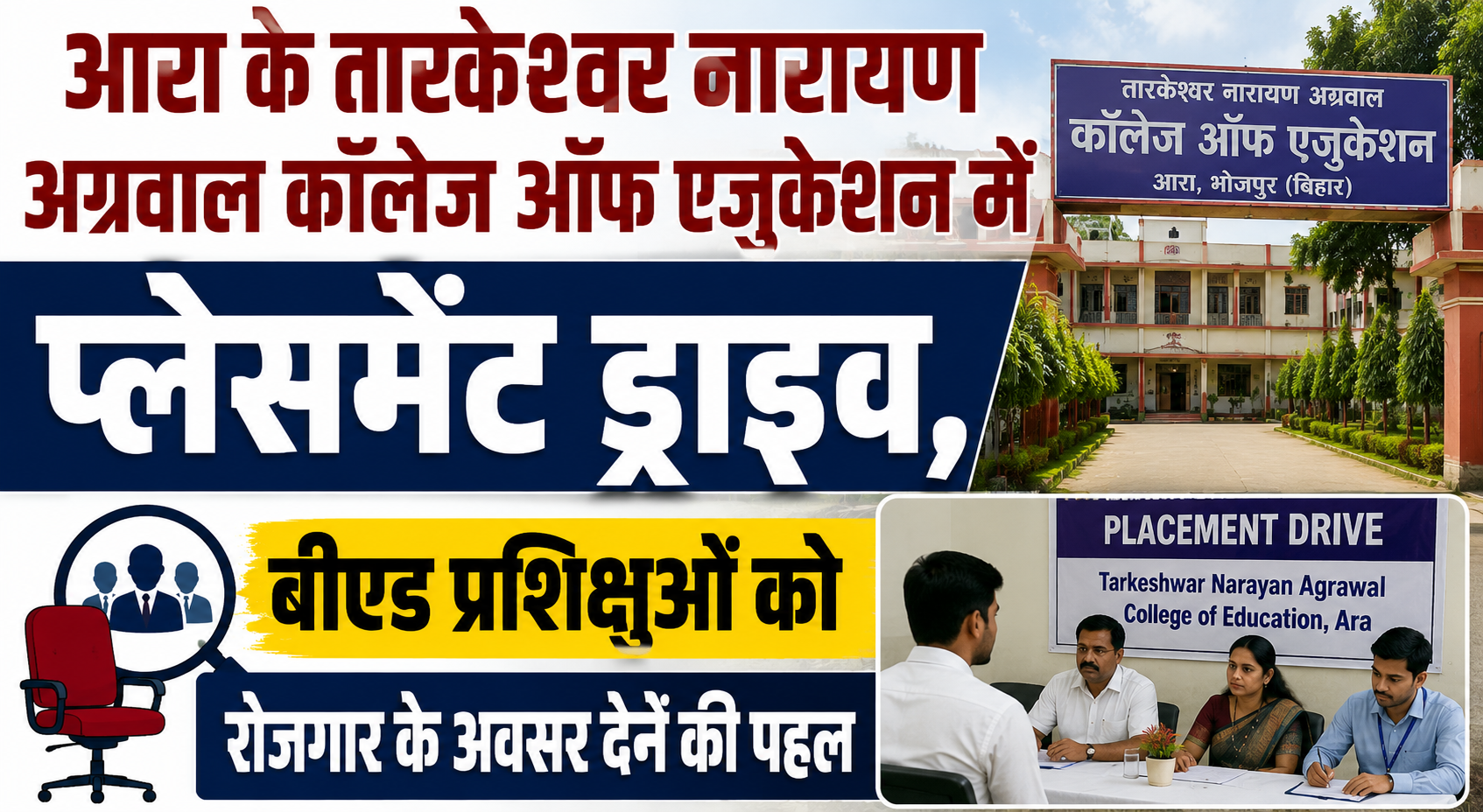
Placement Drive Held at Tarkeshwar Narayan Agrawal College of Education in Ara, Creating Employment Opportunities for B.Ed Trainees
Ara: A placement drive was organised on August 7 at Tarkeshwar Narayan Agrawal College of Education in Ara, Bhojpur district. The primary objective of the programme was to provide B.Ed. and teacher-education trainees with employment opportunities and a platform to begin their careers in the education sector.
The initiative was viewed as an important step toward connecting students with potential employment opportunities. The programme provided trainees with an opportunity to understand the recruitment process and present their academic qualifications, subject knowledge, communication skills and teaching abilities.
Initiative to Connect Students With Employment
The placement drive was organised as part of an effort to connect teacher-education students with employment opportunities.
Students completing B.Ed. programmes can pursue careers in schools, educational institutions and other areas related to teaching and education. While academic qualifications remain important, employers increasingly look for additional skills such as effective communication, classroom management, subject knowledge and familiarity with digital teaching tools.
Placement programmes give students an opportunity to understand these expectations and prepare themselves accordingly.
Important Opportunity for B.Ed Trainees
Placement drives are particularly useful for B.Ed. trainees because trained teachers are required across various educational institutions.
Apart from government schools, opportunities are also available in private schools and other educational organisations. Students can use such programmes to understand the employment landscape and identify areas where they need to improve their skills.
Participation in placement activities can also provide valuable experience for students who will later appear for competitive examinations, teacher recruitment processes and job interviews.
Focus on Skill Development Along With Employment
In today's competitive environment, subject knowledge alone may not be sufficient for a successful teaching career. The growing use of technology has also changed classroom teaching methods.
Smart classrooms, digital learning materials, online educational resources and modern assessment techniques are becoming increasingly common.
As a result, B.Ed. trainees need to develop digital skills along with teaching and communication abilities. Placement drives can help students understand the skills employers may expect from prospective teachers.
Effective communication, leadership, classroom management and familiarity with modern teaching methods can all contribute to improving employment prospects.
Enthusiasm Among Trainees
The placement programme generated interest among the trainees. Students looking for employment opportunities were able to engage with the recruitment process and gain exposure to potential career options.
For some students, the programme may have provided an opportunity to experience a formal placement process for the first time.
Such experiences can help improve confidence. Facing interviews and discussing qualifications with prospective employers can help students identify their strengths and areas requiring improvement.
Helping Students Decide Their Career Path
Many B.Ed. students aspire to become government teachers and prepare for various teacher eligibility and recruitment examinations. However, government employment is not the only career option available to teacher-education graduates.
Private schools, educational institutions and other education-related organisations can also provide employment opportunities.
Placement drives can help students become aware of these alternatives and make informed career decisions according to their interests, qualifications and abilities.
Growing Need for Campus Placement
Educational institutions are increasingly focusing not only on academic qualifications but also on employability skills.
For teacher-education institutions, this responsibility is particularly important because their graduates eventually enter the teaching profession and play a role in shaping the next generation.
Placement drives provide institutions with an opportunity to help trainees understand workplace expectations and improve their readiness for employment.
Employment Opportunities in the Education Sector
Career opportunities in education are not limited to classroom teaching. Trained professionals may also explore areas such as academic coordination, educational content development, teacher training, education management and other related fields.
However, eligibility and experience requirements vary from one position to another. Students need to understand the qualifications and professional requirements associated with specific jobs before choosing a career path.
Placement programmes can serve as a practical platform for gaining such information.
Boosting Students' Confidence
One of the major benefits of campus placement programmes is the improvement in students' confidence.
Some students may perform well academically but struggle to communicate effectively during interviews or formal interactions. Placement drives give them exposure to real-world recruitment situations.
Such experience can help students prepare better for future selection processes.
Students can also learn how to prepare an effective résumé and present their academic achievements, skills and other qualifications in a professional manner.
Important Role of the College
The college administration and faculty members play an important role in making placement programmes successful.
Providing employment opportunities alone may not be sufficient. Students also need preparation for recruitment and interview processes.
Activities such as mock interviews, résumé-writing sessions, communication-skills training, demonstration classes and subject-based preparation can help trainees become more employment-ready.
Regular career-oriented activities can help students adapt to changing requirements in the education sector.
Scope for More Opportunities in the Future
Following the placement drive held on August 7, students and the institution are expected to look forward to more such employment initiatives.
Regular placement programmes can help connect a larger number of trainees with schools, educational organisations and other potential employers.
For this, educational institutions may need to strengthen partnerships and communication with schools and organisations offering employment opportunities.
Regular job fairs and placement drives could create better career pathways for teacher-education students.
Role of Placement in Preparing Future Teachers
For B.Ed. trainees, becoming a teacher is not simply about obtaining employment. Teaching is a profession involving significant responsibility for students' academic and personal development.
Therefore, professional competence is as important as securing a job. Placement programmes allow trainees to understand the expectations of educational institutions and potential employers.
The experience can encourage students to further develop their teaching, communication and professional skills.
The placement drive organised on August 7 at Tarkeshwar Narayan Agrawal College of Education in Ara was an important initiative aimed at connecting B.Ed. and teacher-education trainees with employment opportunities.
The programme gave students an opportunity to learn about career possibilities, understand recruitment procedures and present their academic and professional skills.
With increasing competition in the education sector, such initiatives can prove valuable for students. Along with academic qualifications, employability skills, communication abilities, digital competence and knowledge of modern teaching methods are becoming increasingly important.
If the college continues to organise placement drives, career counselling sessions and skill-development programmes, trainees could receive greater support in preparing for employment.
Such efforts can also contribute to creating a pool of qualified and trained young professionals who are better prepared to meet the requirements of the education sector.


