

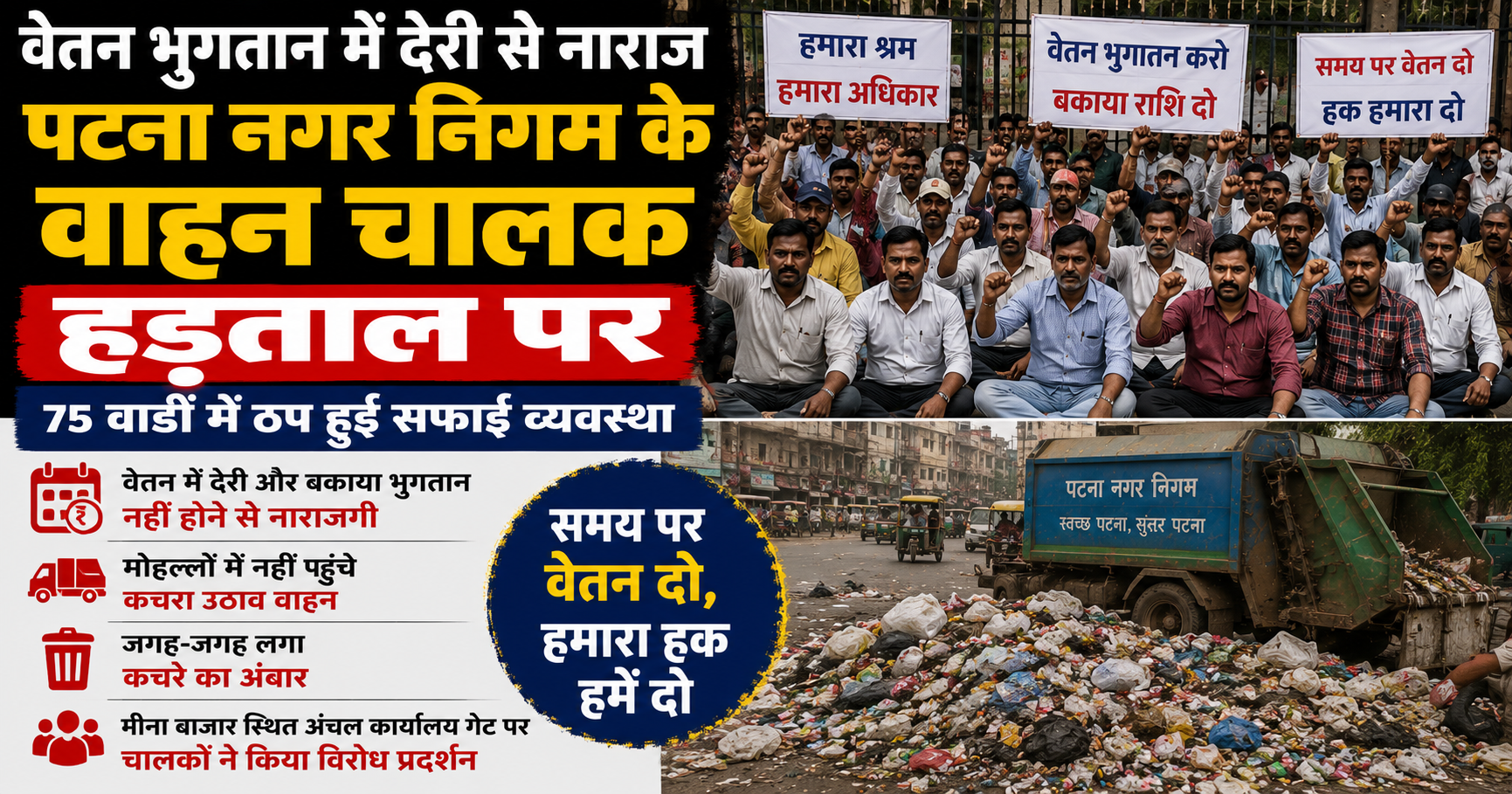
Patna Municipal Corporation Vehicle Drivers Go on Strike Over Delayed Salaries, Sanitation Services Disrupted Across 75 Wards
Patna, Jagran Team: Sanitation services across Bihar’s capital city were severely affected on Tuesday after vehicle drivers working for the Patna Municipal Corporation (PMC) went on strike over delayed salary payments and unpaid dues. The strike brought garbage collection operations to a standstill in all 75 municipal wards, resulting in piles of waste accumulating across roads, streets, and residential neighborhoods. Residents faced significant inconvenience as no garbage collection vehicles arrived in many areas.
According to reports, the drivers had been struggling for a long time with delays in salary payments and the non-payment of pending dues. Despite repeatedly raising their concerns with the concerned agencies and authorities, no satisfactory solution was reached. Frustrated by the situation, the drivers decided to stop work and launch a protest.
On Tuesday morning, a large number of drivers gathered at the Circle Office gate in Meena Bazaar and staged a demonstration. Protesters alleged that although they have been performing their duties regularly, they have not been receiving their salaries on time. As a result, many of them are facing severe financial difficulties, making it increasingly difficult to support their families.
Workers’ Union Organizational Secretary Sunny Kumar said that employees have been receiving assurances for months, but no concrete action has been taken regarding salary payments. He stated that drivers play a crucial role in maintaining the city’s sanitation system, yet their efforts are not being properly recognized. According to him, the failure to clear pending payments has led to widespread dissatisfaction among workers.
Drivers including Rajeev Gupta, Mohammad Saddam, Rohit Kumar, and several others participated in the protest. They stated that they had repeatedly approached officials with their grievances, but every meeting ended only with promises. The protesters warned that their agitation would continue until their demands were addressed with concrete action.
The strike had an immediate impact on the city’s sanitation system. Garbage collection vehicles failed to operate in all 75 wards, causing waste to pile up outside homes, markets, and public places. In many neighborhoods, residents left garbage outside their houses, where it remained throughout the day, creating foul odors and hygiene concerns.
Areas such as Kankarbagh, Rajendra Nagar, Boring Road, Kadamkuan, Patna City, Danapur, Gardanibagh, Ashok Rajpath, and several other parts of the city witnessed disruptions in waste collection services. Local residents expressed concern that the situation could worsen significantly if the strike continued for several more days.
Patna’s sanitation system handles thousands of tons of waste every day through an extensive network of workers and vehicles. With drivers refusing to work, the entire system was disrupted. In several wards, sanitation workers were present, but garbage could not be transported because collection vehicles were unavailable.
Public health experts have also raised concerns about the situation. They warn that accumulated garbage during the monsoon season can become a breeding ground for mosquitoes, flies, and other disease-carrying insects. This could increase the risk of illnesses such as dengue, malaria, chikungunya, and other infectious diseases. Experts have urged authorities to resolve the issue quickly to prevent a public health crisis.
Meanwhile, municipal officials began reviewing the situation as soon as they learned about the strike. Discussions were initiated with the agency responsible for employing the drivers, and officials started examining possible solutions to address the workers’ demands and restore normal sanitation operations.
Sources indicate that talks between municipal authorities, agency representatives, and employee leaders are likely to take place. Officials are attempting to persuade workers to return to duty while exploring ways to resolve salary-related issues. However, the striking drivers have made it clear that they will not resume work based solely on assurances and expect concrete action from the authorities.
Many local residents have expressed support for the workers' demands, arguing that employees who perform essential services should receive their salaries on time. At the same time, citizens have urged the administration to arrange alternative sanitation measures so that the public does not continue to suffer.
Patna Municipal Corporation has been actively working on cleanliness initiatives under various urban sanitation programs, including the Swachh Bharat Mission. The strike has raised questions about the functioning of the municipal contract system and the treatment of workers. Employees argue that no cleanliness campaign can succeed if the concerns of frontline workers remain unresolved.
For now, the standoff between the municipal administration and the striking workers continues. Residents are hopeful that both sides will reach an agreement soon and restore normal sanitation services. If the strike continues for an extended period, the city could face a more serious waste management crisis. Authorities are therefore under increasing pressure to address the workers’ legitimate concerns while ensuring uninterrupted sanitation services for the people of Patna.
At present, the city's attention remains focused on the upcoming negotiations between the municipal administration and employee representatives. The outcome of these discussions will determine whether the strike ends soon or whether Patna’s sanitation crisis deepens further in the days ahead.