
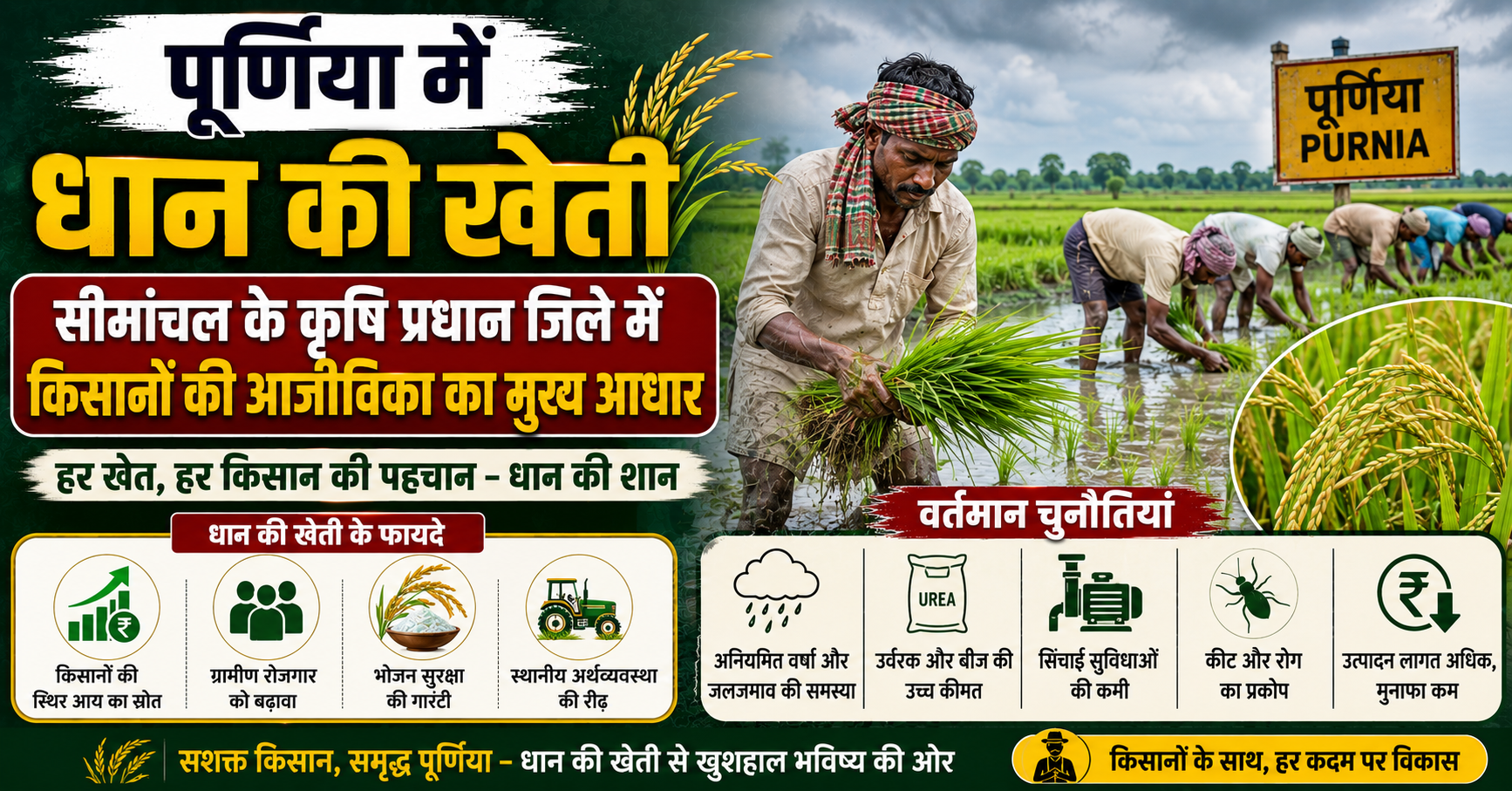
Paddy Cultivation Remains the Primary Foundation of Farmers' Livelihood in the Agricultural District of Seemanchal
Purnia: Situated in the northeastern part of Bihar, Purnia district in the Seemanchal region holds a special identity across the state for its fertile land, abundant water resources, and agriculture-based economy. In this agricultural district, paddy cultivation serves as the primary and strongest foundation of livelihood for millions of farmers here. The paddy crop harvested during the Kharif season not only sustains the families of farmers but also drives the rural and urban commercial cycle throughout the district.
Paddy Cultivation: The Backbone of Purnia's Rural Economy
Purnia's geographical location and the fertile alluvial soil brought by rivers like the Kosi, Mahananda, and Saura prove to be a boon for paddy cultivation. Paddy is cultivated on a large scale across all blocks of the district, including Amour, Baisi, Jalalgarh, Rupouli, Dhamdaha, Kasba, and Baisa.
Farmers' Priority: Most small, marginal, and large farmers of the district are engaged in cultivating traditional and improved varieties of paddy.
Source of Employment: During the seasons of paddy transplantation, weeding, harvesting, and threshing, thousands of agricultural laborers find employment on a large scale, boosting economic activities in rural areas.
Growing Impact of Modern Technology and Government Schemes
Over time, farmers in Purnia have started adopting modern technologies alongside traditional farming methods. With the cooperation of the Agriculture Department and ATMA, farmers are being encouraged to practice cultivation via the System of Rice Intensification (SRI Method), prepare nurseries scientifically, and use high-yielding certified seeds.
Additionally, various government schemes—such as subsidies on fertilizers and seeds, diesel subsidies, and the expansion of irrigation facilities—are providing significant convenience to farmers. However, even today, farmers in many remote areas of the district remain entirely dependent on traditional monsoon rainfall.
Challenges of This Season: Vagaries of Rain and Irrigation Problems
During the early stages of the paddy crop—namely the current month of July—an adequate supply of water is required. In Purnia and surrounding areas, monsoon activity is sometimes robust, while at other times, sudden long dry spells are observed.
Humidity and Water Scarcity: Due to rising sunshine and humidity in recent days, field moisture has decreased rapidly, intensifying worries for farmers engaged in paddy transplantation work.
Canal and Tubewell Systems: In areas lacking government canal irrigation or borehole (tubewell) facilities, farmers are forced to run private pump sets relying on expensive diesel, which substantially drives up their production costs.
Future Hopes and Agricultural Experts' Advice
Agricultural scientists and experts believe that if monsoon winds remain fully active in the coming weeks and sufficient rainfall arrives on time, a bumper paddy yield is strongly expected in Purnia.
Experts have advised farmers to pay special attention to water management considering weather patterns and to choose paddy varieties that yield better results even with lower water consumption. This paddy crop not only brings prosperity into the homes of Purnia's farmers but also makes a vital contribution to the state and nation's food security reserves.


