
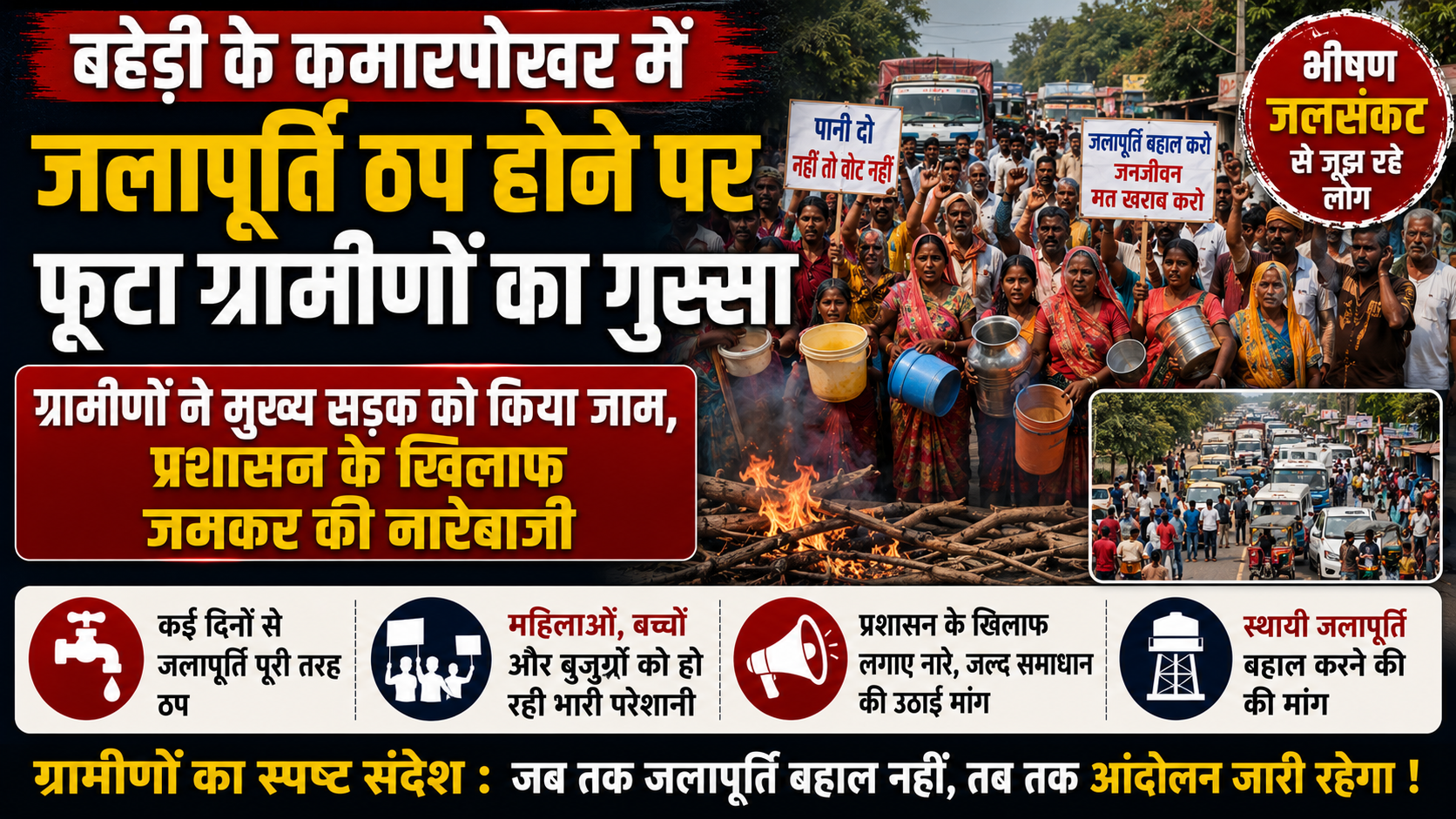
Outrage Erupts as Water Supply Fails in Baheri's Kamarpokhar Village: People Suffering from Severe Water Crisis Block Main Road, Raise Slogans Against Administration
Darbhanga/Baheri: All the tall claims made by the Government of Bihar under the "Saat Nishchay Yojana" (Seven Resolves Scheme) to provide pure drinking water to every household are being thoroughly exposed in the Baheri block area of Darbhanga district. The Chief Minister's Rural Tap-Water Scheme has been completely paralyzed in the remote rural village of Kamarpokhar, leaving the entire village grappling with a severe water crisis for a long time. Driven to the edge while craving a single drop of drinking water, the patience of the enraged villagers finally gave way, forcing them to completely block the main road.
The aggressive protest by the villagers on the road brought traffic to a complete standstill, resulting in long queues of vehicles on both sides. This anger of the villagers against the apathy of the local administration and the concerned department serves as a testament to the massive negligence involved in executing government schemes at the grassroots level.
Severity of the Water Crisis: Kamarpokhar Residents Deprived of Every Drop
The dystopian conditions under which the population of Kamarpokhar village is forced to live today are hard to even imagine. Whether it is the scorching summer season or normal days, water is the most fundamental necessity of human life. However, the tap-water scheme plant meant to fulfill this basic requirement in Kamarpokhar village has proven to be a white elephant for months.
Villagers reported that the water tank and pipeline installed under the tap-water scheme are either closed due to technical glitches or have fallen prey to corruption. The situation is such that most handpumps in the village have either dried up or are discharging contaminated and muddy water. In the absence of clean drinking water, women, children, and the elderly are forced to carry water from distant places. Frequently, villagers have to manage water from fields or distant private boring sites, disrupting their daily lives completely.
Growing Outrage Over Administrative Apathy: No Hearing Despite Repeated Pleas
The villagers stated that they made multiple written and oral appeals to local public representatives, the Block Development Officer (BDO), and officials of the Public Health Engineering Department (PHED) to get the tap-water scheme operational and resolve the water issue. However, every time they received nothing more than empty assurances while conditions on the ground remained unchanged.
When living became miserable due to the water crisis and officials refused to pay heed to their plight, the villagers were left with no other option but to take to the streets. Women and youth participated enthusiastically in this protest, venting their intense frustration against the administration.
Main Road Blocked: Traffic Paralyzed for Hours, Chaos Ensues
Traffic came to a complete halt due to the sudden road blockade staged by villagers on the main road near Kamarpokhar village. Long lines of buses, trucks, and small vehicles formed on both sides of the road. School-going children and office-goers had to face immense difficulties.
The protesting villagers carried banner-posters and raised slogans against the government and administration. Their clear stance was that this road blockade would not be lifted until the water supply was restored.
The angry villagers accused, "The government presents grand statistics on paper regarding the success of 'Jal Jeevan Hariyali' and 'Har Ghar Nal Ka Jal' schemes, but come to Kamarpokhar village and see how people are crying out for water. Is it not the administration's responsibility to quench the thirst of the poor?"
Matter Pacified on Administrative Officials' Assurances
Upon receiving information about the road blockade, the police of Baheri police station and local administrative officials rushed to the spot immediately. Recognizing the gravity of the situation, the officials tried to calm and reason with the protesters.
The administrative officials assured the villagers that within the next 24 to 48 hours, a technical team would be dispatched to fix the deficiencies in the tap-water scheme and restore smooth water supply to the village. Only after receiving these written and verbal assurances from the officials did the villagers calm down and clear the road blockade, allowing normal traffic to resume.
This incident in Kamarpokhar village is enough to expose the reality of the Bihar government's ambitious tap-water scheme. Schemes are executed on paper by spending crores of rupees, but due to a lack of maintenance and monitoring, they collapse within a few days. If the administration fails to take concrete steps in this direction in a timely manner, public outrage could take a more aggressive turn in the coming days. Villagers are no longer willing to rely solely on assurances; they demand water on the ground.


