
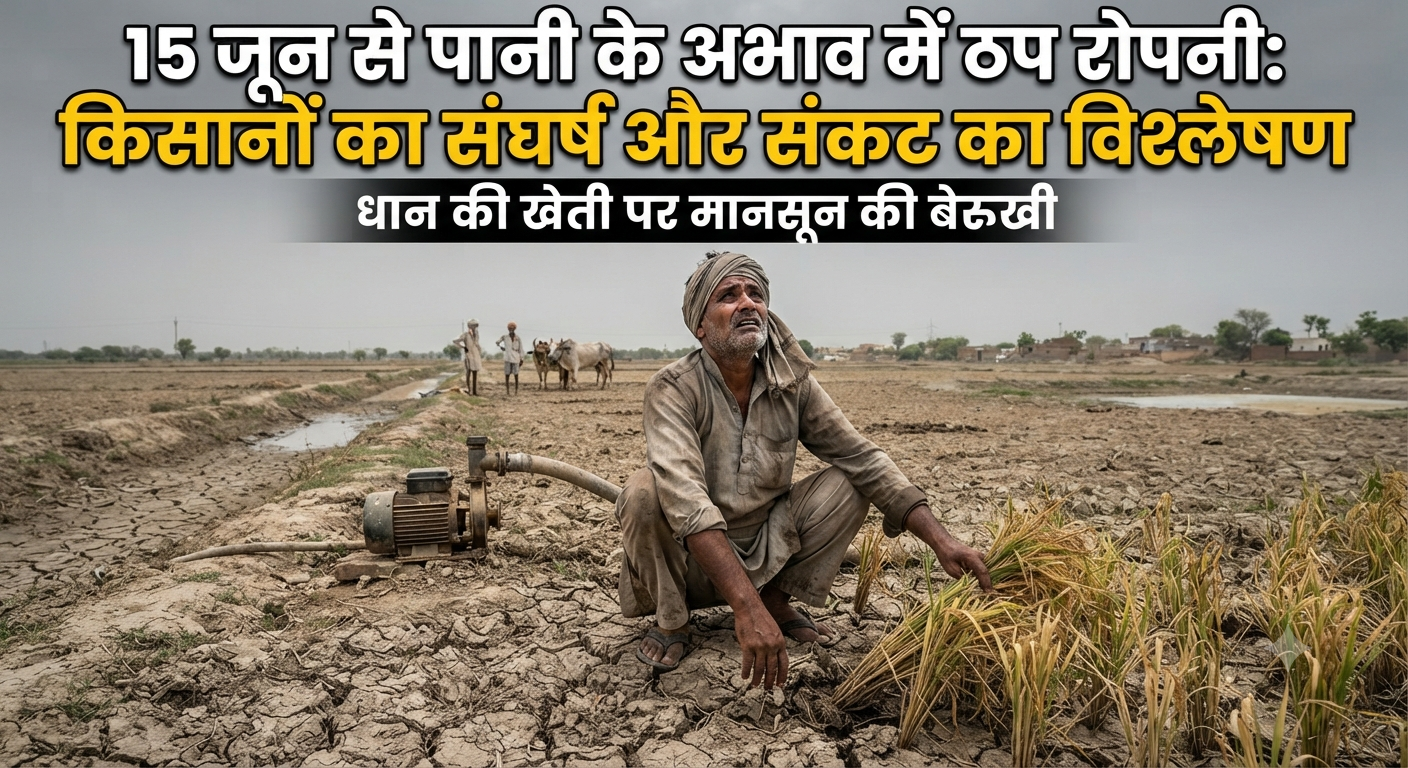
Nursery Ready, Fields Ready, But Transplanting Halted Due to Lack of Water: An Analysis of the Crisis Since June 15
June 15th is a date viewed as a 'deadline' or an auspicious time for paddy (rice) transplanting in most agrarian regions of India, especially in states like Bihar and Uttar Pradesh. Farmers prepare their seedlings (nursery) with utmost diligence and ready their fields through plowing, but when the time comes to transplant the young plants into the muddy fields, the main antagonist emerges—the lack of water.
This year, the situation remains much the same. Due to the hesitation of the monsoon and the failure of irrigation resources, millions of farmers are trapped in a cycle of uncertainty.
The Nature of the Crisis: Seedlings Ready, Fields Parched
Agricultural experts and experienced farmers believe that the period from June 15 to July 15 is the most suitable time for paddy transplantation. By this time, the seedlings are mature (approximately 20-25 days old) and ready for the fields.
Fear of Wasted Seedlings: Once seedlings are ready, they cannot be left in the nursery for too long. If not transplanted on time, they lose their fertility, the plants become overgrown, and eventually, the yield drops significantly.
Cracks in the Fields: The fields that should have been lush with water are now dry and cracked. Plowing the concrete-like hard soil has become impossible, causing plowing costs to double.
Increased Costs: Farmers who have access to pumping sets are forced to irrigate by burning expensive diesel. Rising diesel prices have made farming a losing proposition.
Main Reasons Behind the Water Shortage
This crisis has not emerged suddenly; it is the result of several long-term and immediate factors:
Delayed Monsoon: Due to climate change, there has been a major shift in monsoon patterns. Rains now either arrive very late or occur in such a concentrated burst that it leads to flooding.
Decline in Groundwater Levels: Due to continuous over-extraction, the water table has dropped so low that most government and private tubewells are either dry or unable to provide sufficient water.
Neglect of Canals: In many areas, canals exist, but due to a lack of maintenance, they are clogged with waste. Because water does not reach the tail end, a large portion of farmers remains deprived of irrigation.
Power Issues: The lack of uninterrupted electricity in rural areas has also severely impacted the operation of irrigation pump sets.
Impact on Farmers: Mental and Economic Toll
For a farmer, transplantation is not just an agricultural task; it is the foundation of their livelihood for the entire year.
Economic Burden: The cost of labor, diesel expenses, and investment in seeds and fertilizers are all at stake. If transplantation is delayed further, the crop will take longer to mature, which will also affect the upcoming Rabi (wheat) crop.
Mental Stress: Small farmers who borrow money to farm are the hardest hit. The worries about family needs and the future are pushing many toward distress.
Migration of Laborers: Farm laborers, who rely on the transplantation season for work, are being forced to migrate to cities due to the lack of employment.
Potential Solutions and the Way Forward
To deal with this dire situation, concrete efforts are required at both short-term and long-term levels:
Government Intervention:
Diesel Subsidy: The government should immediately provide a significant subsidy on diesel to farmers so they can irrigate their fields using pump sets.
Canal Cleaning: A war-footing campaign for the excavation and cleaning of canals should be launched.
Adoption of Technology:
SRI Method: The 'System of Rice Intensification' (SRI) technique should be promoted, which produces higher yields with less water.
Drip Irrigation: There is a need for research and adoption of micro-irrigation methods even for paddy.
Water Conservation (Water Harvesting):
The construction of small ponds near fields and making rainwater harvesting mandatory must be prioritized.
Crop Diversification:
In areas with severe water scarcity, farmers should be encouraged to move away from paddy toward crops that require less water (such as maize, pulses, or millets).
June 15 has passed, and in the eyes of farmers looking toward the sky, there is more hope than moisture. This crisis reminds us how fragile our food security is and how directly it is linked to the environment and water management. If effective steps are not taken in time, not only will this year's harvest be affected, but a massive crisis will loom for years to come.
The administration and society must work together to face this challenge. For farmers, this is not just a question of a single season, but a question of their very existence. The government should declare this an 'agricultural crisis' on the lines of disaster management and provide immediate relief so that our food providers are not left in despair.


