
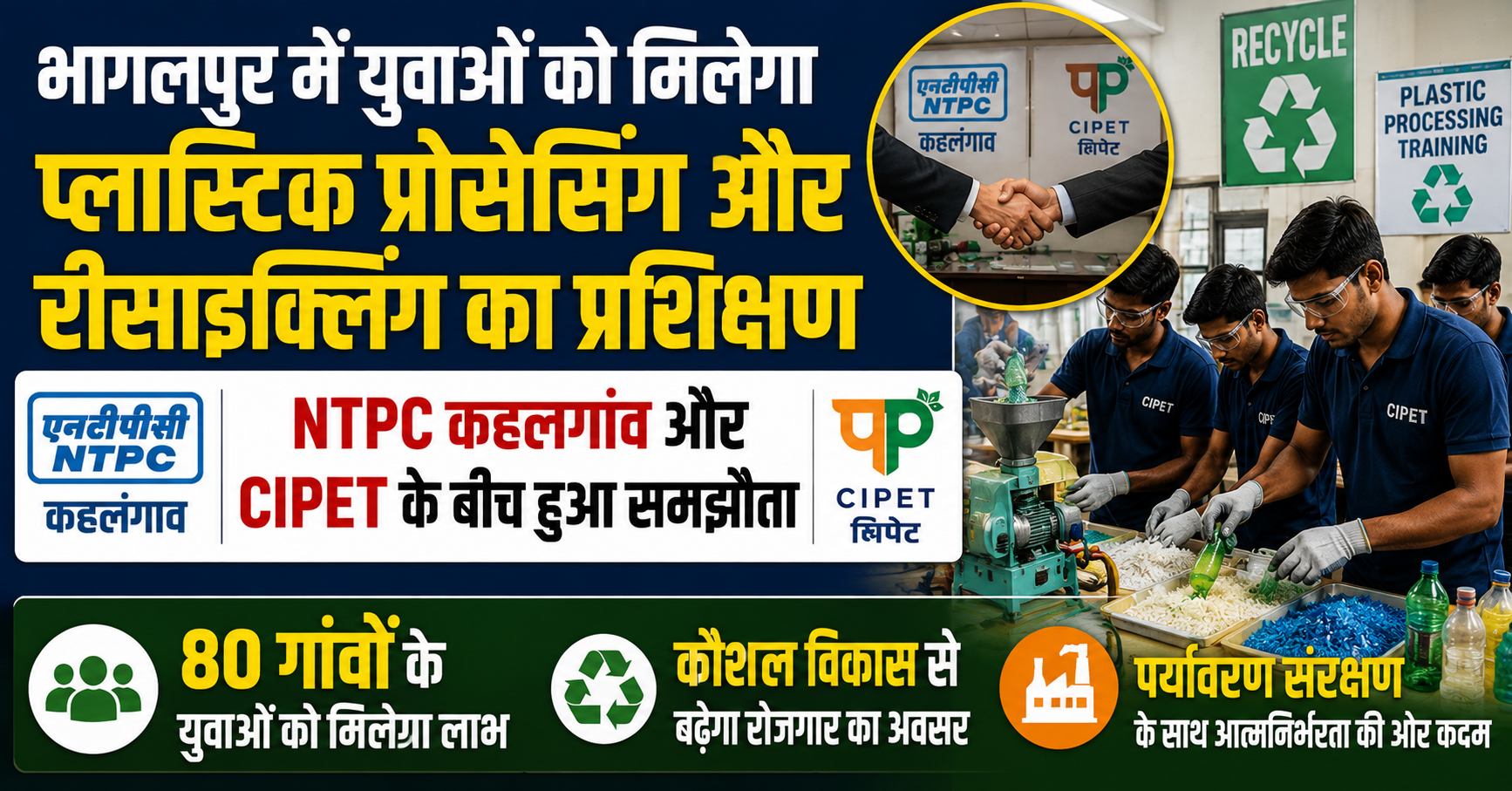
NTPC Kahalgaon Signs MoU with CIPET, 80 Villages to Benefit From Plastic Processing and Recycling Training
Bhagalpur: In a significant initiative aimed at promoting skill development and employment opportunities among rural youth, NTPC Kahalgaon has signed a Memorandum of Understanding (MoU) with the Central Institute of Petrochemicals Engineering & Technology (CIPET), Bhagalpur.
Under the agreement, young people from around 80 villages in the vicinity of NTPC Kahalgaon will be provided training in plastic processing and recycling. The initiative is expected to equip rural youth with technical skills, improve their employment prospects and encourage opportunities for self-employment.
The programme also has an important environmental dimension. By training young people in plastic waste management and recycling techniques, the initiative could contribute to reducing plastic pollution and promoting scientific waste management practices in the region.
MoU Between NTPC Kahalgaon and CIPET
The agreement between NTPC Kahalgaon and CIPET Bhagalpur is being viewed as an important step toward strengthening skill development opportunities in the local area.
Under the MoU, youth from surrounding rural communities will receive technical training related to plastic processing and recycling.
Many young people in rural areas are forced to move to larger cities and other states in search of employment. Providing them with industry-oriented technical skills locally could help create better employment opportunities closer to their homes.
The training programme is expected to be designed according to the needs of the industry and the requirements of participating youth.
Youth From 80 Villages to Benefit
The programme will cover approximately 80 villages located around NTPC Kahalgaon.
Eligible young people from these villages will be selected through a prescribed process and provided technical training.
The programme is expected to cover areas such as plastic processing, operation of relevant machinery, production processes, recycling techniques, quality control and workplace safety.
Such training can help rural youth acquire practical skills that are increasingly required in the plastics and petrochemical industries.
Technical Training in Plastic Processing
Plastic processing is a technology-driven field in which different types of plastic materials are converted into useful products using machinery and industrial processes.
During the training, participants are expected to gain an understanding of basic plastic processing techniques as well as industrial production procedures.
Important areas may include machine operation, production processes, quality control and industrial safety standards.
Once trained, young people may find it easier to explore employment opportunities in plastic manufacturing, processing and related industrial sectors.
Growing Opportunities in Plastic Recycling
Plastic waste has become a major environmental challenge across the world.
When plastic is not properly collected, segregated and recycled, it can remain in the environment for long periods and create serious ecological problems.
Against this backdrop, the demand for trained workers in plastic recycling is expected to grow.
The initiative will provide young people with knowledge about the collection, segregation, processing and recycling of plastic waste.
After completing their training, participants may explore employment opportunities in recycling units, plastic processing facilities and other related industries.
Scope for Self-Employment
The benefits of the programme may extend beyond conventional employment.
Plastic waste collection, segregation and small-scale recycling activities can also provide opportunities for entrepreneurship.
Trained youth could potentially establish small businesses related to plastic waste collection, sorting or processing.
For this to become successful, however, young entrepreneurs would need access to technical guidance, machinery, financing, markets and business-management support.
Linking trained participants with government schemes, banks and entrepreneurship programmes could further strengthen the self-employment component of the initiative.
Potential to Reduce Youth Migration
Migration of young people from rural Bihar to larger cities and other states in search of jobs has long been an important socio-economic issue.
Creating opportunities for skill development and employment closer to their homes could help reduce the pressure to migrate.
The proposed training programme covering approximately 80 villages around Kahalgaon could therefore become an important step in this direction.
If trained youth are subsequently connected with employment opportunities in Bhagalpur and nearby industrial areas, they may have the option of working closer to their families.
Opportunities for Women and Young People
If the skill development programme is implemented inclusively, young women from rural communities could also benefit.
Some activities associated with plastic processing, quality control, packaging, recycling and related operations can offer employment opportunities to women with appropriate training.
However, access to training facilities, safe workplaces and suitable employment opportunities will be important for ensuring wider participation.
Skill development at the local level can also help increase household incomes and strengthen the economic position of rural families.
Environmental Benefits
Environmental protection is another important aspect of the initiative.
Proper collection and recycling of plastic waste can help reduce the negative impact of plastic on the environment.
Young people trained in recycling techniques could also help create greater awareness about scientific waste management practices in their communities.
Improved segregation and collection of plastic waste could help reduce practices such as open dumping and burning of plastic.
This could contribute to cleaner villages and improved environmental conditions in the surrounding areas.
Industry-Oriented Training
Modern industries increasingly require workers who possess practical and technical skills in addition to academic qualifications.
The partnership with CIPET is aimed at providing young people with skills that are relevant to industrial requirements.
Instead of focusing only on theoretical knowledge, the programme is expected to emphasize practical learning.
Training in machine operation, production processes, quality standards and workplace safety can help participants become better prepared for actual industrial work environments.
NTPC’s Community Development Initiative
NTPC is one of India’s major power generation companies and has undertaken various community development initiatives around its project areas.
The skill development programme in the Kahalgaon region can be viewed as part of efforts to promote the socio-economic development of communities located around the NTPC project.
Such initiatives are intended not only to provide training but also to connect local communities with opportunities generated by industrial development.
Employment Linkages Will Be Crucial
While the training programme can provide valuable skills, its long-term success will depend heavily on whether participants are connected to employment or self-employment opportunities after completing their courses.
Providing certificates alone will not be enough to address the employment challenge.
Industry placement partnerships, apprenticeships, job fairs and entrepreneurship support could significantly improve the outcomes of the programme.
Maintaining a database of trained candidates and connecting them with relevant companies could also help strengthen employment opportunities.
Potential Impact on the Local Economy
When young people find employment closer to their homes, the benefits can extend beyond individual families.
Higher incomes can increase spending in local markets and support small businesses.
If youth from around 80 villages receive technical training and subsequently secure employment, the initiative could contribute to strengthening the local economy around Kahalgaon and Bhagalpur.
The development of small recycling and waste-management enterprises could also generate additional employment.
Future Demand for Plastic Processing Skills
Plastic is widely used in packaging, automobiles, electronics, construction, agriculture and numerous other industries.
As a result, technical skills related to plastic processing are expected to remain relevant.
At the same time, increasing emphasis on environmental regulations, recycling and the circular economy is creating new opportunities in the recycling sector.
Training rural youth in these areas could therefore help prepare them for future industrial requirements.
A Step Toward Skill-Based Rural Development
The partnership between NTPC Kahalgaon and CIPET Bhagalpur represents an effort to connect industry, technical education and rural youth.
By providing specialized training to young people from approximately 80 villages, the programme could create new pathways to employment and entrepreneurship.
Its environmental component could also help promote responsible plastic waste management and recycling practices.
If the trained youth are effectively connected with industries, apprenticeships, jobs and entrepreneurship opportunities, the initiative could become a model for skill development in the region.
The MoU signed between NTPC Kahalgaon and CIPET Bhagalpur is expected to create new opportunities for young people living in villages surrounding the NTPC project.
Through training in plastic processing and recycling, youth will have an opportunity to acquire practical technical skills that can improve their prospects in the industrial sector.
The initiative has the potential to generate benefits in several areas, including employment, self-employment, rural economic development and environmental protection.
The key challenge will be to ensure that training is followed by meaningful employment and entrepreneurship opportunities.
If effective industry linkages, apprenticeships and placement support are established, the programme could play an important role in reducing youth migration, strengthening local employment and developing a skilled workforce in the Bhagalpur-Kahalgaon region.


