
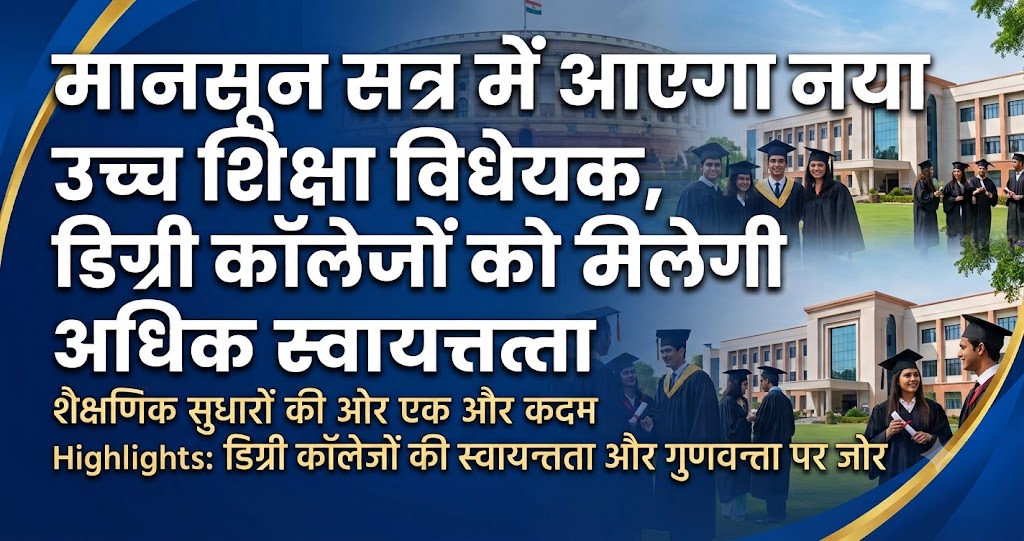
New Higher Education Bill to Be Introduced in Monsoon Session, Degree Colleges to Gain Greater Autonomy
Patna: The Bihar government is preparing to introduce a landmark Higher Education Bill during the upcoming Monsoon Session of the State Legislature, aiming to bring sweeping reforms to the state's higher education system. One of the most significant provisions of the proposed legislation is that degree colleges will no longer remain under the direct administrative control of universities and will be granted greater institutional autonomy.
The government believes the reform will improve administrative efficiency, speed up decision-making, and enhance the quality of higher education across Bihar. Education experts have described the proposal as one of the most significant structural reforms in the state's higher education sector in recent years.
Bill to Be Tabled During the Monsoon Session
According to sources in the Education Department, the proposed Higher Education Bill is in its final stages of preparation. The government plans to present the legislation during the Monsoon Session and seek its approval.
The primary objective of the bill is to modernize Bihar's higher education system and align it with the principles of the National Education Policy (NEP) by making educational institutions more transparent, accountable, and efficient.
The proposed law is expected to redefine the administrative relationship between universities and affiliated degree colleges, giving colleges greater authority over academic and administrative matters.
Degree Colleges to Gain Greater Independence
Under the existing system, most degree colleges in Bihar function as affiliated institutions under universities, with major decisions related to examinations, curriculum, administrative approvals, and several academic processes being controlled by the universities.
If the proposed legislation is enacted, degree colleges are expected to receive greater decision-making powers in several areas. This could significantly reduce administrative delays and allow institutions to respond more effectively to local educational needs.
Focus on Improving Educational Quality
The government's objective extends beyond administrative restructuring. The proposed reforms are intended to improve the overall quality of higher education by encouraging modern teaching methods, digital learning, research activities, and skill-based education aligned with industry requirements.
Officials believe that granting greater autonomy will enable colleges to utilize their resources more efficiently and offer students a more employment-oriented education.
Aligned with the National Education Policy
The National Education Policy emphasizes institutional autonomy, multidisciplinary learning, innovation, and academic flexibility. The proposed Bihar Higher Education Bill is seen as an important step toward implementing these reforms at the state level.
Education experts believe that autonomous colleges will be better positioned to introduce new academic programs, collaborate with industries, strengthen research initiatives, and improve overall institutional performance.
Greater Powers for College Administration
The proposed legislation is also expected to strengthen the role of college principals and governing bodies by granting them greater authority over financial management, academic planning, infrastructure development, and institutional administration.
This increased autonomy could accelerate campus development projects and enable colleges to address local challenges more efficiently.
Benefits for Students
Students are expected to be among the biggest beneficiaries of the proposed reforms. Autonomous colleges may introduce modern curricula, advanced laboratories, digital libraries, skill development programs, and industry-oriented courses tailored to evolving employment markets.
Administrative processes related to examinations and academic activities are also expected to become faster and more efficient, reducing delays that often affect students.
New Opportunities for Faculty Members
The reforms are likely to place greater emphasis on faculty development, research, innovation, and academic excellence. With increased academic flexibility, colleges may introduce new teaching programs and research initiatives, creating additional opportunities for educators.
Experts believe these changes could improve the national standing and institutional rankings of Bihar's colleges.
Boost to Digital Education
The government also plans to promote greater use of digital technologies in higher education institutions. Smart classrooms, e-learning platforms, online assessment systems, digital record management, and virtual laboratories are expected to become integral components of the new system.
These initiatives could significantly improve access to quality education, particularly for students in rural and remote areas.
Better Financial Management
The proposed framework may allow colleges greater flexibility in managing their financial resources. This could facilitate faster investments in infrastructure, laboratories, libraries, student facilities, and campus development projects.
The government aims to ensure that institutions have the ability to prioritize development according to their individual needs while maintaining accountability.
Experts' Views
Education experts believe that if the legislation incorporates strong accountability mechanisms, transparency standards, and quality assurance measures, it could become a historic reform for Bihar's higher education system.
However, they also stress that increased autonomy must be accompanied by effective regulatory oversight, regular quality assessments, and sound financial governance to maintain academic standards.
Government's Vision
The Bihar government aims to transform the state's higher education system into one that meets national and international standards. The proposed reforms focus on administrative modernization, digital transformation, research promotion, skill-based education, and institutional autonomy.
Officials believe the new Higher Education Bill has the potential to fundamentally reshape the functioning of universities and degree colleges across the state while providing students with higher-quality, career-oriented education.
If passed during the Monsoon Session, the legislation could mark the beginning of a new era for higher education in Bihar. Greater autonomy, improved governance, and expanded opportunities for institutional growth are expected to enhance educational outcomes and strengthen the state's overall higher education ecosystem.


