
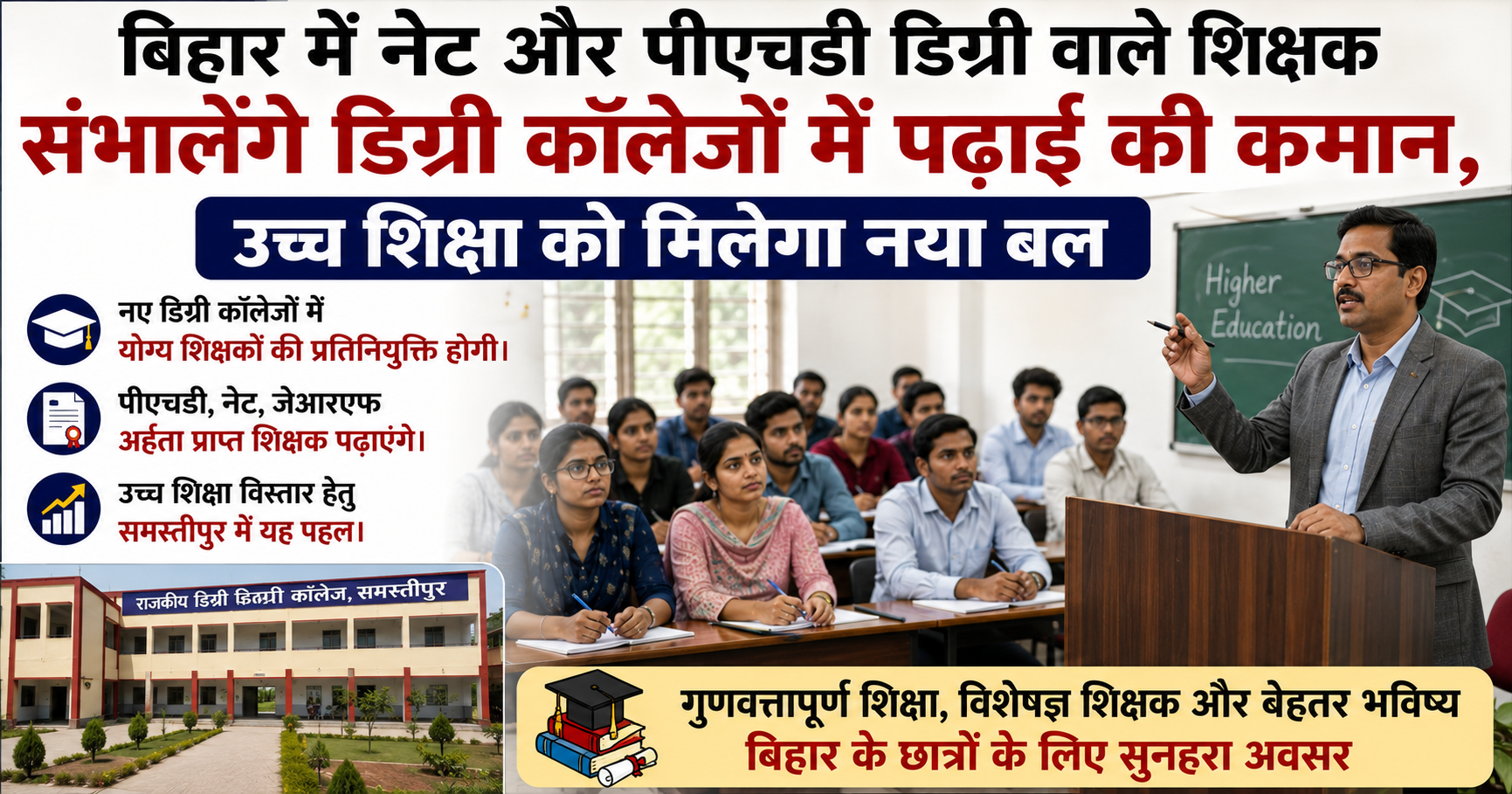
NET and PhD-Qualified Teachers to Lead Teaching in Bihar's Government Degree Colleges, Giving a Major Boost to Higher Education
Samastipur: In a significant step toward strengthening higher education and ensuring quality undergraduate education in rural areas, the Bihar government has initiated a major reform for newly established government degree colleges. To address the shortage of faculty members, teachers possessing NET (National Eligibility Test), JRF (Junior Research Fellowship), or PhD qualifications will now be deputed to teach undergraduate courses. The initiative is expected to enhance the quality of higher education in Samastipur and several other districts across the state.
The government's objective is not merely to establish new colleges but also to ensure that students receive quality education close to their homes, reducing the need to migrate to larger cities for undergraduate studies.
Focus on Teacher Availability in New Degree Colleges
Over the past few years, several new government degree colleges have been established in Samastipur and other districts of Bihar. These institutions were created to provide undergraduate education to students within their own blocks and nearby areas. However, a shortage of regular faculty members has affected academic activities in many of these colleges.
To overcome this challenge, the Education Department has decided to depute qualified teachers. Under the new arrangement, teachers currently serving Classes 9 to 12 who possess NET, JRF, or PhD qualifications will be assigned to teach undergraduate courses in these colleges based on institutional requirements.
Opportunity for NET, JRF, and PhD-Qualified Teachers
Only teachers who meet nationally recognized higher education qualifications will be considered for deputation. NET and JRF are widely accepted eligibility standards for university-level teaching and research in India, while a PhD demonstrates advanced academic expertise and research capability in a specific subject.
The appointment of such qualified educators is expected to provide undergraduate students with access to subject experts, significantly improving the quality of teaching and learning.
Direct Benefits for Students
The government's decision is expected to benefit students from rural and semi-urban areas the most. They will no longer have to travel to distant cities in search of quality undergraduate education.
With qualified teachers available locally, students will receive regular classroom instruction, academic mentoring, guidance for competitive examinations, and a stronger learning environment, ultimately improving their academic performance and career prospects.
Major Step Toward Expanding Higher Education
According to the Education Department, establishing college buildings alone is not sufficient to strengthen higher education. The availability of competent and qualified faculty members is equally essential for ensuring academic excellence.
With this objective, the state government has planned to deploy highly qualified teachers to newly established government degree colleges, enabling these institutions to conduct academic activities more effectively.
Strengthening Rural Higher Education
Education experts believe that many government degree colleges in rural Bihar have long struggled with faculty shortages. As a result, students often missed regular classes and depended on private coaching institutes or institutions located in larger cities.
The deputation of NET, JRF, and PhD-qualified teachers is expected to address this issue and provide rural students with educational standards comparable to those available in urban colleges.
Students to Benefit from Experienced Faculty
Most of the teachers selected for deputation already possess classroom teaching experience at the secondary and higher secondary levels. Combined with their advanced academic qualifications, they are considered well-equipped to teach undergraduate students effectively.
Their subject expertise and teaching experience are expected to help students not only in regular coursework but also in research projects, higher studies, and preparation for competitive examinations.
Positive Transformation in the Education System
Education specialists believe the initiative could bring significant improvements to Bihar's higher education system. If qualified teachers are consistently available, newly established degree colleges are likely to witness increased student enrollment and greater public confidence in government institutions.
Improved educational opportunities at the local level will also reduce the financial burden on families who otherwise have to send their children to distant cities for higher education.
New Opportunities for the Youth
Higher education plays a crucial role in the social and economic development of any state. Access to quality undergraduate education will better prepare students for competitive examinations, postgraduate studies, research opportunities, and professional careers.
Experts describe this initiative as more than a temporary staffing arrangement. They believe it represents an important investment in Bihar's long-term human resource development.
Deputation Process Expected to Begin Soon
The Education Department has already issued necessary instructions to the concerned authorities. Eligible teachers are expected to be identified and deputed to newly established government degree colleges based on institutional needs.
Once the process is completed, undergraduate classes are expected to function in a more organized and effective manner from the upcoming academic session.
A Significant Reform in Bihar's Higher Education
The Bihar government's decision is being viewed as an important reform aimed at expanding access to quality higher education across the state. By ensuring the availability of highly qualified teachers, newly established degree colleges are expected to strengthen their academic standards, provide a better learning environment, and improve educational opportunities for students in rural areas.
If implemented effectively, the initiative could transform Bihar's government degree colleges into strong centers of academic excellence, benefiting thousands of students and contributing significantly to the state's educational development in the years ahead.


