
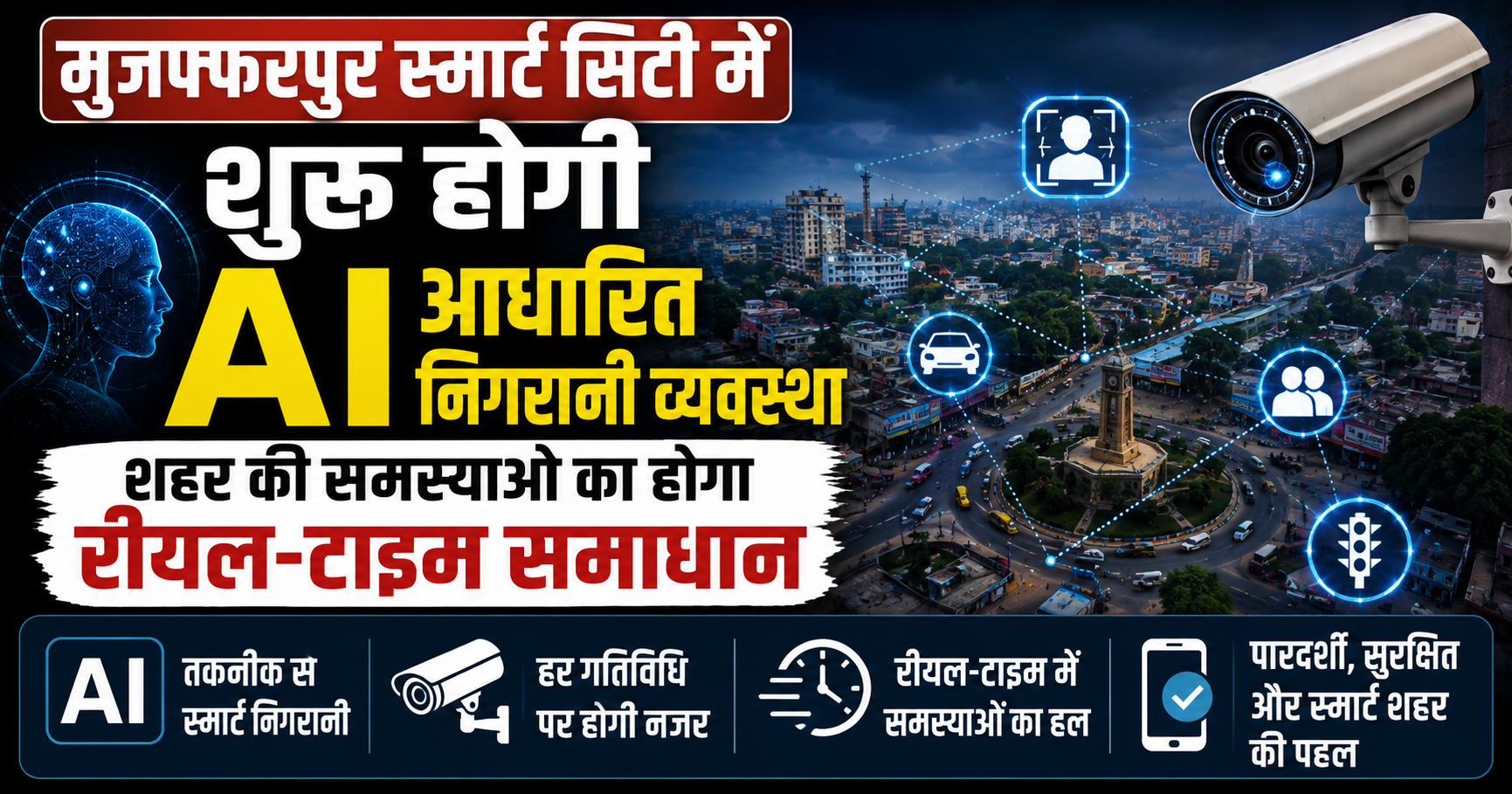
Muzaffarpur Smart City to Introduce AI-Based Monitoring System for Faster and Real-Time Resolution of Urban Problems
Muzaffarpur: The Smart City project in Muzaffarpur, Bihar, is set to adopt advanced technology to improve urban governance through an Artificial Intelligence (AI)-based monitoring system. The initiative aims to identify and resolve civic issues more quickly, transparently, and efficiently, enabling the Municipal Corporation and other concerned departments to respond in real time.
The ambitious plan was prepared last year under the leadership of then Municipal Commissioner Vikram Virkar, with inputs from technology experts. According to the proposal, dashcams and mobile-based visual data will be used to detect urban issues automatically and send real-time alerts to the Muzaffarpur Municipal Corporation and other relevant departments.
What Is the AI-Based Monitoring System?
The new system will use artificial intelligence to analyze videos and images collected from different parts of the city. Visual data captured through dashcams, mobile devices, and other digital sources will be processed by AI algorithms capable of automatically identifying civic issues.
If the system detects potholes, waterlogging, garbage accumulation, damaged roads, open manholes, illegal encroachments, malfunctioning streetlights, or other public infrastructure problems, it will automatically generate alerts and notify the concerned department for immediate action.
Real-Time Monitoring to Improve Efficiency
One of the key advantages of the proposed system is that authorities will no longer have to wait for public complaints before taking action. Instead, AI will identify issues on its own and immediately notify officials.
This is expected to significantly reduce response time and improve the efficiency of municipal services, ensuring that problems are addressed much faster than under traditional complaint-based systems.
Greater Transparency in Civic Administration
The Municipal Corporation believes that the AI-driven system will also improve transparency in civic administration. In the past, delays in resolving complaints and a lack of information about the status of issues have often led to public dissatisfaction.
Under the new system, every detected issue will be digitally recorded, and its progress—from identification to resolution—can be tracked electronically. This will allow authorities to monitor when a problem was detected, which department was assigned the task, and when the issue was resolved.
Better Coordination Among Government Departments
Many civic issues require coordination between multiple government agencies rather than the Municipal Corporation alone. Road maintenance, electricity supply, water management, drainage, and traffic regulation often involve different departments.
The AI-based platform is expected to improve communication among these agencies by instantly sharing information with the appropriate department, reducing delays in addressing public concerns.
Direct Benefits for Citizens
If implemented successfully, the new monitoring system is expected to provide several benefits to city residents. Problems such as damaged roads, waterlogging, waste management issues, faulty streetlights, and other civic concerns could be identified and addressed much more quickly.
Citizens may also have to file fewer complaints, as the system will proactively detect many issues before they are formally reported.
Strengthening the Smart City Mission
Muzaffarpur has already undertaken several development projects under India's Smart City Mission. The introduction of AI-based monitoring is considered another important step toward building a technology-driven urban governance model.
Urban planning experts say that data-driven decision-making, digital surveillance for civic management, and artificial intelligence are becoming increasingly important features of modern smart cities worldwide. This initiative could place Muzaffarpur among cities embracing these advanced technologies.
Expert Opinion
Technology experts believe that AI-powered visual analytics can significantly improve the efficiency of urban administration. Instead of relying solely on public complaints, municipal authorities will be able to identify and prioritize issues automatically.
However, experts also emphasize that the system's success will depend on effective implementation, high-quality data collection, reliable technical maintenance, and strong coordination among government departments.
Data Security and Privacy
Experts stress that while implementing AI-based monitoring, authorities must also ensure robust data security and protect citizens' privacy. They recommend limiting the system's use strictly to public infrastructure and civic management while ensuring secure handling and storage of digital data.
Maintaining transparency regarding how the collected data is used will also be important for building public trust.
A New Step in Urban Development
Municipal officials believe that adopting modern technologies can significantly improve the quality of urban administration. Early identification of civic issues will enable more efficient use of resources and provide better public services to residents.
In the future, the AI monitoring platform could also be integrated with other Smart City initiatives, creating a more comprehensive digital governance ecosystem for Muzaffarpur.
The proposed AI-based monitoring system in Muzaffarpur Smart City represents a significant step toward modernizing urban governance through technology. By using dashcams and mobile-based visual data to identify civic problems in real time and instantly notify the relevant departments, the initiative aims to make municipal services faster, more transparent, and more effective.
If implemented successfully as planned, Muzaffarpur could emerge as one of the leading cities in Bihar—and potentially in India—to use artificial intelligence on a large scale for improving civic administration and delivering better public services.


