

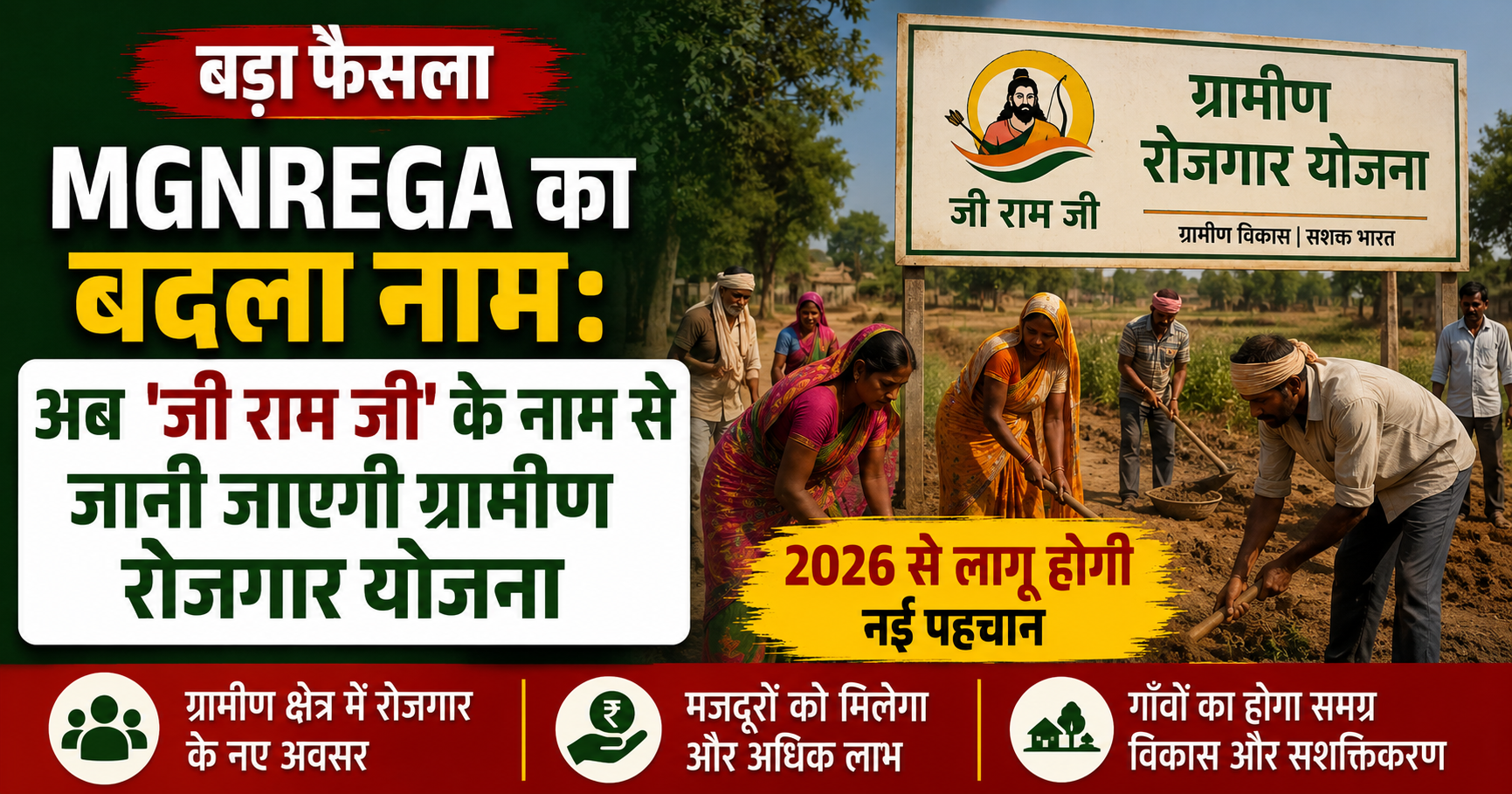
MGNREGA Renamed: Rural Employment Scheme to Be Known as 'G-RAM-JI' from 2026
Araria: One of India's largest rural employment programmes, the Mahatma Gandhi National Rural Employment Guarantee Scheme (MGNREGA), is set to receive a new identity. Originally launched in 2005 as the National Rural Employment Guarantee Act (NREGA) and renamed MGNREGA in 2010, the flagship rural employment programme will now operate under a new name from 2026.
Under the Centre's new decision, the scheme will be known as G-RAM-JI, which stands for Viksit Bharat Guarantee for Rural Employment and Livelihood Mission – Rural. The renaming is being presented as part of a broader effort to modernize rural development initiatives while continuing to provide employment opportunities and strengthen rural livelihoods.
A New Identity for a Two-Decade-Old Programme
The rural employment programme was introduced in 2005 under the National Rural Employment Guarantee Act (NREGA) with the objective of providing at least 100 days of wage employment every financial year to eligible rural households willing to undertake unskilled manual work.
In 2010, the programme was renamed the Mahatma Gandhi National Rural Employment Guarantee Scheme (MGNREGA). Over the past decade and a half, it has become one of India's most significant social welfare initiatives, providing employment and income support to millions of rural families.
Beginning in 2026, the scheme will carry a new name while continuing its role in supporting rural employment.
What Is G-RAM-JI?
Under the revised identity, the programme will be known as G-RAM-JI, which expands to:
- G – Guarantee
- R – Rural Employment
- A – Livelihood (Aajeevika)
- M – Mission
- JI – Rural Development Initiative
In Hindi, the full title is "Viksit Bharat Guarantee for Rural Employment and Livelihood Mission – Rural."
According to the government, the new identity reflects a broader vision of promoting not only wage employment but also sustainable livelihoods, rural development, and long-term economic growth in villages.
More Than Just a Name Change
Officials associated with rural development say the initiative is intended to go beyond simple rebranding.
The government plans to integrate the programme with modern technology, stronger transparency measures, and improved monitoring systems.
Future implementation is expected to include enhanced online monitoring of projects, digital wage payments, geo-tagging of development works, land-record-based project planning, and more efficient supervision.
The scheme may also be better integrated with other rural development programmes to maximize its impact.
Greater Focus on Livelihood Development
Policy experts believe the new name signals the government's intention to move beyond temporary wage employment and place greater emphasis on creating sustainable livelihoods for rural households.
Development activities such as water conservation, irrigation infrastructure, rural roads, plantation drives, community assets, agricultural improvement projects, and natural resource management are expected to receive increased attention.
Millions of Rural Families Will Continue to Benefit
MGNREGA remains one of India's largest social security programmes, benefiting millions of households across the country, including Bihar.
For many rural families, particularly during agricultural lean seasons, the programme serves as a crucial source of income and employment.
Officials have clarified that the renaming does not alter the scheme's core objectives, eligibility criteria, or employment guarantee. The primary change is the programme's new branding and administrative identity.
Greater Use of Digital Technology
The government has been steadily expanding the use of digital technology in rural employment programmes.
Under G-RAM-JI, work approvals, attendance records, wage payments, project monitoring, and implementation are expected to become increasingly digital.
Officials believe this will improve transparency, reduce fraudulent practices, ensure timely wage payments, and enhance the overall quality of development works.
Boost to Rural Development
Experts say that if implemented effectively, the updated programme could accelerate infrastructure development alongside employment generation in rural areas.
Projects related to water conservation, ponds, roads, land improvement, afforestation, and agriculture could provide long-term benefits while creating sustainable community assets.
Public and Political Debate
The renaming has also sparked discussion in political and public circles.
Supporters view it as part of a broader vision for rural transformation under the "Viksit Bharat" initiative, while critics argue that the focus should remain on strengthening implementation rather than changing the programme's name.
The government, however, maintains that the programme's primary objective—providing employment opportunities to rural households—will remain unchanged while efforts are made to improve its efficiency and effectiveness.
What It Means for Beneficiaries
According to rural development officials, existing beneficiaries do not need to worry about the transition.
There will be no requirement for fresh registration, and existing job cards, wage payments, and employment procedures will continue without interruption.
If any administrative changes are introduced in the future, they will be communicated through local panchayats and government authorities.
India's flagship rural employment programme, MGNREGA, is set to enter a new phase under the name G-RAM-JI beginning in 2026. While the programme's identity is changing, its core mission of providing employment opportunities to rural households remains intact.
The government says the new framework aims to combine rural employment, sustainable livelihoods, digital governance, and infrastructure development under a modernized system. Millions of rural families are expected to continue benefiting from the programme as it evolves with a renewed focus on transparency, efficiency, and long-term rural development.