
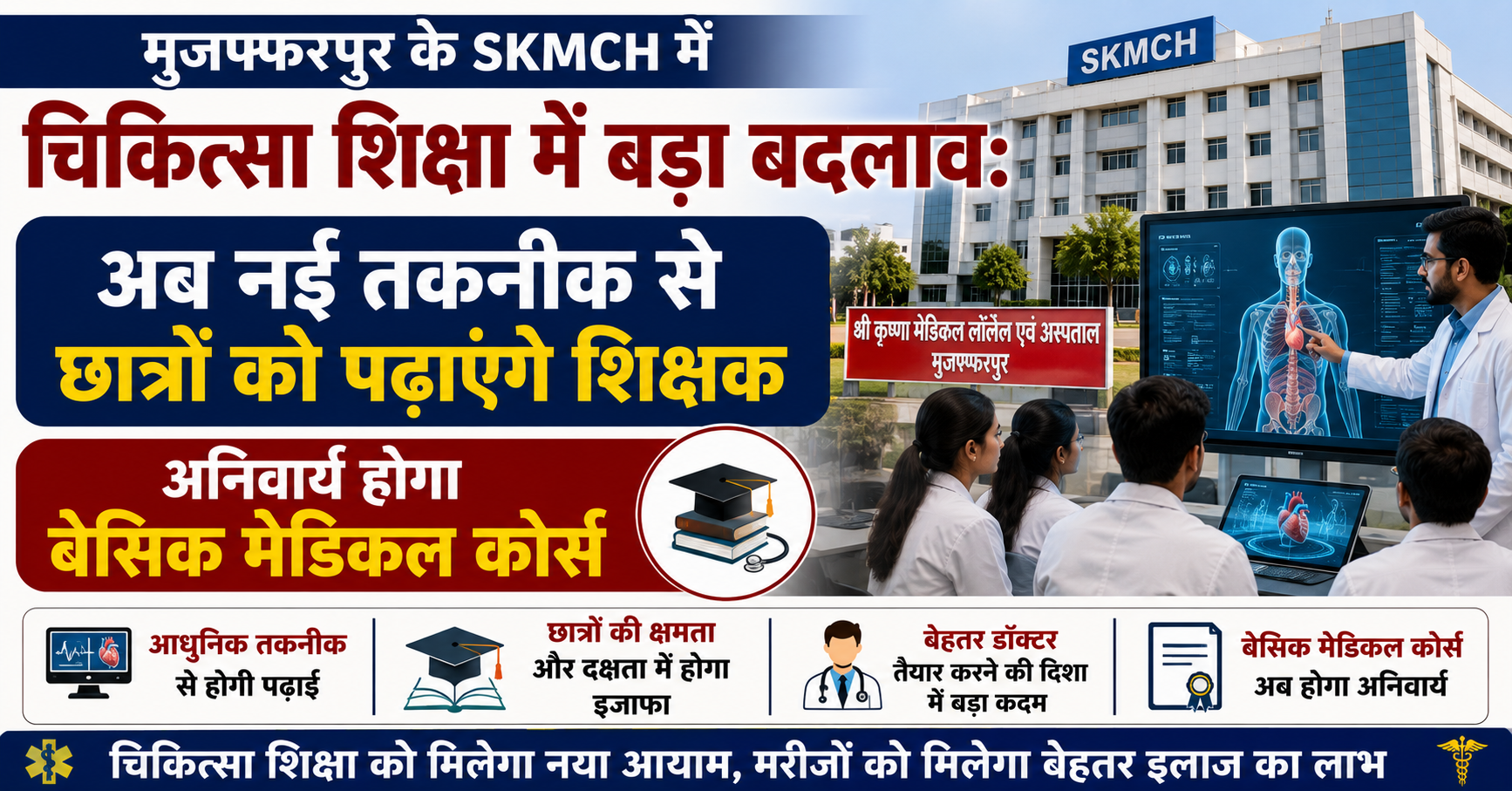
Major Transformation in Medical Education at SKMCH, Muzaffarpur: Teachers to be Trained in New Teaching Techniques; Basic Medical Course Made Mandatory
Muzaffarpur: In a significant move aimed at aligning medical education with global standards and integrating modern technology into pedagogical practices, Shri Krishna Medical College and Hospital (SKMCH) is set for a major overhaul. Following strict directives from the National Medical Commission (NMC), all faculty members at the college will now be trained in 'New Teaching Techniques.' The primary objective of this initiative is to move beyond rote learning and equip students with practical, application-based, and technical competencies.
NMC Directives and Faculty Preparation
The National Medical Commission has made it clear that teaching methods in medical colleges can no longer rely on outdated models. Under this new framework, it is not enough for teachers to be subject experts; they must also be proficient in using modern digital tools, simulations, and case-based learning to simplify complex concepts for students.
The SKMCH administration has prepared an action plan to implement these orders. It is mandatory for professors and teachers across all departments to participate in specialized training sessions. This training will focus on teaching them how to convey complex medical concepts to students in an accessible and engaging manner.
Basic Medical Course Made Mandatory
A key component of this directive is the mandatory 'Basic Medical Course.' As per NMC guidelines, every medical teacher is required to complete this course. The course is specifically designed to hone the teachers' pedagogical skills, evaluation processes, and research capabilities.
According to the college administration, faculty members from 9 different departments have been enrolled for this mandatory course this year, and their training is scheduled to commence shortly. Teachers who have previously completed this course will be required to undergo refresher modules to keep their teaching methodologies updated.
Technology to Reshape the Learning Experience
The integration of new techniques into teaching will provide several benefits to the students of Muzaffarpur:
Interactive Learning: Classes will no longer be limited to traditional lectures; there will be an increased emphasis on the use of smart classrooms and digital resources.
Practical Exposure: Teachers will receive simulation-based training, enabling them to better instruct students on real-world patient treatment methodologies.
Academic Accountability: The new system includes evaluating the effectiveness of teaching based on student feedback and academic performance.
Administrative Initiatives and Challenges
The Principal of SKMCH stated that this step would also help improve the college’s academic ranking. While balancing the rigorous training with the heavy patient load in the OPD is a challenge, the college management has clarified that there will be no compromise on NMC standards.
The changes being implemented at Shri Krishna Medical College represent a positive shift in the field of medical education. If the faculty adopts these new techniques and courses with seriousness, the doctors graduating from Muzaffarpur in the future will not only be more knowledgeable but also fully equipped with all aspects of modern medicine. These changes could prove to be a milestone for students in the upcoming academic sessions.


