
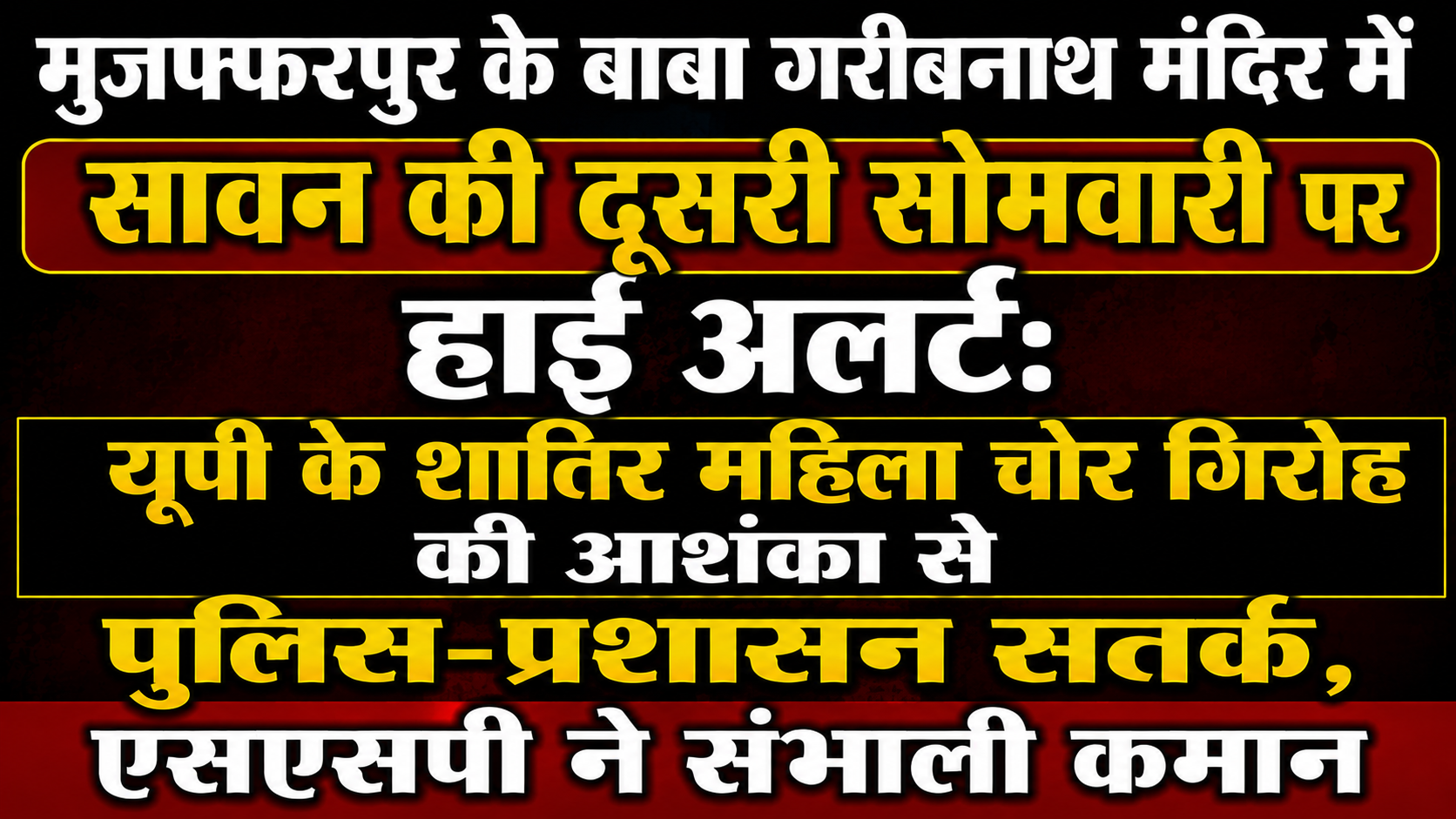
Major Administrative Action Near Baba Garibnath Temple Road in Muzaffarpur: Dozens of Flower and Prasad Stalls Removed Ahead of Sawan's Second Monday; Over 200 Vendors Protest Before Police Intervention Subdues the Situation
Muzaffarpur (Bihar): In view of the second Monday of the holy month of Shravana (Sawan), the Muzaffarpur district administration has begun enforcing strict measures concerning security and crowd management. In this vein, executing a major operation on Sunday under administrative directives, all flower, belpatra, and prasad stalls along Baba Garibnath Temple Road and its main access routes were completely cleared out. This administrative move was enacted to ensure the smooth movement of the millions of pilgrims visiting the temple and to avert any potential stampedes or accidents.
However, angered by this abrupt action, over 200 shopkeepers and vendors staged a vociferous protest. The merchants argued that the month of Sawan represents their primary livelihood generator of the year, and abruptly shutting down their shops in this manner has plunged them into a severe economic crisis. Observing the tense atmosphere at the spot, a heavy police contingent was deployed, after which police intervention successfully pacified the situation. Let us examine the primary motive behind this action, the protests by vendors, and a detailed breakdown of the administration's stringent policy.
Background of the Operation: Why Was This Step Taken?
Every Monday during Sawan, lakhs of kanwarias and Shiva devotees arrive at Baba Garibnath Dham from across Bihar and neighboring states to perform Jalabhishek. This crowd reaches its absolute zenith on the second Monday.
Crowd and Escape Route Challenges: The narrow lanes leading up to the temple and the main temple road were already choked by permanent or makeshift shops run by encroaching vendors. Consequently, in an emergency, no clear pathway remained for ambulances, fire engines, or police forces to navigate through.
The Threat of Stampedes: The district administration and disaster management department concluded that the dense gathering of worshippers standing around flower and prasad stalls along the temple road could trigger severe congestion and suffocation, risking a major catastrophe at any moment. Keeping this hazard in view, the administration resolved to render this pathway entirely encroachment-free for the duration of the holy month, or at least throughout the critical Monday windows.
Vendor Protests and Outrage: "A Crisis for Livelihoods"
As soon as teams from the administration and municipal corporation arrived alongside police forces on temple road and ordered shopkeepers—who had been vending flowers and prasad there for decades—to clear out, panic swept through the locality.
Protest by Over 200 Vendors: Opposing the operation, roughly 200 flower, prasad, and worship-material vendors sat in protest right on temple road, raising slogans against the administration.
Arguments Raised by Shopkeepers: The protesting merchants asserted that they earn the bulk of their annual income during the Sawan season to sustain their households throughout the year. Forcing them to shut down abruptly without any prior alternative arrangement amounts to a direct assault on their families' sustenance. They further contended that the administration ought to have provided them with temporary alternative plots at a short distance or within an open ground.
Police Intervention and Restoration of Order
With opposition escalating rapidly during the clearance drive, a tense atmosphere brewed at the site, but the police administration handled the situation with immense tact and restraint.
Deployment of Police Forces: To preserve law and order, a substantial deployment of male and female police personnel, alongside magistrates, had been positioned at the location.
Calming the Protesters Through Dialogue: Senior police officials and local administrators reasoned with the aggrieved shopkeepers, explaining that the decision had been enacted strictly in the interest of the general public and the safety of the pilgrims themselves. The administration assured them that their grievances would be reviewed once the special Sawan periods concluded. Facing a firm police stance coupled with administrative persuasion, the vendors eventually calmed down and cleared the path.
The Administration's Clear Message: Safety Above All
Following these events, top officials of the district administration made it explicitly clear that no compromise whatsoever can be entertained regarding pilgrim safety.
No-Entry and No-Vendor Zones: A 500-meter radius surrounding the temple has been officially designated as a strict 'No-Vendor Zone' to allow kanwarias to approach the shrine directly without any obstructions.
Search for Alternative Sites: The administration has instructed local bodies to weigh options for designating temporary vending zones slightly removed from the temple premises for small-scale shopkeepers, safeguarding their livelihoods while keeping the temple route thoroughly secure.
The operation to clear flower and prasad stalls from Baba Garibnath Temple Road in Muzaffarpur ahead of Sawan's second Monday highlights administrative readiness and an unwavering commitment to security. Although the protests and outrage from over 200 vendors briefly generated tension, prompt intervention by police and administrators successfully contained the situation. While this administrative measure guarantees safe and smooth worship for millions of Shiva devotees, it simultaneously proves to be an essential and indispensable step toward planned urban traffic and crowd management within the city.


