
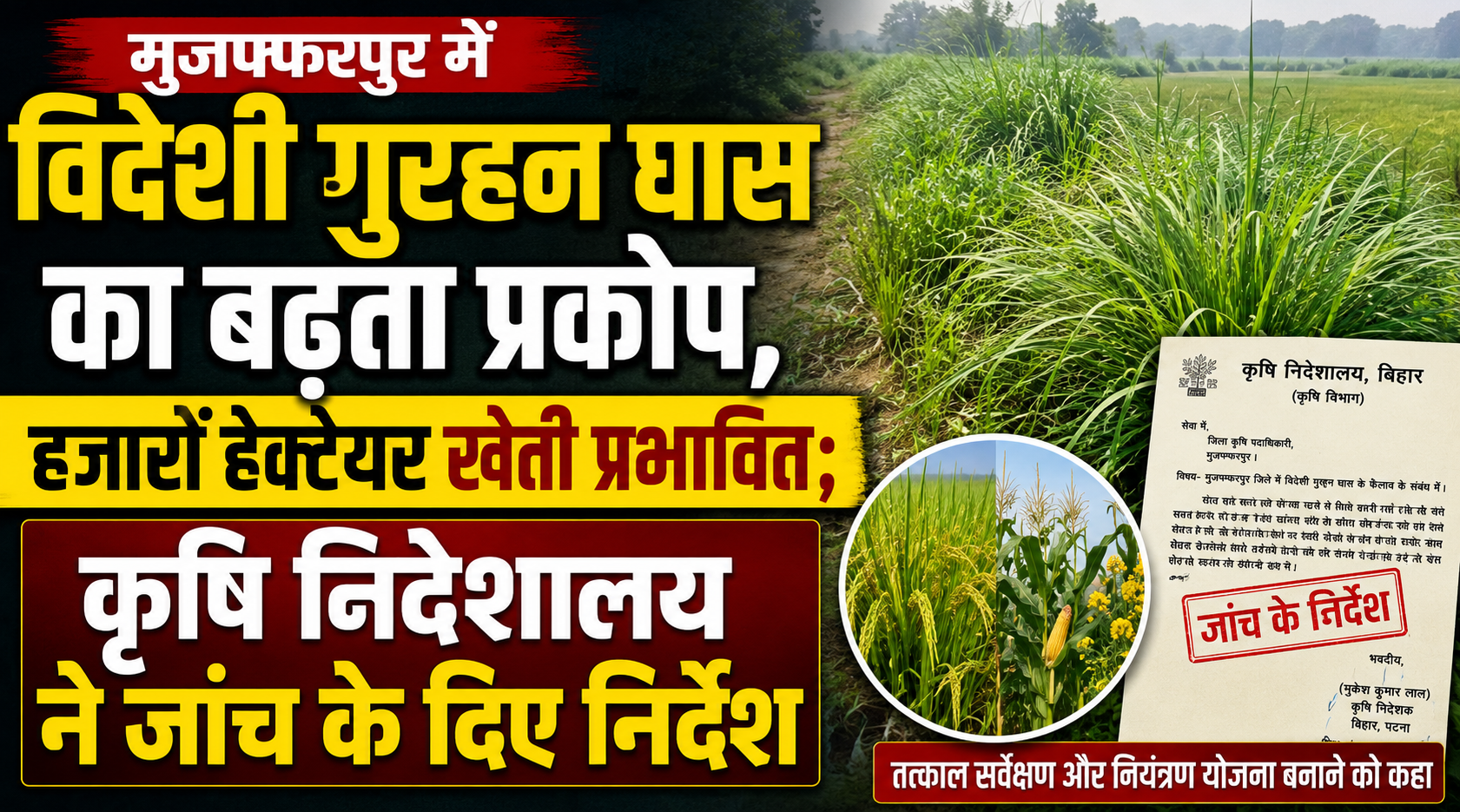
Foreign Gurhan Grass Spreading Rapidly in Muzaffarpur, Thousands of Hectares of Farmland Affected; Agriculture Directorate Orders Investigation
Muzaffarpur: The rapid spread of foreign Gurhan grass along the embankment from Kataujha to the Katra border in Muzaffarpur district has become a growing concern for farmers and livestock owners. The grass has reportedly spread across thousands of hectares, with its presence beginning to affect major crops such as paddy, maize, mustard and toria.
Taking the matter seriously, the Agriculture Directorate has directed the district authorities to immediately investigate the affected areas. A special survey has also been ordered to assess the extent of the spread and prepare an action plan for controlling and eliminating the invasive grass through technical measures.
The department's objective is to assess the actual situation at an early stage and prevent the problem from spreading further into agricultural land.
Rapid Spread Along Embankment Raises Concern
The foreign Gurhan grass has reportedly been spreading rapidly along the embankment between Kataujha and the Katra border. Its presence has been noticed around agricultural fields, field boundaries and other areas surrounding the embankment.
The spread has become a concern for farmers because controlling unwanted vegetation is already an important part of agricultural management. If an invasive grass spreads over a large area, removing it can require additional labour and increase cultivation costs.
The agriculture department is now preparing to conduct a detailed survey to determine how far the grass has spread and which areas have been most severely affected.
Thousands of Hectares Reportedly Affected
According to the information available, the foreign Gurhan grass has spread across thousands of hectares. Major crops in the affected areas, including paddy, maize, mustard and toria, are reportedly facing pressure because of the spread.
These crops are an important source of income for farmers in the region. Any additional pressure on crop production could therefore create economic difficulties for farming communities.
However, the exact and updated extent of the affected area will become clear only after the official survey is completed. This is one of the reasons the Agriculture Directorate has directed the district agriculture authorities to conduct an immediate investigation.
The survey will help determine the areas where the grass is most concentrated, the direction in which it is spreading and its actual impact on agricultural land.
Agriculture Directorate Takes Serious Note
After receiving information about the rapid spread of the foreign grass, the Agriculture Directorate has taken the matter seriously.
Agriculture Director Mukesh Kumar Lal has written to the District Agriculture Officer and directed the department to immediately inspect the affected areas.
The directorate has called for a special survey rather than limiting the exercise to routine inspections. The aim is to scientifically assess the scale of the problem and determine how extensively the grass has spread.
The department has also directed officials to prepare an action plan for eliminating the grass through appropriate technical measures.
Technical Measures Being Considered
Before adopting any method to control invasive or unwanted vegetation, it is important to assess its impact on crops, soil and surrounding areas.
For this reason, the Agriculture Directorate has asked officials to prepare an action plan based on technical measures.
One of the major challenges will be controlling the grass without causing damage to nearby crops or agricultural land. Expert advice and detailed field surveys will therefore be important.
Farmers may also need to follow official technical recommendations when attempting to control the grass. Unsupervised use of chemicals or other control methods could potentially damage crops and soil.
Why the Grass Is a Concern for Crops
Any rapidly spreading unwanted vegetation can compete with crops for available space and other resources.
If the grass becomes widespread in agricultural fields, farmers may have to spend additional money and labour to remove it. This can increase the overall cost of cultivation.
Weed management is already an important part of growing crops such as paddy, maize, mustard and toria. The widespread presence of foreign Gurhan grass could therefore add another challenge for farmers.
The long-term impact will become clearer after the department completes its field assessment and technical study.
Livestock Also a Concern
The spread of the grass is not being viewed only as an agricultural issue. It could also have implications for livestock, particularly in rural areas where farming and animal husbandry are closely connected.
Farmers often depend on locally available vegetation and fodder resources for their livestock. If an unwanted or foreign grass occupies large areas, questions may arise regarding the availability and quality of fodder.
However, the actual impact of the grass on livestock will need to be established through expert assessment. Farmers and livestock owners should therefore follow guidance issued by the agriculture and animal husbandry authorities.
Need for Special Monitoring Along Embankment
Given the reported spread along the embankment from Kataujha to the Katra border, increased monitoring of the area will be important.
If the grass continues to move from the embankment into nearby agricultural fields, the affected area could expand further.
Therefore, the upcoming survey should not only assess the areas already affected but also identify the direction and possible pattern of further spread.
Early identification of vulnerable areas could allow authorities to prioritise them for control measures.
Farmers Need Awareness and Guidance
Along with controlling the grass, creating awareness among farmers will also be important.
Farmers need to know how to identify the grass and which department or official they should contact if they find it spreading in or around their fields.
Attempting to control the grass independently using unsuitable methods could potentially damage crops or soil. Clear instructions from the agriculture department could therefore help farmers respond appropriately.
Farmers may also need guidance on measures that can prevent the grass from being transported or spread from one area to another.
Special Survey Expected to Provide Clear Picture
The special survey ordered by the Agriculture Directorate will be an important step in understanding the situation.
Officials can collect information about the affected area, the density of the grass and its impact on agricultural fields. This information can then be used to determine the most appropriate control strategy.
The resulting assessment could help the department identify priority areas, recommend technical control measures and establish a monitoring mechanism.
Early Control Considered Important
If the foreign Gurhan grass continues to spread unchecked, controlling it at a later stage could become more difficult.
Timely identification and management of rapidly spreading vegetation can help reduce potential agricultural losses. The Agriculture Department's decision to order an immediate investigation is therefore significant.
The immediate challenge for officials in Muzaffarpur is to accurately assess the area affected between Kataujha and the Katra border and then develop a scientifically and technically appropriate strategy to control the spread.
Farmers Await Effective Action
For farmers in the affected areas, the next steps taken by the Agriculture Department will be crucial.
Farmers are expected to look for a practical and effective solution to the problem after the survey is completed. If experts prepare a suitable control strategy and it is implemented effectively, the further spread of the grass could potentially be restricted.
Regular monitoring will also be necessary even after control measures are introduced so that any renewed spread can be detected and addressed at an early stage.
Important Step for Agricultural Protection
The increasing spread of foreign Gurhan grass in Muzaffarpur has emerged as a significant challenge for the agriculture sector.
Reports of its presence across thousands of hectares and its impact on crops such as paddy, maize, mustard and toria have increased concern among farmers.
The Agriculture Directorate has taken the first major step by directing the District Agriculture Officer to conduct an immediate investigation and special survey.
The focus will now be on identifying the affected areas, determining the extent of the spread and developing a technical action plan.
The effectiveness of the response will depend on how quickly the affected areas are identified, how scientifically the grass is controlled and how effectively farmers receive technical guidance.
If these measures are implemented properly, the department could limit the further spread of the grass and reduce its potential impact on crops, livestock and rural livelihoods.
For now, the areas along the embankment between Kataujha and the Katra border will remain under focus as officials prepare to assess the situation.
The survey and subsequent action plan ordered by the Agriculture Directorate will determine how effectively the rapidly spreading foreign Gurhan grass can be brought under control.


