

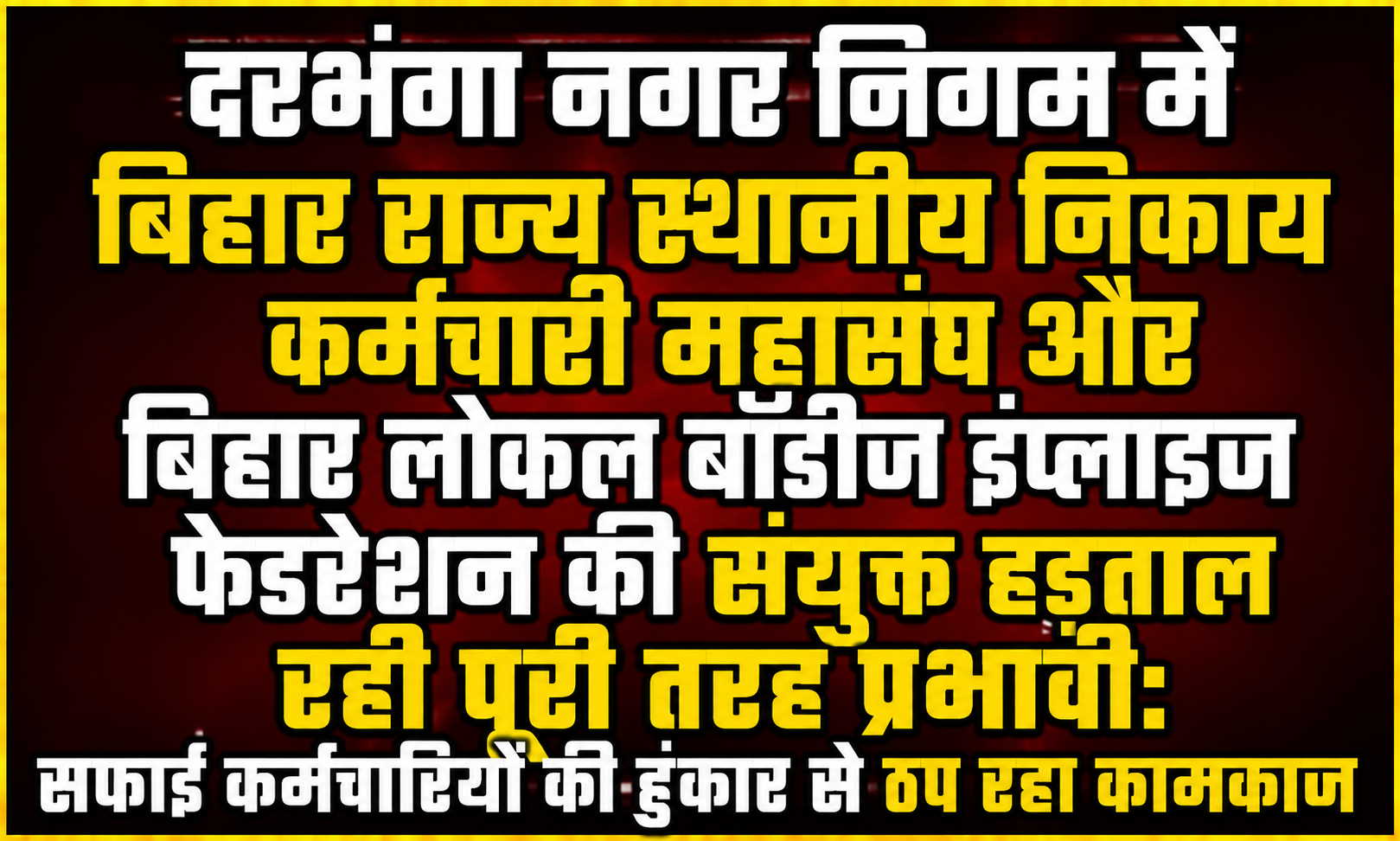
Joint Strike by Bihar State Local Body Employees Federation and Bihar Local Bodies Employees Federation proves Entirely Effective in Darbhanga Municipal Corporation: Work Comes to a Standstill Amidst Sloganeering by Sanitation Workers
Darbhanga: The struggle for the rights of laborers, sanitation workers, and local body employees in the historical and cultural center of Bihar, the Darbhanga Municipal Corporation area, has reached a new and decisive turning point. The state-wide strike called under the joint auspices of the Bihar Rajya Sthaniya Nikay Karamchari Mahasangh and the Bihar Local Bodies Employees Federation proved entirely effective and widespread within Darbhanga Municipal Corporation. Thousands of permanent, contract, and daily-wage sanitation workers took to the streets against the alleged obstinate and indifferent attitude of the government and local administration. The employees staged vociferous demonstrations demanding that the government immediately accept and implement their long-pending, legitimate demands. Due to this joint agitation, the city's entire sanitation system and administrative operations came to a complete standstill, creating a stir within the municipal corporation administration.
Genesis of the Joint Strike: Why Did the Two Major Federations Unite?
Underlying discontent had been brewing for a long time against the pathetic economic condition and exploitation of sanitation workers and fourth-grade employees serving in Bihar's urban local bodies.
Continuous Ignorance of Demands: Employees alleged that the state government and local body administration were merely feeding them hollow assurances, while no tangible solutions to their basic problems were being implemented on the ground. Forced to work on meager honorariums or wages amidst skyrocketing inflation, the patience of these workers had finally worn thin.
Formation of a Joint Front: Against this backdrop, the Bihar State Local Body Employees Federation and the Bihar Local Bodies Employees Federation decided to set aside mutual differences and forge a strong joint front. The coming together of both major organizations lent unprecedented strength to the movement, making its full impact visible across the Darbhanga Municipal Corporation region.
Key Demands of Employees and Resentment Toward the Government
During the sit-in and demonstration held within the municipal corporation premises, employees and federation leaders forcefully presented their primary demands before the government:
Equal Pay for Equal Work: Contract workers and daily wagers should be provided with salaries and benefits equivalent to regular employees for the same work.
Regularization of Personnel: The services of contract and daily-wage sanitation workers who have served for years should be regularized immediately.
Timely Payment of Honorariums: The trend of withholding honorariums for months must be halted, and wage disbursements must be ensured on a fixed date every month.
Social Security Benefits (PF & ESI): The benefits of Provident Fund (PF), Employees' State Insurance (ESI), and health insurance schemes must be made mandatory for all sanitation workers.
Improvement in Service Conditions and Risk Allowance: Sanitation workers operating amidst hazardous drains and waste must be provided with special risk allowances and safety gear.
Widespread Impact of the Strike on the Darbhanga Municipal Corporation Region
The strike, launched at the call of the joint federation, exerted a severe and extensive impact on the city of Darbhanga.
Streets Littered with Heaps of Garbage: From the very first day of the strike, sanitation workers completely halted garbage collection. As a result, mountains of refuse piled up across major markets, Laheriasarai Tower, Darbhanga Tower, Benta, and various residential neighborhoods. The foul odor and filth spreading everywhere made daily life miserable for general citizens.
Aggressive Solidarity Among Employees: Starting early in the morning, thousands of male and female sanitation workers carrying banners and posters gathered at the main gates of the Darbhanga Municipal Corporation office. Anti-government slogans echoed across the entire municipal complex. Speakers warned that if the government fails to convene tripartite talks and fulfill their demands soon, the agitation will be intensified further.
The joint strike by the Bihar State Local Body Employees Federation and the Bihar Local Bodies Employees Federation has once again proven that unless workers organize and raise their voices for their rights, the establishment pays no heed to their plight. This strike proved entirely effective in Darbhanga Municipal Corporation and has compelled the governing administration to take notice. It remains to be seen when the government will accept the legitimate demands of these hardworking sanitation workers and take concrete, positive steps to secure both the city's sanitation system and the future of its employees.