
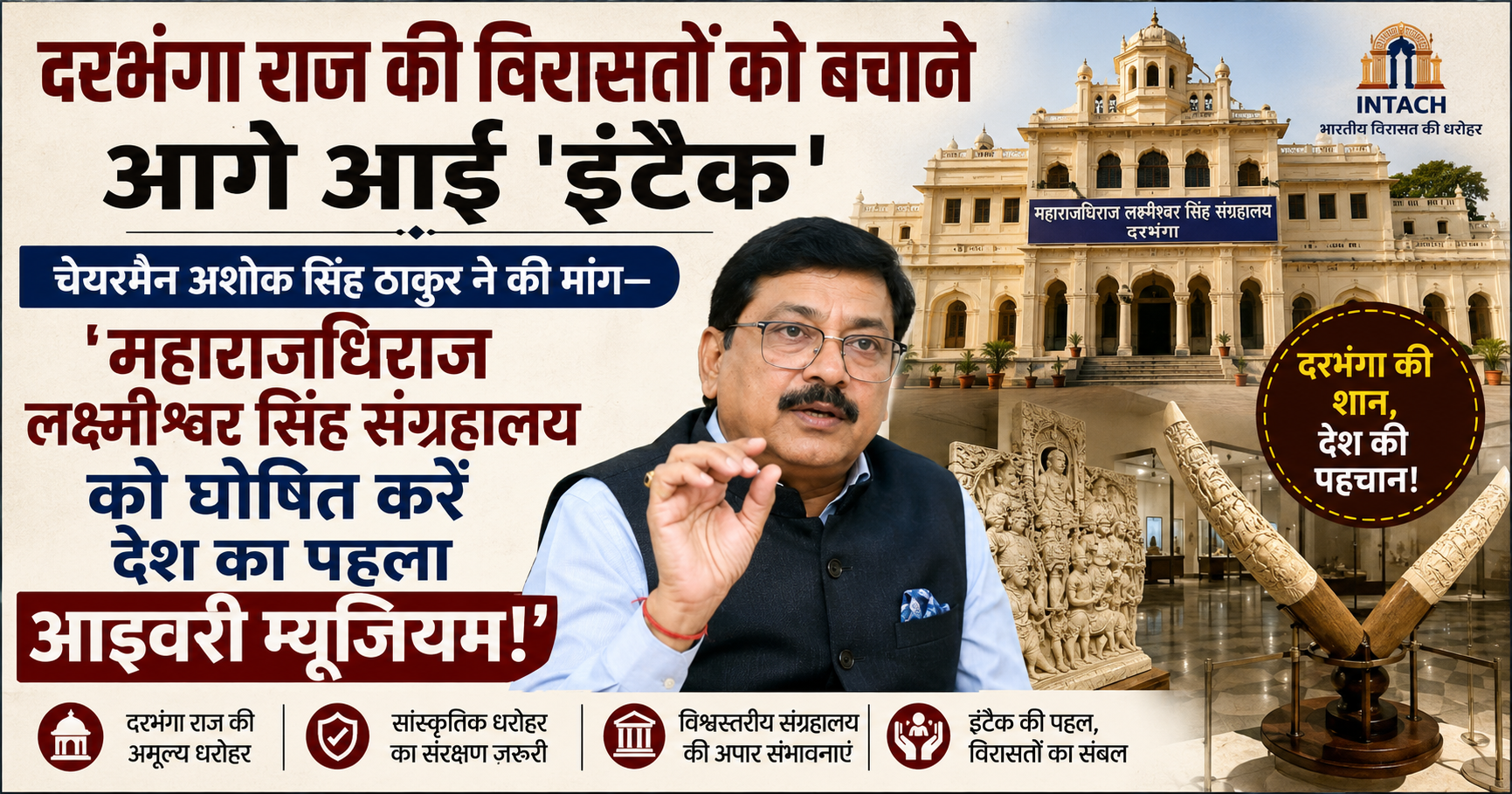
INTACH Steps in to Save Darbhanga Raj Legacies; National Chairman Ashok Singh Thakur Urges—'Declare Maharajadhiraja Lakshmishwar Singh Museum as India's First Independent Ivory Museum!'
Global Heritage Status Demanded: Mesmerized by the scale and absolute rarity of the ivory exhibits at the Lakshmishwar Singh Museum, INTACH National Chairman Ashok Singh Thakur pressed the need to re-brand and declare it an independent 'Ivory Museum.'
The Heritage Route: A high-level INTACH delegation conducted a dense architectural assessment of historic landmarks, including Nargona Palace, Moti Mahal, Lakshmishwar Vilas Palace, the Raj Fort, and Indra Bhawan.
Deep Concern Over Decay: Expressing grief over the structural deterioration of centuries-old monuments and endangered historical flora (such as the sacred Shakhai Tar and Bhadraksh trees), the INTACH chief extended a comprehensive restoration blueprint.
Ground Zero: India's Premier Heritage Body Descends upon Darbhanga
A monumental wave of momentum has been triggered to reclaim and globally elevate the glorious history and priceless cultural artifacts of 'Raj Darbhanga'—the cultural capital of Mithilanchal. The Indian National Trust for Art and Cultural Heritage (INTACH), the country’s apex body specializing in the scientific preservation of ancient architecture, sculptures, and art, is currently conducting an aggressive on-spot assessment of Darbhanga's unique heritage.
As part of this historic itinerary, INTACH National Chairman Ashok Singh Thakur led a comprehensive inspection of the Maharajadhiraja Lakshmishwar Singh Museum (Established: 1977) located near the Darbhanga Railway Station. He was accompanied by Bhairab Lal Das, Convener of INTACH Bihar Chapter, and former museum curator Dr. Shiv Kumar Mishra, who briefed the apex delegation on the incredible legacy of the Darbhanga Raj.
【 HERITAGE PROFILE - LAKSHMISHWAR SINGH MUSEUM 】 Prime Distinction: Possesses India’s largest and rarest assembly of Ivory Craft. Key Exhibits: Royal thrones, gold-and-silver weaponry, Greek-style marble structures. The Blueprint: Upgrading the repository to a standalone, nationally branded 'Ivory Museum.'
Chairman Spellbound: 'Such Invaluable Artifacts Exist Nowhere Else on the Planet!'
While touring the royal chambers and sprawling galleries, INTACH Chairman Ashok Singh Thakur was completely awestruck upon entering the designated 'Ivory Gallery.' Examining the microscopically precise and fluid carvings done entirely on elephant tusks, he extended boundless praise to the historic artisans of Mithila and Bihar.
Official Statement by the INTACH Chairman: > "Throughout my career, I have audited hundreds of museums globally, but the colossal and magnificent treasury of ivory artifacts preserved here at the Maharajadhiraja Lakshmishwar Singh Museum is completely unmatched. Finding craftsmanship of this scale, realism, and micro-precision anywhere else is virtually impossible. The Government of Bihar and the Central Ministry must join forces to market this peerless heritage on the international tourism grid as a specialized, world-class 'Ivory Museum.'"
The 5 Priceless Royal Relics That Captivated the Delegation
During the heritage walk, the INTACH chief expressed deep fascination over several distinct antiquities, highlighting their artistic brilliance:
1. The Ivory 'Mahishasura Mardini'
Sculpted out of a single, continuous block of elephant tusk, this masterpiece of Goddess Durga slaying the buffalo demon leaves onlookers stunned. Every piece of jewelry, expression, and dynamic posture appears fully alive.
2. Equestrian Statue of Chhatrapati Shivaji Maharaj
A rare equestrian sculpture of the Maratha icon Chhatrapati Shivaji Maharaj carved out of ivory, serving as a pristine benchmark for classical Indian micro-sculpting.
3. The Royal Palanquin and Elephant Howdah
The grand royal palanquin (Palki) and the elephant-back riding seat (Howdah) used by the Maharajas during public processions, heavily adorned with fine ivory sheets and ornate silver-filigree relief work.
4. The Micro-Woven Ivory Mat and Net
A breathtaking woven mat and decorative window-net made by slicing stiff ivory into threads as fine as silk yarn. It defies belief that such a delicate, flexible texture was achieved from a solid tusk.
5. The Gold and Silver Throne of Maharaja Rameshwar Singh
Dominating Gallery Hall No. 1 is the original, authentic 'Royal Throne' of Raj Darbhanga, heavily encrusted with pure gold, silver plates, and priceless gems—standing as a silent witness to the staggering wealth of the former principality.
Grief Over Administrative Decay: INTACH Extends Free Restoration Engineering
Following the museum review, the INTACH delegation surveyed the structural health of the wider Darbhanga Raj campus, auditing Nargona Palace, Moti Mahal, Lakshmishwar Vilas Palace (currently Kameshwar Singh Sanskrit University), the European Guest House, and the ancient Raj Fort fortifications.
Witnessing wild vegetation breaching the walls, cracking domes, and clear signs of institutional neglect, the INTACH team expressed deep alarm.
The Free Technical Proposal: Delivering a massive policy statement, Chairman Ashok Singh Thakur announced that if the Darbhanga Royal Family and local trusts step forward, INTACH is prepared to deploy its expert heritage engineers and technical restoration consultants free of charge to scientifically revive these historic monuments, ancient birch-bark (Bhojpatra), and palm-leaf (Talpatra) archives.
Appreciation for Chandradhari Museum and Kalyani Foundation
During his high-profile tour, the INTACH Chairman also evaluated Darbhanga's famous Chandradhari Museum, applauding the immense passion of its founder, Babu Chandradhari Singh, for heritage collection. Additionally, the team visited the library of the 'Maharajadhiraja Kameshwar Singh Kalyani Foundation,' hailing its ongoing academic research and preservation of centuries-old rare manuscripts as a robust pillar of India’s intellectual heritage.
The demand by INTACH Chairman Ashok Singh Thakur to establish a dedicated 'Ivory Museum' is not a mere bureaucratic formality—it can serve as a massive structural turning point for Bihar’s tourism and historical projection. If this repository secures independent status and global branding, Darbhanga could comfortably stand alongside the Taj Mahal or the Ajanta Caves on the international itinerary. The ball is now firmly in the court of the state administration and the royal foundations to see how quickly this sleeping giant of a heritage gets its second lease on life!


