
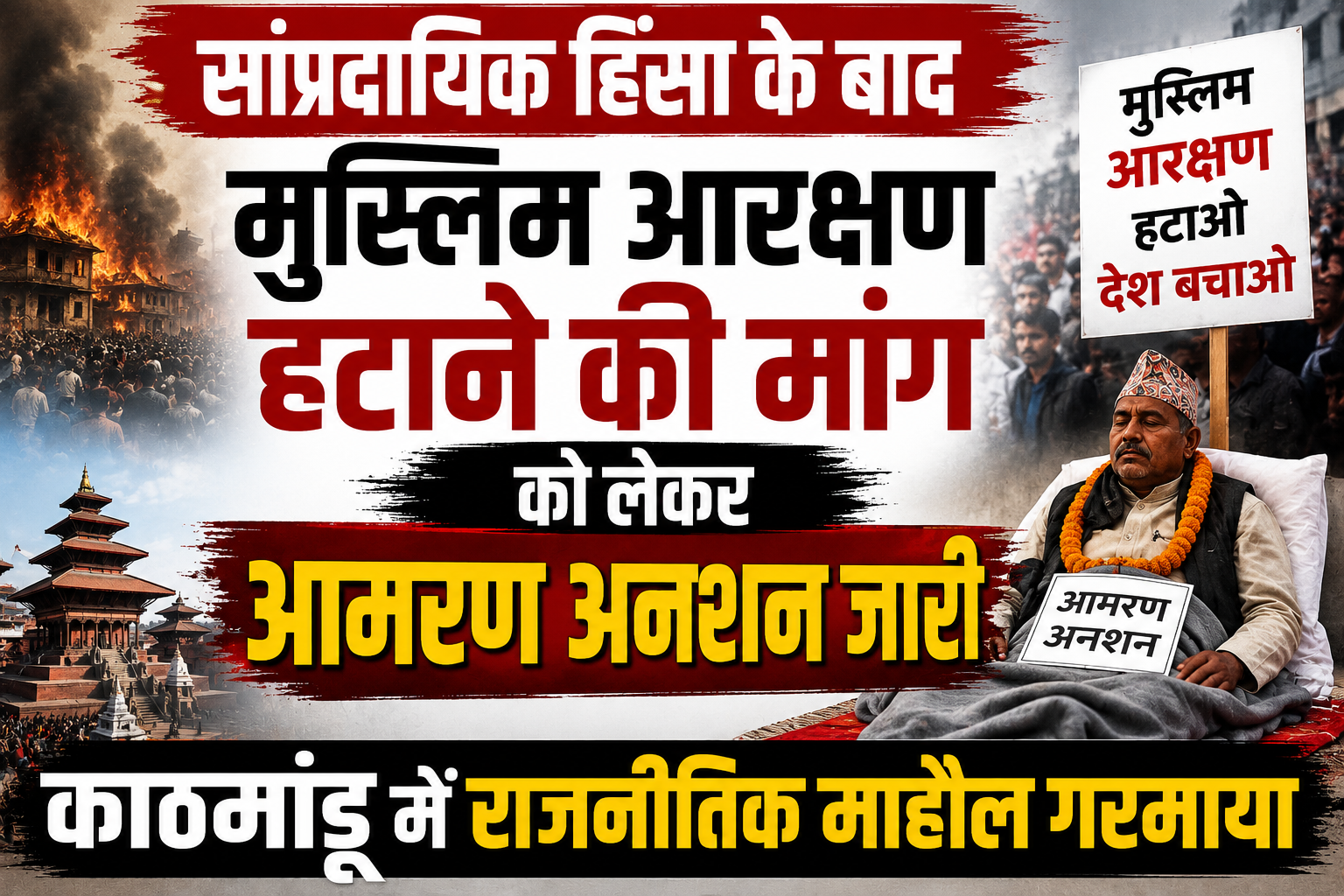
Hunger Strike Over Demand to Remove Muslim Reservation Continues After Communal Violence, Political Atmosphere Heats Up in Kathmandu
Kathmandu: Nepal is currently going through a period of continuous social and political developments. The country had not yet fully recovered from the impact of the recent Gen Z movement when new controversies emerged over communal tension and reservation policies. Following the communal violence in Devanganj area of Sunsari district, political and social organizations have become increasingly active.
After the incident, the National Unity Party started an indefinite hunger strike at Maitighar Mandala in Kathmandu, demanding the removal of the Muslim reservation system. The protest has reportedly entered its eighth day. The protesters claim that Nepal should have an equal system for all citizens and that separate reservation policies for any particular community should be reconsidered.
Situation Changed After Devanganj Violence
The communal violence in Devanganj of Sunsari district changed the situation significantly in the region. Following the incident, the administration had to remain highly alert to maintain law and order.
The incident once again sparked discussions about social harmony and trust between different communities in Nepal. Political parties and social organizations have expressed different views regarding the matter.
Some organizations described the incident as a serious challenge to social peace, while others demanded a fair investigation and strict action against those responsible.
Indefinite Hunger Strike at Maitighar Mandala
After the Devanganj incident, the National Unity Party began an indefinite hunger strike at Maitighar Mandala, one of Kathmandu’s major protest sites. The organization says that its movement is aimed at demanding equality and a unified citizenship policy in the country.
The protesters have raised the demand to remove Muslim reservation provisions. They argue that state policies should be equal for all citizens and that there should not be separate arrangements for any particular community.
Even on the eighth day of the hunger strike, the protest continues to remain a major topic of discussion in Nepal’s political circles.
Debate Over Reservation Policy Intensifies
Reservation and inclusion policies have been subjects of political debate in Nepal for a long time. Various policies have been introduced to provide representation and opportunities to communities and groups considered socially and economically disadvantaged.
However, these policies have repeatedly faced both support and opposition. Some groups believe reservations are necessary to provide opportunities to historically marginalized communities, while others view them from the perspective of equal citizenship rights.
The demand to remove Muslim reservation has once again intensified this debate.
Challenge Before the Government
The biggest challenge before the Nepal government is maintaining social and political balance. On one hand, it needs to address communal tensions, while on the other hand, it must respond to demands raised through democratic means.
Experts say that the government needs to handle such sensitive issues carefully and ensure that no community develops a feeling of insecurity or exclusion.
Continuous Changes After Gen Z Movement
In recent months, youth-led movements in Nepal have influenced the country's political environment. During the Gen Z movement, young people raised their voices on issues related to governance, corruption, and their future.
However, before the impact of that movement completely settled, new social and political issues emerged, creating fresh debates across the country.
Political analysts believe that increasing participation of youth and social organizations may influence Nepal’s political direction in the coming days.
Response from Social Organizations
Various social organizations in Nepal have expressed concern over the Devanganj violence and the developments that followed. They said that disputes should be resolved through dialogue and constitutional processes.
Organizations have appealed to people to maintain peace and avoid spreading rumors. They emphasized that maintaining communal harmony is extremely important for a diverse society like Nepal.
Security Increased
The administration has increased security arrangements in Kathmandu and other sensitive areas. Police and security agencies are closely monitoring the situation.
Authorities are trying to prevent any untoward incidents and ensure that law and order remains stable.
Political Parties Keeping an Eye on Protest
Nepal’s political parties are closely watching the movement led by the National Unity Party. Some parties have appealed to the government to hold discussions on the issue, while others have suggested that the concerns raised by protesters should be examined.
Political experts believe that sensitive issues like reservation policies require broad discussions involving all stakeholders.
Future Situation Under Watch
At present, the hunger strike at Maitighar Mandala continues, and attention remains focused on the government's next steps. It will be important to see whether discussions take place between the government and protesters in the coming days.
Issues such as communal tension, reservation policies, and social balance are likely to remain central topics of political debate in Nepal.
Nepal is once again passing through a phase of social and political uncertainty. The hunger strike demanding the removal of Muslim reservation after the communal violence in Sunsari’s Devanganj area has started a fresh debate in the country.
While protesters are demanding an equal system for all citizens, experts are emphasizing the importance of maintaining social harmony and finding solutions through constitutional and democratic processes. All eyes are now on the government’s next move and the future course of the protest.


