
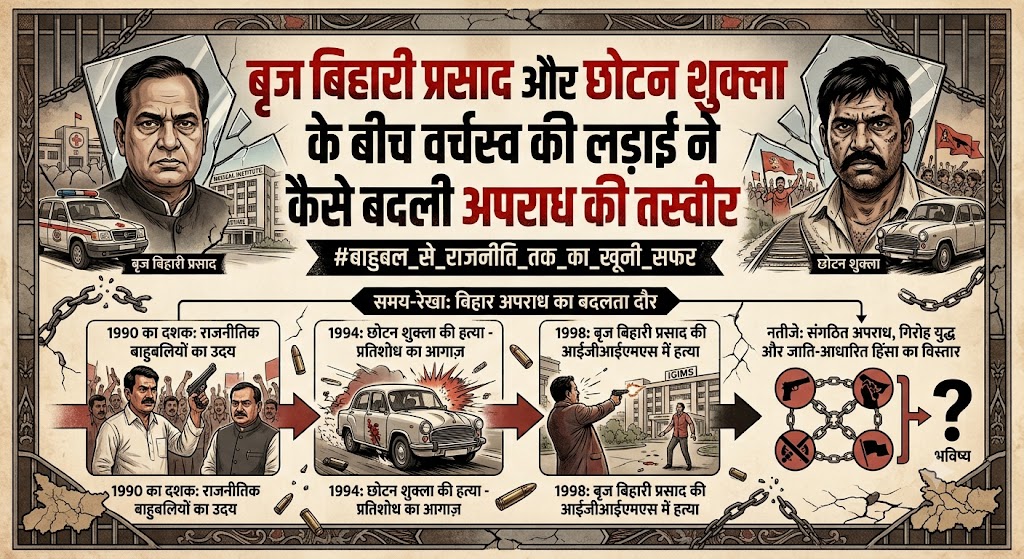
How the Rivalry Between Brij Bihari Prasad and Chhotan Shukla Shaped the State's Criminal Landscape
Patna: The 1990s in Bihar are remembered not only for political upheaval but also for the rise of organized crime and violent gang rivalries that dominated public discourse for years. During that period, several criminal groups were active across the state, competing for influence and territorial control. Among the names that frequently surfaced in public discussions were Brij Bihari Prasad, a prominent political figure of the time, and Chhotan Shukla, who was associated with the criminal underworld. The developments involving the two became major talking points and raised serious concerns about law and order in the state.
According to political analysts and historical accounts, the 1990s witnessed widespread concerns over extortion, contract-related disputes, alleged criminal networks, and the influence of organized crime in several parts of Bihar. Violent incidents, including murders, kidnappings, and shootings, created an atmosphere of fear among residents and significantly affected public life.
During this period, Brij Bihari Prasad and Chhotan Shukla became central figures in discussions surrounding crime and politics in Bihar. Various media reports and public records from that era describe a prolonged rivalry involving individuals and groups associated with the two, drawing widespread attention from both political circles and law enforcement agencies.
Political observers note that the decade was marked by frequent debates over the alleged nexus between crime and politics. Several high-profile criminal cases prompted large-scale investigations by the police and other agencies. Many of these cases went through lengthy judicial proceedings, with courts delivering judgments based on the evidence presented in each case.
Several major criminal incidents from that period made national headlines. Business owners, contractors, and ordinary citizens expressed concerns about public safety, while reports suggested that commercial activities and investment were adversely affected by the prevailing security situation. In some areas, people were reluctant to venture out after dark due to fears over law and order.
To address the deteriorating situation, the state government and law enforcement agencies launched special operations against organized crime. Several wanted criminals were arrested, while investigations into major cases were transferred to specialized agencies. Over time, many high-profile cases reached the courts, where legal proceedings continued over several years before judgments were delivered.
Experts believe that the 1990s represented a critical phase in Bihar's history, from which the state learned important lessons. In the years that followed, successive efforts were made to strengthen policing, modernize law enforcement, improve intelligence gathering, and expedite judicial processes. The adoption of technology, CCTV surveillance, digital record management, and better coordination among agencies contributed to strengthening policing in later years.
Sociologists argue that organized crime affects not only law and order but also a state's social and economic development. An atmosphere of fear can discourage investment, disrupt education, reduce employment opportunities, and negatively impact everyday life. Effective crime control, therefore, is considered essential for sustainable development and public confidence.
Today, comparisons between Bihar's current law-and-order situation and that of the 1990s continue to be part of political debate. Different political parties and analysts present varying perspectives on the state's progress, but the events of that era remain an important part of Bihar's political and criminal history. Numerous books, research papers, media archives, and judicial records continue to document and examine the period.
Historians emphasize that such episodes should be studied not merely as accounts of crime but also as lessons in governance, policing, judicial reform, and institutional development. Understanding the challenges of that era can help policymakers strengthen public institutions and improve law enforcement in the future.
Over the past three decades, Bihar has witnessed significant changes in infrastructure, education, healthcare, investment, and governance. Efforts to improve policing and public security have also continued. Nevertheless, experts stress that maintaining law and order requires constant vigilance and sustained institutional reforms.
The events associated with Brij Bihari Prasad and Chhotan Shukla remain among the most discussed chapters in Bihar's political and criminal history. The violent rivalry of that period symbolized a challenging era that tested the state's governance, security apparatus, and justice system. Looking back at those events provides valuable lessons for building stronger institutions, ensuring effective law enforcement, and fostering a safer society.


