
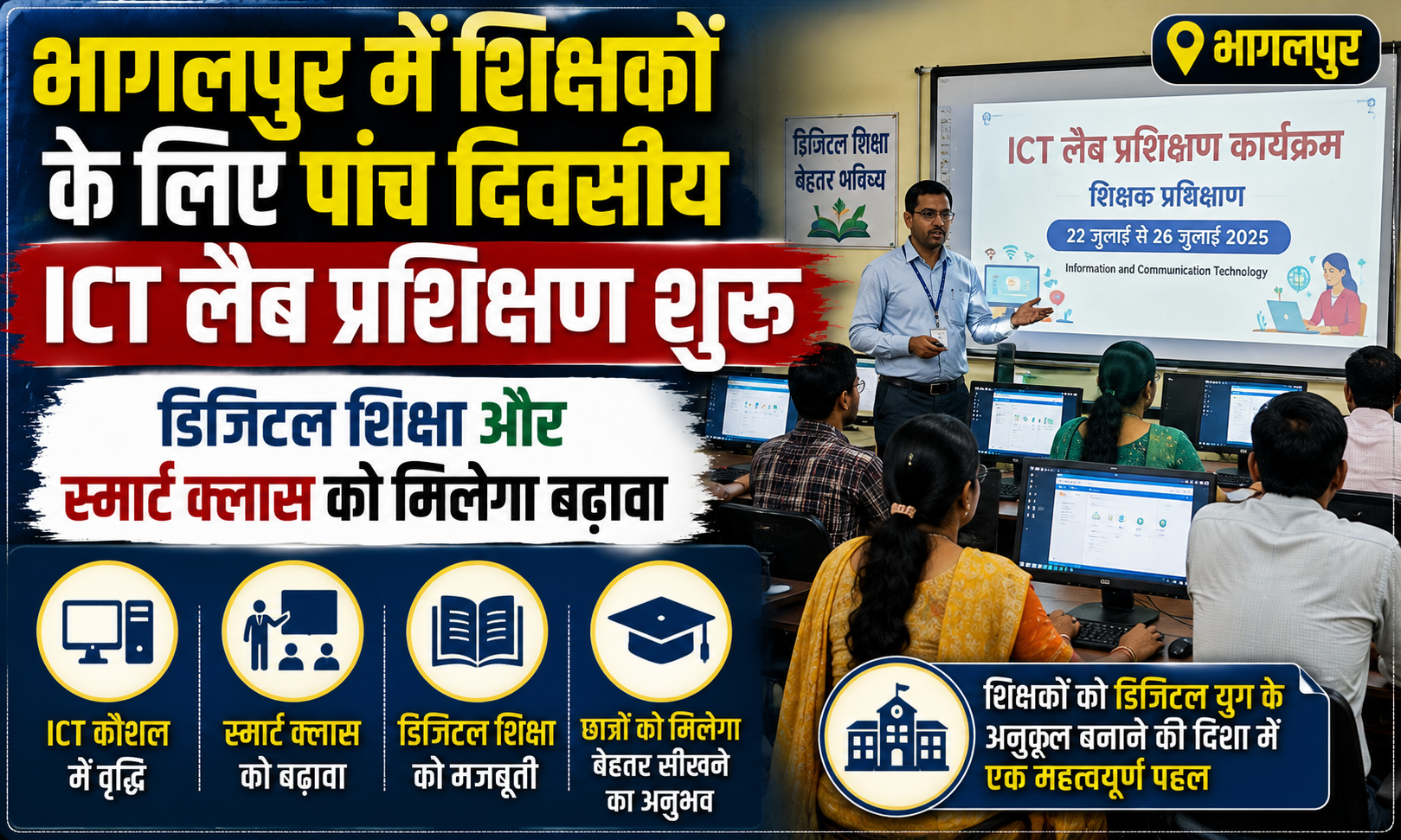
Five-Day ICT Lab Training Program for Teachers Begins in Bhagalpur to Strengthen Digital Education and Smart Classrooms
Bhagalpur: As the education system continues to embrace digital transformation, the use of modern technology in classrooms is becoming increasingly important. In line with this objective, a five-day Information and Communication Technology (ICT) Lab Training Program for teachers commenced on Monday at Jhunjhunwala Adarsh Girls High School in Bhagalpur. The training program is being attended by 38 teachers from 19 schools across the district.
The primary objective of the initiative is to equip teachers with the skills required to effectively use digital technologies in classrooms and to strengthen the implementation of smart classrooms and technology-enabled teaching in government schools.
Education officials believe that the effective use of modern technology will not only improve the quality of teaching but also make learning more engaging, interactive, and effective for students.
An Important Step Toward Digital Education
With the implementation of the National Education Policy (NEP) 2020 and the growing emphasis on digital learning, the role of technology in education has expanded significantly. Traditional chalk-and-board teaching is increasingly being complemented by smart boards, projectors, computers, tablets, and digital learning resources.
The ICT Lab Training Program aims to familiarize teachers with these technologies so they can deliver lessons more effectively and enhance students' understanding of various subjects.
Participation of 38 Teachers from 19 Schools
The five-day training program has brought together 38 teachers representing 19 government schools in Bhagalpur district. These educators are expected to play a key role in promoting digital learning within their respective institutions after completing the training.
Participants will receive practical instruction on modern teaching methods, the operation of digital equipment, and the effective use of online educational resources.
Special Focus on Smart Classroom Management
One of the major components of the program is training teachers in the effective management of smart classrooms. They are being taught how to use projectors, interactive displays, computers, digital boards, and multimedia content to make classroom instruction more engaging.
Education experts believe that visual and audio-based teaching methods improve students' comprehension and make even complex topics easier to understand.
Hands-On Training in ICT Lab Resources
During the training, teachers are receiving practical guidance on using ICT laboratory facilities, including computers, internet resources, educational software, e-learning platforms, and digital content.
The program also covers skills such as creating digital presentations, conducting online quizzes, utilizing virtual learning platforms, managing virtual classrooms, and implementing technology-based student assessments.
Direct Benefits for Students
Education experts believe that the greatest beneficiaries of this initiative will be students. Teachers trained in digital tools will be better equipped to make classroom learning more interactive, engaging, and student-centered.
The use of digital content, animations, educational videos, and interactive teaching materials is expected to improve students' understanding of academic subjects while increasing their interest in learning.
Aligned with the National Education Policy
The National Education Policy (NEP) 2020 places significant emphasis on integrating technology into education. The policy seeks to prepare students for a digitally driven future while encouraging teachers to adopt modern teaching practices.
The ICT training program is considered an important step toward achieving these goals by strengthening technology-enabled education in schools.
Enhancing Teachers' Professional Skills
The training extends beyond technical knowledge and also focuses on developing teachers' professional competencies. Participants are learning how to create interactive, collaborative, and student-focused classroom environments using digital tools.
They are also being trained in developing digital learning materials, maintaining electronic academic records, and using technology to assess students' progress more efficiently.
Preparing Schools for the Future
Education experts believe that the importance of digital learning will continue to grow in the coming years. Therefore, it is essential for teachers to remain updated with emerging educational technologies.
Effective utilization of ICT resources can also help reduce the digital divide between urban and rural schools, ensuring that students across different regions have access to quality technology-enabled education.
Positive Impact on the Education System
Training programs of this nature are expected to bring significant improvements to the quality of education in government schools. As teachers become more digitally competent, students will gain access to better learning experiences supported by modern educational technologies.
The Education Department has been organizing similar training initiatives periodically to help teachers adapt to technological advancements and strengthen classroom teaching.
The five-day ICT Lab Training Program launched at Jhunjhunwala Adarsh Girls High School in Bhagalpur represents an important initiative to promote digital education in Bihar. With 38 teachers from 19 schools participating, the program is expected to strengthen their skills in using digital technologies, managing smart classrooms, and integrating ICT tools into everyday teaching.
The initiative is expected to enhance teachers' technological capabilities while enabling thousands of students in government schools to benefit from more engaging, interactive, and high-quality education. It marks another significant step toward building a stronger, technology-driven education system for the future.


