
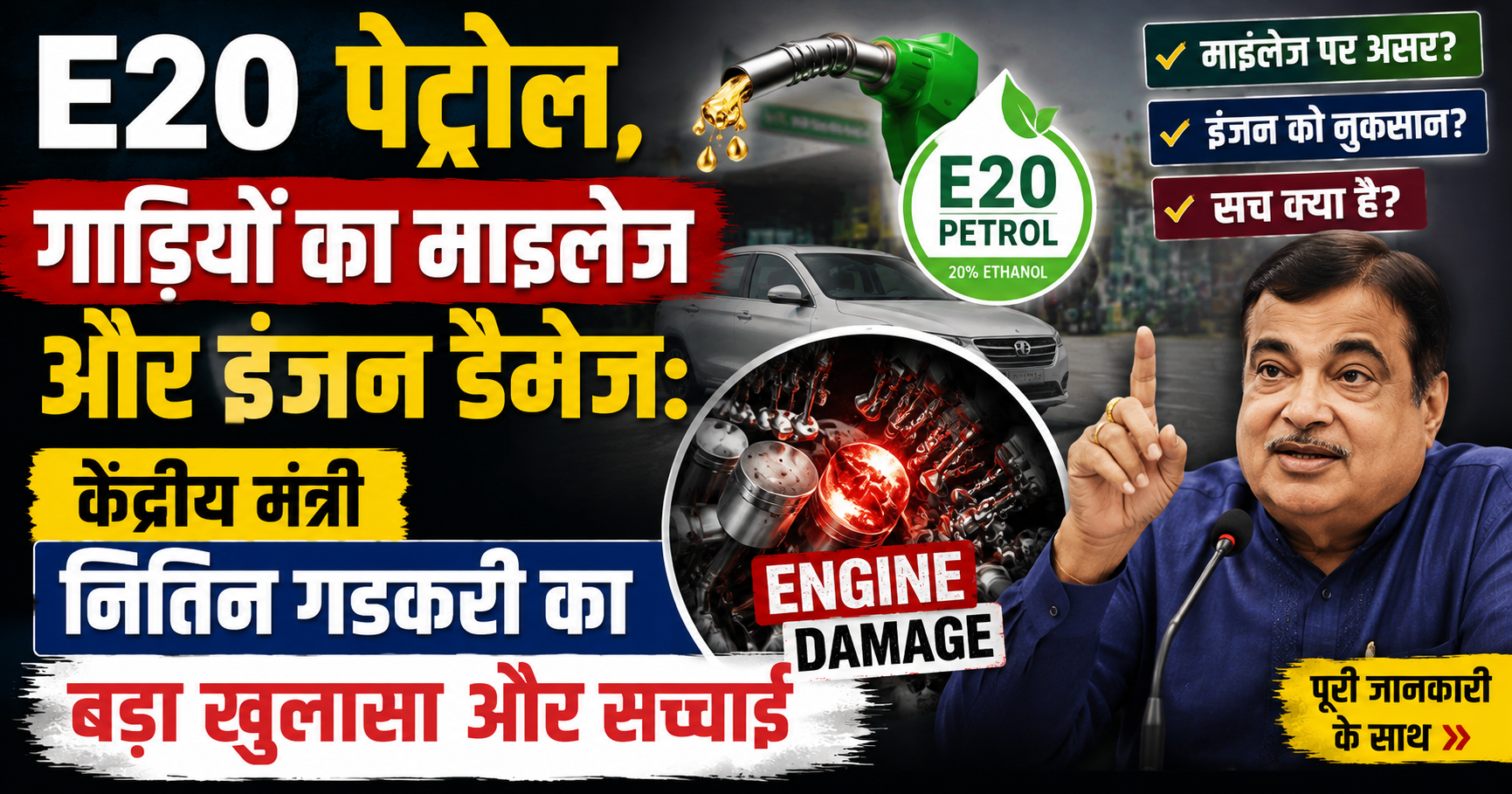
E20 Petrol, Vehicle Mileage, and Engine Damage: Union Minister Nitin Gadkari's Big Revelation and the Truth
Introduction
For some time now, a massive debate has been raging among social media platforms, automotive forums, and everyday drivers. Ever since fuel blended with 20% ethanol, known as E20 petrol, was made mandatory and widely available across the country, vehicle owners have harbored various apprehensions. Continuous claims are circulating on social media suggesting that the use of E20 petrol drastically drops vehicle mileage (fuel efficiency) while prematurely ruining and damaging engines.
Union Minister for Road Transport and Highways, Nitin Gadkari, has issued a sharp and clear statement addressing all these speculations, criticisms, and rumors spreading on social media. Dismissing these claims entirely, he issued an open challenge to critics and skeptics. Let us explore in detail the revelations made by Nitin Gadkari regarding this controversy and the government's policy and plans for both old and new vehicles.
What Did Nitin Gadkari Say About E20 Petrol and Mileage?
Addressing public concerns regarding ethanol-blended petrol, Nitin Gadkari acknowledged that there is a difference in the energy density, or calorific value, between pure petrol and ethanol.
Difference in Calorific Value: The minister clarified that ethanol has a slightly lower calorific value compared to traditional petrol. It is a scientific fact that increasing the ethanol content in fuel can marginally (almost negligibly or very slightly) affect a vehicle's average mileage.
Traffic and Driving Conditions: Gadkari also added that a vehicle's mileage does not depend solely on the type of fuel; it also depends on where and how you drive. In stop-and-go traffic across major metropolises like Delhi and Mumbai, vehicles frequently run in lower gears and require frequent braking, which puts pressure on the engine and naturally reduces mileage. If someone drives at a constant speed on an open highway, the difference becomes negligible.
Open Challenge Regarding Engine Damage Claims
Addressing reports on social media concerning engine seizures or corroded parts, Nitin Gadkari issued a direct challenge to the critics.
Name Even One Vehicle: The minister stated firmly, "Show me the name of even a single car, bike, or scooter in the country that has broken down or suffered an engine failure due to the use of E20 petrol." He noted that the stories being spread on social media are entirely groundless.
Impact of Paid Campaigns and Lobbies: Gadkari alleged that a deliberate narrative is being manufactured against the successful rollout of E20 and green fuels. This may be driven by vested interests or a so-called petroleum lobby attempting to undermine indigenous fuel policies.
Rigorous Testing: The government did not launch E20 nationwide without due diligence. Before implementation, rigorous tests exceeding 100,000 kilometers were conducted on various vehicles by research teams from the Automotive Research Association of India (ARAI), the Indian Institute of Petroleum (IIP), and oil companies. These tests established metal and plastic compatibility and proved there are no abnormal adverse effects on engines.
What is the Plan for Older Cars and Non-Compliant Vehicles?
The government and automakers have also clarified their preparations regarding the maintenance of older models or vehicles purchased years ago that are not directly E20-calibrated:
Replacements During Servicing: Original Equipment Manufacturers (OEMs) have been instructed that during regular servicing of older vehicles, if any minor rubber or plastic component coming into contact with ethanol (such as fuel hoses or gaskets) shows minor wear, it should be upgraded or replaced.
Minimal Impact and Tuning: According to the Ministry of Petroleum and automotive experts, if older vehicles experience a slight mileage variation of 3% to 6%, it can be easily managed through timely engine tuning and standard maintenance. All new vehicles manufactured in the country since April 2023 are built to be fully E20-compatible.
Future of Flex-Fuel Technology: Keeping future requirements in mind, the government is rapidly promoting flex-engine technology. Flex-fuel vehicles can easily run on any blend of ethanol and petrol (ranging from E20 up to E85 or E100) without any loss in efficiency.
Why is Ethanol an Essential Alternative for India?
Nitin Gadkari did not just defend the policy; he also highlighted its major economic and strategic benefits:
Foreign Exchange Savings: India imports a vast majority of its energy and crude oil needs, spending roughly 22 trillion rupees annually. Ethanol blending is significantly reducing this import bill.
Boost to Farmers' Income: Apart from sugarcane, ethanol is now being produced from maize and other grains. Maize-based ethanol production provides farmers with better crop prices, yielding tens of billions of rupees in extra profits for maize-producing states like Uttar Pradesh and Bihar.
These statements by Union Minister Nitin Gadkari and official tests clarify that reports of E20 vehicle engines breaking down overnight are an exaggerated myth or propaganda. Although minor mileage variations (1% to 2% in new vehicles and 3% to 6% in older vehicles) are natural due to differences in calorific value, they can be managed with proper maintenance and tuning. This program is part of the government's long-term, secure foresight for national interest, environmental protection, and farmers' prosperity.


