
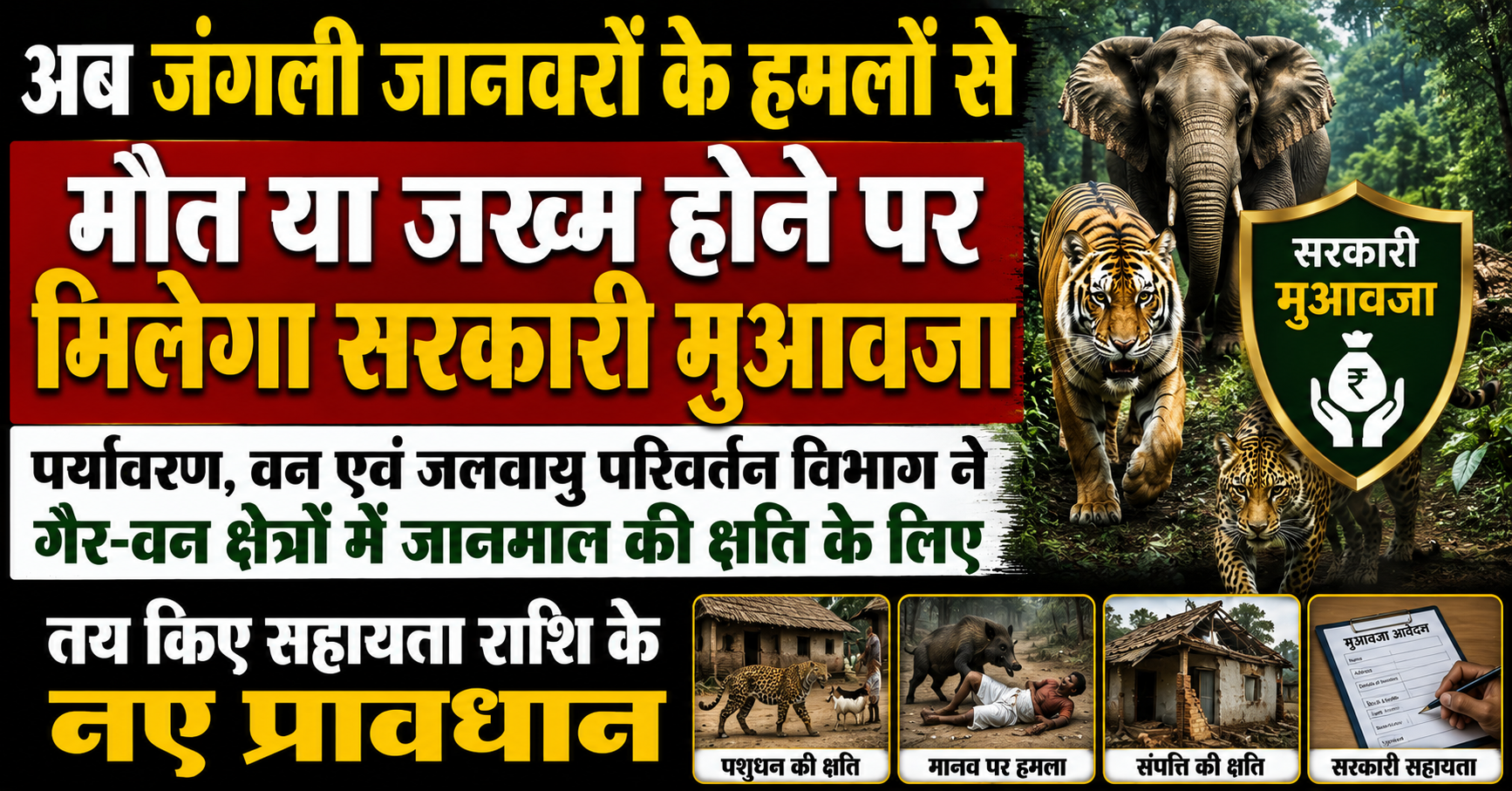
Department of Environment, Forest and Climate Change Fixes New Provisions for Financial Assistance for Loss of Life and Property in Non-Forest Areas
In the rural and semi-urban areas of Bihar, incidents of wild animals (such as nilgai, wild boars, jackals, or other wildlife) straying from forests into residential areas and attacking humans and damaging crops have been continuously rising over the past few years. In such incidents, ordinary citizens frequently have to lose their lives or suffer severe injuries. Understanding the gravity of this problem, very relieving news has emerged for affected families.
Now, in Saharsa and across the entire Bihar, affected families will receive financial compensation from the government in the event of death or injury caused by wild animal attacks. The Department of Environment, Forest and Climate Change has explicitly and comprehensively laid down provisions for financial assistance for loss of life and property specifically in non-forest areas. This policy will prove to be a major source of support for rural regions where forest boundaries end, but the movement of wildlife continues persistently. Let us analyze in detail the various aspects of this new provision, the framework of compensation, administrative procedures, and its far-reaching impacts.
Background: Why Did the Demand for Compensation in Non-Forest Areas Arise?
Traditionally, provisions for compensation upon suffering losses caused by wildlife within or around forest areas had been in place for a long time, but due to administrative complexities and technicalities of rules, victims of accidents occurring in non-forest areas (such as fields, villages, or towns) were forced to run from pillar to post.
Rising Human-Wildlife Conflict: Due to deforestation, expansion of human settlements, and shrinking natural habitats, wildlife often turns toward villages in search of food and water.
Vulnerable Rural Population: In several rural belts of Saharsa district, incidents of farmers and passersby being attacked by nilgai and other wild animals have frequently been a topic of discussion. In such cases, there was an absence of any solid compensation policy to deal with the sudden financial crisis arising before poor families, which the department has now addressed.
Key Provisions of the Compensation Policy: How Much Assistance for Loss of Life and Property?
According to the new guidelines issued by the Department of Environment, Forest and Climate Change, clear financial assistance amounts have been prescribed for losses occurring in non-forest areas:
Ex-Gratia Amount in Case of Death: If any person dies due to a wild animal attack in a non-forest area, their dependent family will be provided a fixed and substantial economic assistance amount (ex-gratia grant under standard rules) by the government, so that the family receives financial support to tide over this sudden shock.
Assistance in Case of Grievous Injury: If any person sustains grievous injury in a wild animal attack, compensation will be provided by the department for hospital expenses and medical treatment. Separate provisions have been made for cases of permanent disability or severe physical damage, ensuring that the burden of the victim's treatment does not fall upon their family.
Ordinary Injury and Loss of Crops/Property: Furthermore, the path has been paved for providing assistance to affected farmers based on the assessment of ordinary injuries and agricultural crop damage caused by wildlife.
Application Process and Formalities for Compensation
To ensure that the benefit of this scheme easily reaches actual victims, the department has issued instructions to streamline the administrative process.
Information at Local Level: In the event of an incident, affected families or local villagers must immediately inform the local forest department (Range Office) or district administration officials.
Investigation and Verification: An investigation of the incident will be jointly conducted by forest department officials and local police/administration, certifying that the attack was indeed perpetrated by a wild animal in a non-forest area.
System of Swift Payment: Upon the preparation of the verification report and completion of prescribed administrative formalities, the compensation amount will be transferred directly into the victim's bank account, maintaining transparency.
Social and Practical Significance of This Initiative
The implementation of this new provision in Saharsa and surrounding regions has conveyed a positive message to the general public.
Mental Security for Farmers and Villagers: Farmers working in fields who often felt insecure due to the fear of wild animal attacks will now be able to rest assured that if any untoward incident occurs, the government stands with them.
Administrative Sensitivity in Changed Circumstances: This step demonstrates that the government is fully alert and sensitive toward the security and rights of ordinary citizens residing near settlements, and not just inside forests.
The provision of compensation even in non-forest areas for death or injury caused by wild animal attacks across Saharsa district and the entire state is a highly welcome and commendable step by the Department of Environment, Forest and Climate Change. Rectifying this anomaly that persisted for three decades or a long time, the department has granted a massive legal and economic cushion to affected families. Now, what is required is a widespread dissemination of this scheme at the grassroots level so that ordinary people in rural areas can avail of this government assistance without any hassle during any accident and find support amid this era of human-wildlife conflict.


