
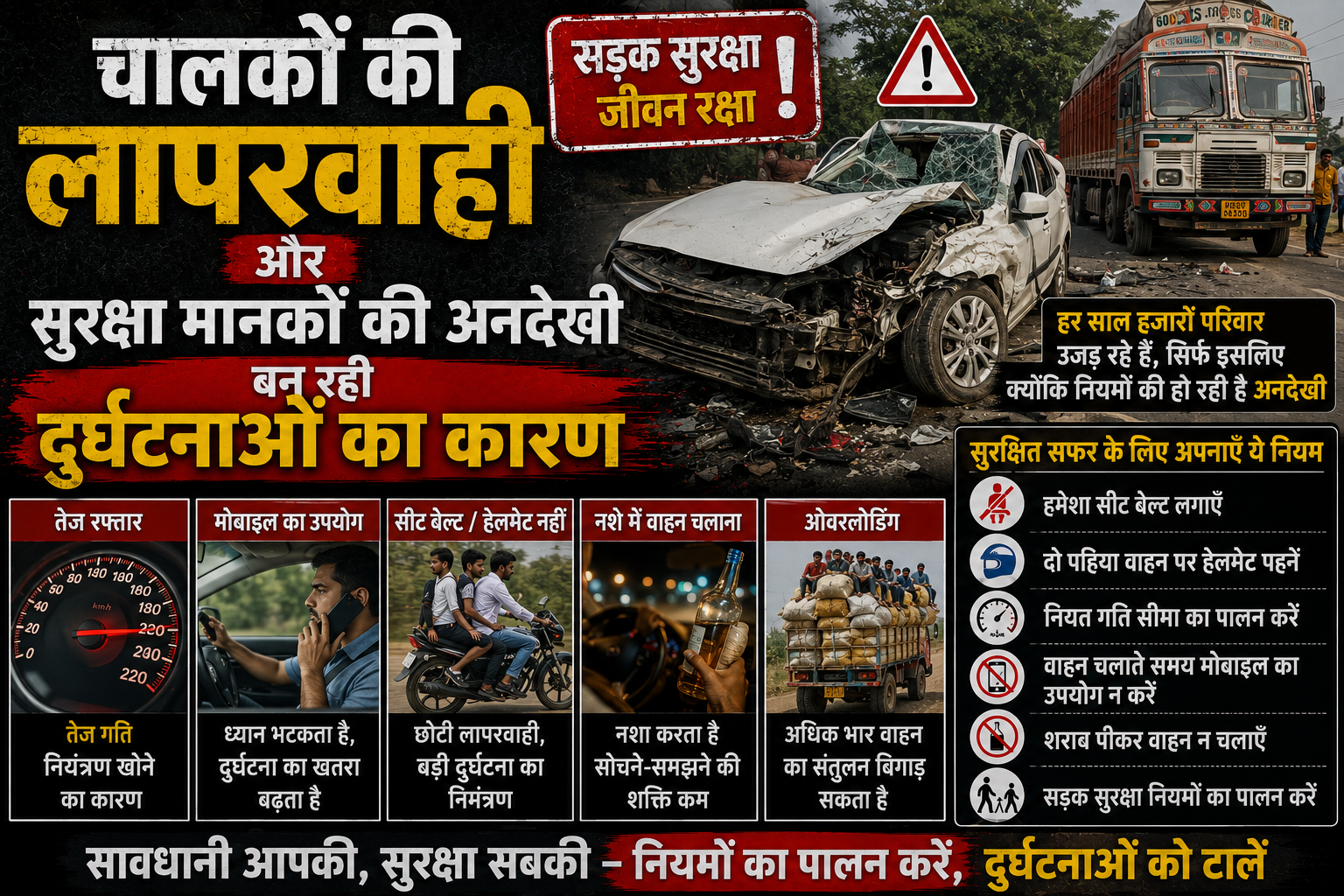
'Death' Racing on Highways — Driver Negligence and Ignoring Safety Standards Are Fueling Accidents
National Highways are the arteries of progress for any region. However, the national highways in our district are transforming from paths of development into 'death traps.' The road accidents occurring on these highways day after day are not only claiming precious lives but are shattering families forever. Recent data and studies make it clear that a lethal mix of human negligence and flaws in the safety system is responsible for these accidents.
Key Causes of Accidents: An Analysis
1. Driver Negligence and Indiscipline
The most significant cause of accidents is human error. Negligence displayed by drivers while on the highway puts everyone's life at risk:
Over-speeding: In a race to reach their destinations quickly, most drivers ignore speed limits. Losing control of a vehicle at high speeds is the most common cause of accidents.
Violation of Traffic Rules: Habits such as failing to follow lane driving, driving on the wrong side, and applying sudden brakes invite major disasters.
Fatigue and Sleep: Drowsiness or driving while exhausted during long-distance journeys often proves fatal.
2. Merging Traffic from Local Roads
A serious issue on the district’s highways is vehicles entering the NH from local link roads.
Often, local drivers steer their vehicles directly onto the highway without any caution or checking the flow of traffic.
Drivers of heavy vehicles coming at high speeds on the highway do not get a chance to control their vehicles when others suddenly appear in front of them, leading to horrific collisions.
The lack of proper signage and speed-control 'rumble strips' at these entry-exit points exacerbates the problem.
3. Lack of Safety Standards
Infrastructure deficiencies also contribute significantly to accidents:
Poor Road Design: Many locations feature 'blind curves' without proper warning signs.
Lack of Lighting: At night, the absence of sufficient lighting on highways makes stalled vehicles or pedestrians invisible.
Unauthorized Cuts: Illegal cuts made by locals in the middle of the highway often become major hubs for accidents.
The Role of Administration and Departments
To curb accidents, the administration needs to tighten its enforcement:
Intensive Checking Drives: Traffic police should not just check for helmets and seatbelts but must impose heavy fines for over-speeding and wrong-side driving.
Highway Patrolling: There should be a constant presence of highway patrol vehicles to provide immediate assistance and manage traffic during accidents.
Awareness Campaigns: Workshops and road safety awareness camps should be organized periodically for drivers.
Solutions and Suggestions: The Way Forward
Engineering Improvements: 'Acceleration and deceleration lanes' should be constructed at all junctions. Speed breakers or rumble strips should be mandatory to control vehicle speed before entering the highway.
Strict Law Enforcement: Adopting a 'zero-tolerance' policy, authorities should initiate the cancellation of licenses for drivers who break rules.
Modern Technology: CCTV cameras and radar speed-measuring systems should be installed at 'black spots' on highways to maintain fear through e-challans.
Community Cooperation: It is vital to educate villagers living along the NH about road safety so they keep themselves and their livestock away from the highway.
Accidents on national highways are not just statistics; they are a collective failure of our society. A single act of negligence by one driver endangers the safety of the entire highway. If we are to make our highways safe, drivers must realize their responsibility, and the administration must demonstrate strictness.


