
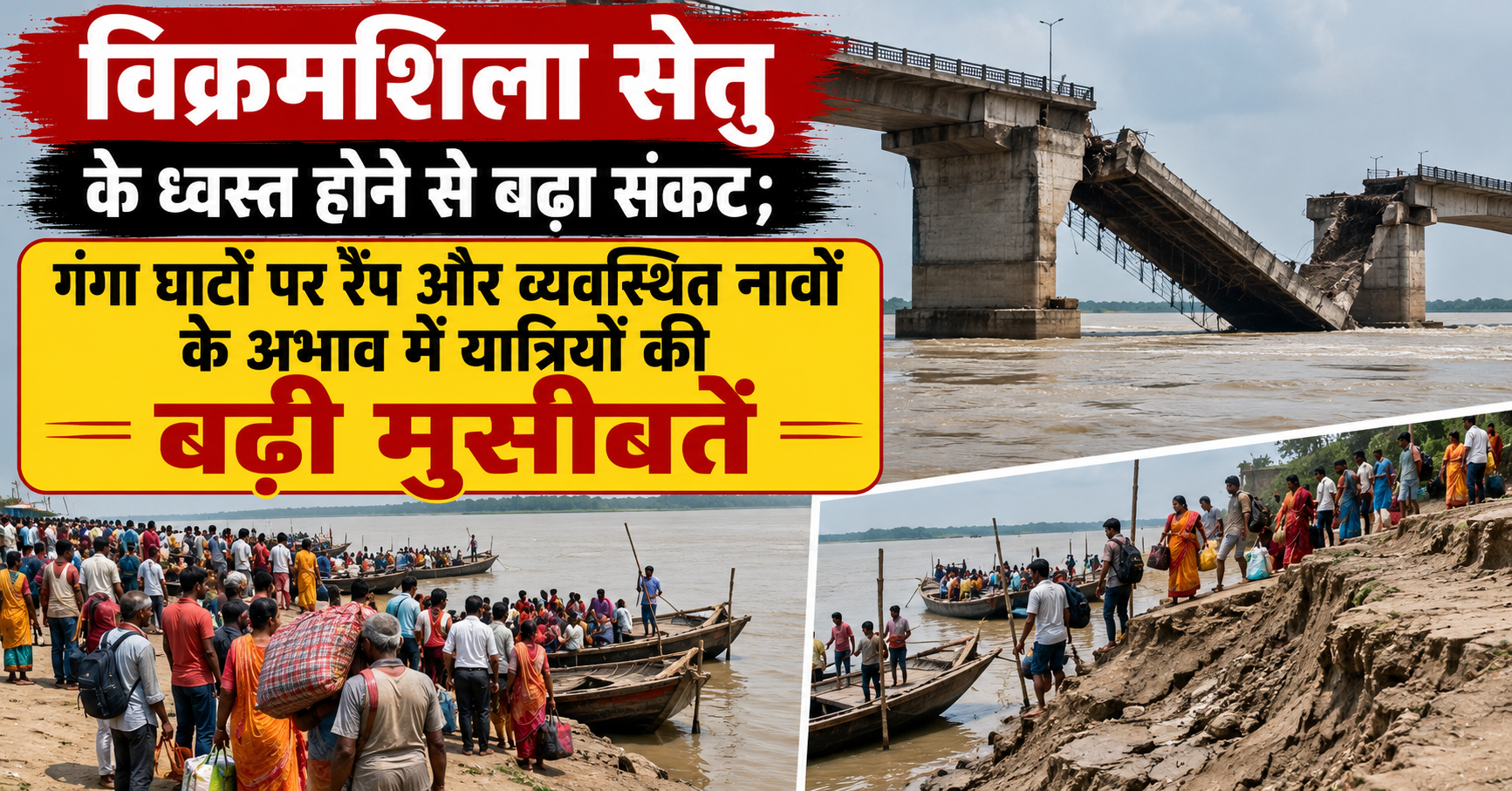
Crisis Deepens Following Vikramshila Setu Collapse; Lack of Systematic Ramps at Ganga Ghats Adds to Commuters' Woes
BHAGALPUR: The crisis surrounding the Vikramshila Setu—the lifeline connecting Bhagalpur and Naugachia—has now taken the form of a major disaster. Ever since a large concrete slab near Pillar No. 133 collapsed into the Ganga in early May 2026, traffic on this bridge has been completely halted. While the administration has implemented alternative arrangements since the bridge's closure, the lack of basic infrastructure at the Ganga ghats, particularly the absence of systematic ramps and sufficient ferry services, has made life miserable for common citizens and commuters alike.
The Dire Situation Following the Collapse
When a section of this 4.7-kilometer-long bridge fell into the Ganga late on the night of May 4, 2026, panic gripped the entire region. Fortunately, due to the administration's vigilance, people were evacuated in time, preventing any loss of life. However, this incident has effectively severed the main link between North and South Bihar. Now, people traveling from Bhagalpur to Naugachia are forced to rely on boats to cross the Ganga, but the conditions at the ghats are worsening by the day.
Severe Lack of Facilities at Ganga Ghats
The pressure on the Ganga ghats has surged suddenly since the bridge collapse. The current situation is as follows:
Absence of Ramps: There are no systematic ramps or paved pathways to reach the boats at most of the ghats. Due to slippery mud and sludge, the elderly, the sick, and schoolchildren face immense difficulty in boarding the boats.
Safety Measures Missing: Amidst the heavy crowds, there is a visible lack of adequate safety measures during boat operations. To manage the sudden influx of people, there is neither sufficient lighting at the ghats nor any trained personnel on duty.
State of Disarray: Due to the shortage of boats, people are forced to wait for hours. Often, boats are loaded beyond their capacity, creating a constant fear of an accident.
Commuters' Agony: Impact on Duty and Health
The closure of the bridge has hit those the hardest who commute between the two sides for daily tasks. Many individuals, such as teacher Pooja Kumari, who used the bridge daily for work, are now forced to either take leaves or risk their lives traveling by boat.
Commuters argue that the administration closed the bridge as a precautionary measure but has only done the bare minimum in the name of "alternative arrangements." Neither has the number of boats increased at the ghats, nor have any ramps been constructed to ease the journey.
Administrative Apathy and Traffic Burden
The closure of the Vikramshila Setu has not only placed a burden on the Ganga ghats but also on alternative routes. Massive traffic jams are common at both ends of the bridge. Often, instead of being stuck in jams near the bridge, commuters are forced to cover long distances on foot.
The administration claims that the situation is being closely monitored and that possibilities for repairing the bridge are being explored, but public anger is mounting. The citizens' primary demands include:
Construction of Systematic Ramps: Paved ramps should be built at all major Ganga ghats so that the public can reach the boats easily.
Safe and Sufficient Ferries: The number of large and safe boats for operations should be increased.
Traffic Management: Deployment of police forces around the ghats should be increased to control traffic congestion.
A Call for Solutions
The collapse of the Vikramshila Setu is not merely a technical failure but a consequence of neglecting basic infrastructure. Until the bridge is restored, the Ganga ghats remain the only viable link. The administration must realize that the disarray at the ghats and the lack of ramps are invitations to a major tragedy. The people of Bhagalpur are no longer satisfied with mere assurances; they demand immediate, safe, and systematic alternative arrangements.


