
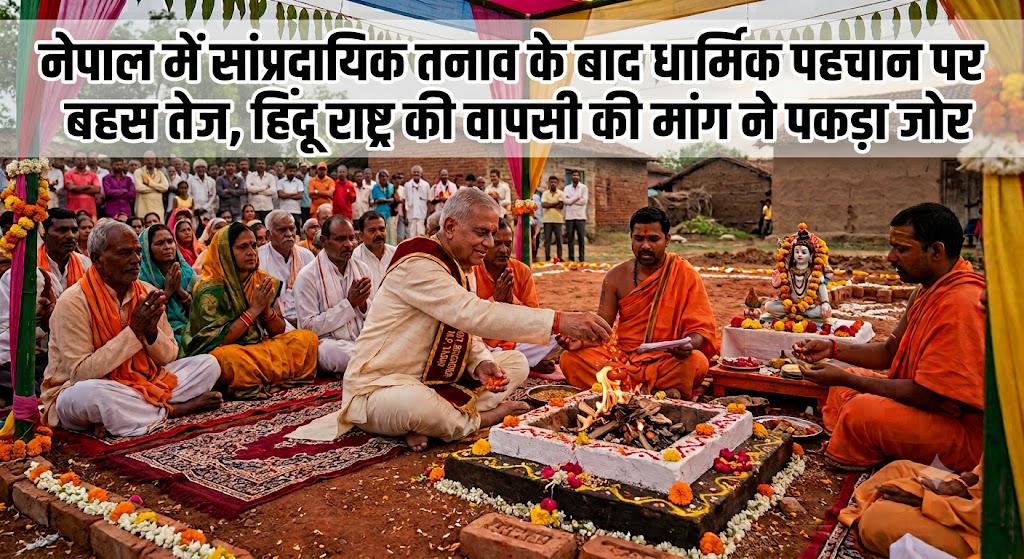
Calls for Restoration of Hindu State Grow After Communal Violence in Sunsari
Kathmandu: Following recent communal tensions in Nepal's Sunsari district, debate over religious identity, conversion and the activities of foreign religious organizations has intensified. Some Hindu and nationalist groups and political leaders have renewed their demand for Nepal to be declared a Hindu state again.
Supporters of the demand argue that Nepal's historical and cultural identity should be protected through a Hindu-state framework. On the other hand, supporters of the secular system link the issue to religious freedom and constitutional rights.
The recent developments have once again placed the relationship between religion and politics at the center of public debate in Nepal. However, allegations surrounding communal violence or any particular community should not automatically be generalized to an entire religious group. Nepal has long been a country of religious and ethnic diversity, and the current debate is largely about finding a balance within that diversity.
Nepal Was a Hindu State Until 1990
Nepal remained officially a Hindu state for a long period. Until 1990, Hinduism held a special position within the country's political system and state structure. The country's public identity was closely associated with Hindu traditions.
The 1990 People's Movement brought major political changes to Nepal. With the establishment of multiparty democracy, the country began a process of restructuring its political and social institutions.
Following these changes, debates over religious freedom, democratic rights and social equality became increasingly prominent. Nepal gradually moved toward a political system in which the state was expected to provide equal rights to citizens rather than being identified with a particular religion.
Secular System After 2006-07
Following Nepal's major political transformation in 2006-07, secularism became part of the country's formal political framework. Citizens gained greater freedom to practice their religions.
Under the secular system, different religious communities received greater space to conduct their religious activities. The social environment surrounding personal religious choices and conversion also became more open than before.
During the same period, the activities of various non-governmental organizations, social institutions and religious organizations expanded. Some organizations received foreign assistance, leading to periodic political debates about the relationship between foreign funding and religious activities.
Debate Over Missionary Activities
The growing presence of Christian missionary activities in Nepal has been a concern raised by some nationalist and Hindu organizations. These groups allege that certain foreign-supported organizations are involved in religious activities alongside social services.
However, not all such allegations can be treated as established facts. A number of non-governmental and religious organizations in Nepal also work in areas such as education, healthcare, disaster relief and social welfare.
Religious conversion remains a sensitive political issue in Nepal. Therefore, any allegations concerning an organization's activities need to be examined through independent investigation and legal procedures.
Political Environment Changed After Maoist Movement
Nepal's Maoist movement and the political changes that followed had a major impact on the country's social and political structure. With the end of the monarchy and the establishment of a republic, the relationship between the state and religion also became the subject of extensive debate.
Former National Liberation Party central spokesperson and Madhesi leader Raman Pandey has claimed that activities associated with the Christian community increased during the Maoist movement and subsequent political changes.
According to him, activities of foreign church organizations also became more visible during the political transition. However, such claims require assessment against independent and official data before broader conclusions can be drawn.
Claims About Demographic Changes
Supporters of restoring Nepal as a Hindu state argue that changes in the country's religious demographics could affect its traditional identity.
Some groups claim that the growth of the Christian population and religious conversion are changing the country's social balance. They are using these arguments to mobilize support for the restoration of Nepal's Hindu-state status.
However, changes in religious demographics should be assessed using official census data and reliable statistics. It would not be appropriate to draw conclusions about the religious composition of the entire country based on an isolated local incident.
Political Activity Increases After Communal Tensions
Following the incident in Sunsari, religious organizations and nationalist groups are reportedly becoming more active. Such groups are calling for greater government monitoring of religious activities and the role of foreign organizations.
Supporters of secularism, however, argue that religious communities that operate within the law should not be viewed with suspicion solely because of their religious identity.
Nepal's Constitution provides citizens with religious freedom and equality. Therefore, any action against a religious organization or individual should be based on applicable law.
Arguments Behind the Hindu-State Demand
Organizations calling for the restoration of a Hindu state put forward several arguments. They say Nepal's historical, cultural and religious identity has long been associated with Hindu traditions.
They also argue that Hinduism has been an important foundation of Nepal's social traditions, festivals, temples and cultural life. For this reason, nationalist groups are seeking the restoration of Nepal's Hindu-state identity.
Some nationalist organizations believe that such a change could help control what they describe as growing foreign religious influence.
Different View of Secularism Supporters
Supporters of Nepal's secular system take a different position. They argue that in a modern democratic state, citizens' identities and rights should not be determined by religion.
Nepal is home to Hindu, Buddhist, Muslim, Christian and other religious communities. Supporters therefore view secularism as a mechanism for ensuring equal constitutional rights for all communities.
They argue that if an organization violates the law, action should be taken against it, but an entire community should not be held responsible for the actions of particular individuals or organizations.
Discussion Around the Muslim Population
Recent political discussions have also included claims by some nationalist groups concerning Nepal's Muslim population and alleged external influence. However, claims describing a community as being involved in “infiltration” should not be presented as facts without credible official evidence.
Nepal shares borders with several countries, and social and economic movement across border regions is a normal phenomenon. Border security, citizenship and illegal immigration are separate administrative and legal issues.
These matters need to be addressed through evidence, law and administrative procedures rather than through religious identity.
Demand for Monitoring Foreign Organizations
Nationalist and Hindu organizations are also calling for greater transparency in the activities of foreign-funded non-governmental organizations and religious institutions.
They argue that authorities should regularly monitor how foreign funding is being used. If an organization operates in the fields of education, healthcare or social welfare, its sources of funding and activities should remain transparent.
Social organizations, on the other hand, argue that not every foreign-supported organization should be viewed with suspicion. Organizations operating legally should be allowed to carry out their work.
Challenge of Religious Freedom and Social Harmony
One of Nepal's major challenges is maintaining a balance between religious freedom and social harmony.
Individuals should have the freedom to practice their faith, while allegations of forced or unlawful religious conversion should also be investigated impartially.
Similarly, those responsible for communal violence should face legal action, but collectively blaming an entire community could further increase social tensions.
Potential Political Impact
The demand to restore Nepal as a Hindu state could influence political debates in the coming period. If the issue gains broader public or political support, political parties may also be required to clarify their positions.
However, Nepal's current constitutional system is secular, and any major change would require the appropriate constitutional and political process.
Restoring Hindu-state status would therefore not simply be a religious decision. It would involve significant constitutional, political and social considerations.
The renewed debate over religious identity and the restoration of a Hindu state following communal tensions in Sunsari reflects Nepal's evolving political environment.
Nepal's historical Hindu identity, the democratic movement of 1990, the political transformation of 2006-07 and the subsequent establishment of a secular system have all shaped the country's current social structure.
Questions concerning missionary activities, religious conversion and foreign organizations should be investigated on the basis of evidence and law. Similarly, claims regarding Muslim communities or alleged “infiltration” should be assessed using credible official evidence.
Supporters of restoring Nepal as a Hindu state see the issue as one of protecting cultural identity, while supporters of secularism view it as a matter of equal citizenship and religious freedom.
The extent to which this issue influences Nepal's future politics will depend on the debate among political parties, civil society and the public.
Most importantly, communal tensions should be addressed through law, impartial investigation and dialogue, while collective accusations against any religious community should be avoided. Such an approach can help protect social harmony and strengthen Nepal's democratic institutions.


