
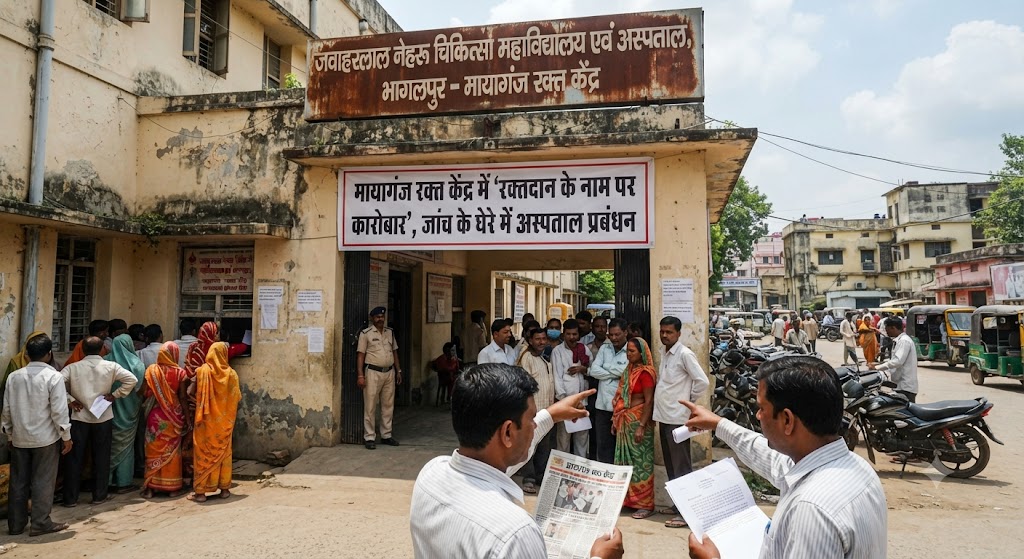
'Business in the Name of Blood Donation' at the Blood Center; Hospital Management Under Scanner
Bhagalpur: The Jawaharlal Nehru Medical College and Hospital (JLNMCH), locally known as 'Mayaganj Hospital,' has been shamed once again. The network of brokers (dalals) has re-emerged within the hospital’s blood center, which was established to save the lives of patients. Reports indicate that an organized gang of brokers is active in the vicinity of the blood center, extorting money from the relatives of needy patients in the name of providing blood.
What is the Whole Issue?
According to hospital sources, the broker gang targets the relatives of patients who require blood urgently in emergency situations. When a desperate relative goes to the counter, they are often turned away with excuses like "blood shortage" or "it will take time for processing." Meanwhile, brokers lurking within the hospital premises approach them and 'promise' to arrange blood in exchange for a hefty sum of money.
The involvement of some low-level hospital staff in this entire game cannot be ruled out, as brokers receive instant information regarding which blood group is in demand and which relatives are in distress.
The Alarming Modus Operandi
This network of brokers operates with extreme cunning:
Misleading Relatives: Brokers take the disappointed relatives away from the counter and instill fear by highlighting the flaws in the hospital's system.
Illegal Extortion in the Name of Blood: Brokers are charging between ₹2,000 to ₹5,000 per unit of blood from poor families, whereas, according to government regulations, the processing fee for blood is nominal.
Collusion of Middlemen: These brokers often remain active inside the hospital itself, leading patients to believe they are affiliated with the hospital administration, causing them to pay without hesitation.
Administrative Silence and Systemic Failure
The problem of blood shortage at Mayaganj Hospital is not new, but this 'trade of blood' has raised serious questions about the efficiency of the administration. For years, the hospital management has claimed that "there is no shortage of blood," yet how do these brokers remain active?
Senior doctors state that brokers often bring donors in the name of 'voluntary blood donation,' but in reality, they either force the relatives themselves to become donors or bring in donors from outside to extort money from them. This entire process is not only unethical but also against the fundamental objectives of healthcare services.
Questions on Security and Transparency of the Blood Center
While many claims are made about CCTV cameras in the hospital's blood bank, the unchecked movement of brokers proves that security arrangements are limited only to paper.
Lack of Surveillance: The role of security personnel stationed near the blood bank is also under a cloud of suspicion.
Data Management: Stock reports for blood are not displayed transparently, which gives brokers the opportunity to lie that "the stock is empty."
Demands for Action and Future Challenges
The surfacing of this issue has caused a stir in the hospital administration. Representatives of civil society have submitted a memorandum to the Hospital Superintendent, demanding that:
Police deployment around the blood center should be increased.
A 'Token System' and a 'Blood Availability Display Board' should be made mandatory for relatives coming to collect blood.
The broker network must be identified, and legal action should be taken against them.
The Hospital Superintendent has acknowledged the matter and assured the formation of an investigation committee. However, the big question remains: will this investigation be limited to files, or will this broker network truly be dismantled?
A Blot on Humanity
Blood donation is considered the greatest act of charity, but at Mayaganj Hospital, it has been turned into a 'business.' When a poor patient is struggling between life and death, the activity of such brokers is a blot on humanity. The Mayaganj Hospital administration must understand that if they fail to stop this 'Broker-Raj,' the common public will lose all faith in the government healthcare system.


