
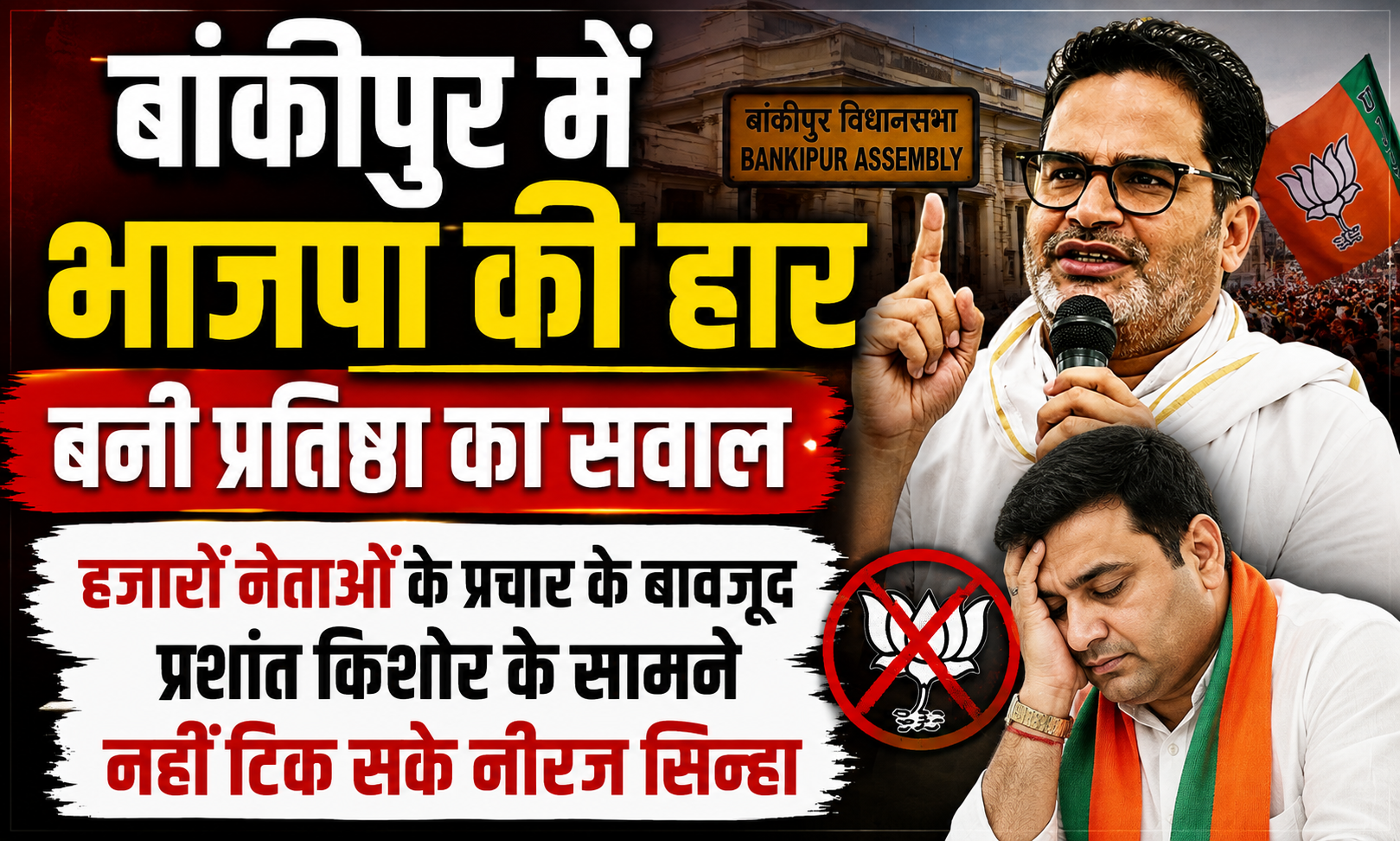
BJP's Defeat in Bankipur Seen as a Major Prestige Setback; Neeraj Sinha Falls Short Against Prashant Kishor Despite Massive Campaign
Patna: The outcome of the Bankipur Assembly by-election, one of the most closely watched electoral contests in Bihar's capital, has sparked fresh political debate across the state. While Jan Suraaj founder Prashant Kishor's victory is being viewed as a significant political milestone, the Bharatiya Janata Party's (BJP) defeat is widely being seen as a setback to the party's political prestige. Political analysts believe the BJP attached considerable importance to retaining the seat and mobilized its organizational machinery extensively during the campaign. Despite those efforts, party candidate Neeraj Sinha was unable to defeat Prashant Kishor.
Following the election results, political circles have been discussing the broader implications of the BJP's loss in such an important constituency. However, analysts also note that electoral outcomes are influenced by multiple political, social, and local factors, and should be assessed within a broader political context.
A High-Stakes Electoral Contest
From the beginning, the Bankipur by-election was viewed as a high-profile political battle. Located in the heart of Patna, the constituency attracted significant attention from all major political parties. The BJP deployed senior leaders, office-bearers, and grassroots workers throughout the campaign and organized extensive outreach efforts down to the booth level.
Political observers say the scale of the campaign reflected the party's determination to retain the constituency. Despite the extensive mobilization of resources and organizational strength, the final verdict did not match the party's expectations.
Prashant Kishor's Campaign Strategy Proved Effective
Throughout the campaign, Prashant Kishor focused on issues such as development, accountability, transparent governance, education, healthcare, employment, and solutions to urban civic problems. He repeatedly promised to transform Bankipur into a model Assembly constituency and maintained continuous engagement with local residents.
Political analysts believe that his emphasis on constituency-specific issues resonated with many voters. His political identity, campaign messaging, and organizational strategy also remained key talking points throughout the election.
BJP Candidate Failed to Gain Expected Support
Although BJP candidate Neeraj Sinha actively campaigned across the constituency, the election results fell short of expectations. The outcome has led to discussions over whether the party's large-scale campaign was sufficient to persuade voters.
Political experts argue that an extensive campaign alone does not guarantee electoral success. Factors such as a candidate's local acceptance, constituency-specific issues, voter priorities, and the overall political environment also play crucial roles in determining election outcomes.
Changing Preferences of Urban Voters
Bankipur is one of Patna's prominent urban constituencies, with a large population of educated voters, professionals, business owners, and middle-class residents. During the campaign, issues such as roads, traffic management, drainage, employment, education, healthcare, and civic infrastructure dominated public discourse.
Political observers believe that urban voters are increasingly placing greater emphasis on development, governance, and administrative performance. As a result, local civic issues became central themes of the election campaign.
An Opportunity for BJP to Review Its Strategy
Political analysts suggest that the Bankipur by-election provides the BJP with an opportunity to reassess its organizational structure and electoral strategy. The party is expected to evaluate the factors behind the disappointing result and explore ways to strengthen its position in urban constituencies.
Such a review may include examining candidate selection, grassroots organization, campaign strategy, and methods of voter outreach.
Important Lessons for the Opposition as Well
The result carries important lessons not only for the BJP but also for other political parties. The election demonstrated that voters are increasingly paying attention to local development, effective leadership, and public accountability.
Political parties may need to recognize that traditional electoral calculations alone are no longer sufficient. Understanding voter expectations and addressing local concerns are becoming equally important for electoral success.
Possible Impact on Future Assembly Elections
The outcome of the Bankipur by-election could influence campaign strategies for the upcoming Bihar Assembly elections. Political parties are expected to analyze the verdict carefully while deciding candidate selection, campaign priorities, and policy messaging.
Development, employment, education, healthcare, urban infrastructure, and transparent governance are likely to become even more prominent themes in future election campaigns.
A Sign of Changing Political Trends
According to political observers, the Bankipur by-election suggests that voter priorities in Bihar are gradually evolving. Particularly in urban constituencies, voters appear to be placing greater emphasis on candidates' performance, credibility, and long-term vision rather than relying solely on traditional political considerations.
If this trend continues, political parties may need to substantially revise their electoral strategies for future contests.
The Bankipur Assembly by-election has delivered several significant political messages. Prashant Kishor's victory has strengthened his political position in Bihar, while the BJP's defeat is likely to prompt internal review and strategic reassessment. The election also reinforces the principle that in a democracy, the final decision rests with the voters, who evaluate political parties and candidates based on their own priorities and expectations.


