
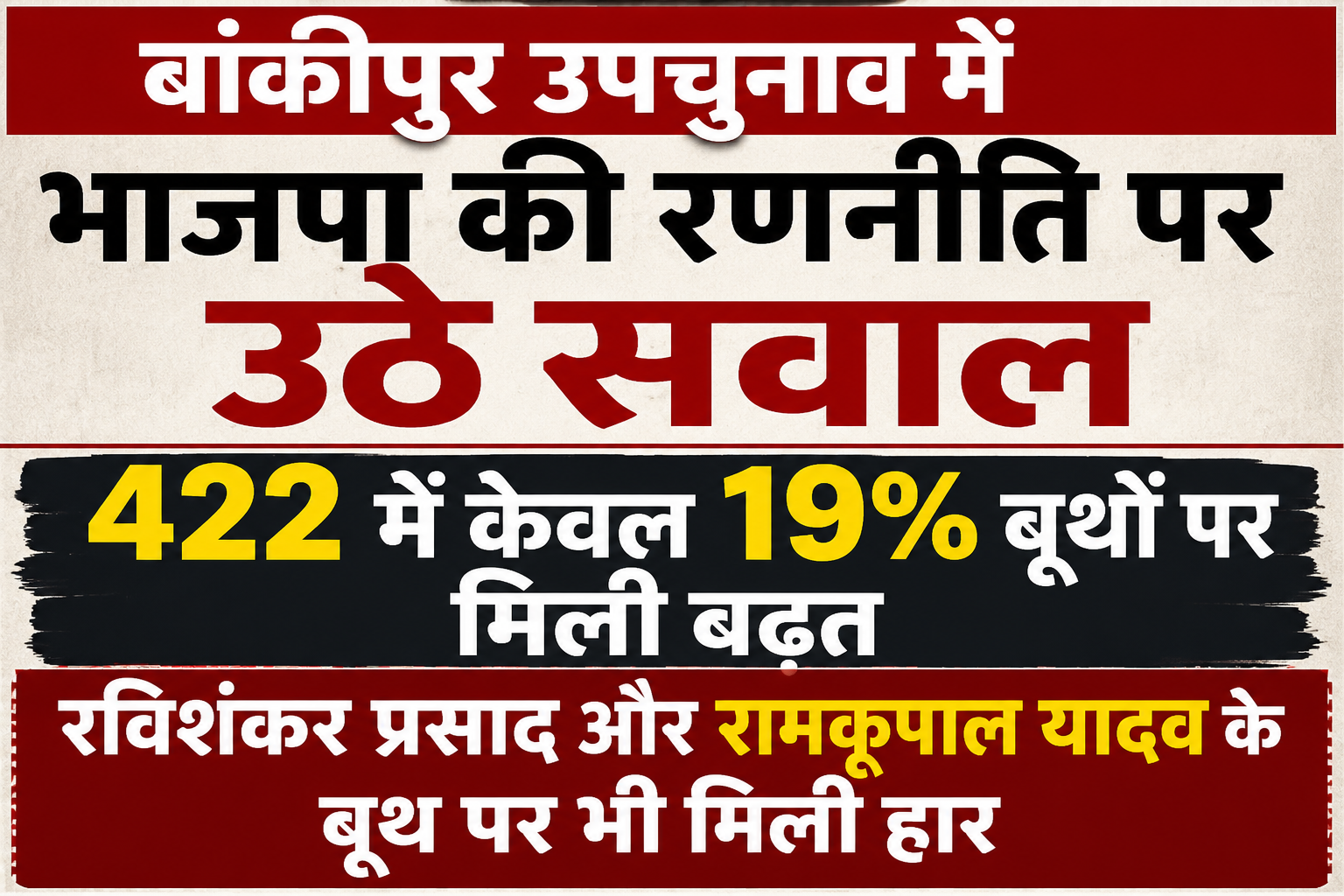
BJP Faces Setback in Booth-Wise Performance; Led in Only 19% of 422 Polling Booths, Lost Even at Booths Linked to Ravi Shankar Prasad and Ram Kripal Yadav
Patna: The results of the Bankipur Assembly by-election have sparked a fresh political debate in Bihar. A detailed booth-wise analysis of the election results reveals that Bharatiya Janata Party (BJP) candidate Neeraj Sinha secured a lead over Jan Suraaj Party candidate Prashant Kishor at only about 19% of the 422 polling booths. At the remaining majority of booths, Prashant Kishor established a significant lead, giving him a decisive advantage in the electoral contest.
One of the most widely discussed aspects of the results is that the BJP candidate reportedly failed to secure a lead even at the polling booths associated with senior BJP leaders and Members of Parliament Ravi Shankar Prasad and Ram Kripal Yadav. The outcome has raised questions about the party's organizational strategy, booth management, and grassroots support in the constituency.
Booth-Wise Analysis Changes the Political Narrative
Following the declaration of the election results, a detailed analysis of voting patterns across individual polling booths was conducted. The findings showed that out of 422 polling booths, the BJP managed to lead at only around 19 percent, while the Jan Suraaj Party secured the lead at the vast majority of booths.
Political analysts believe that the results indicate the electoral trend was not confined to a few isolated areas but reflected a broader shift in voter preferences across the constituency.
Prashant Kishor's Campaign Strategy Proved Effective
According to political observers, the Jan Suraaj Party focused heavily on door-to-door outreach, direct engagement with residents, and building a strong organizational network at the booth level.
Throughout the campaign, Prashant Kishor emphasized issues such as development, education, healthcare, employment, and local civic concerns. His direct interaction with voters on these topics is considered a major factor behind the party's strong booth-level performance.
Analysts believe this grassroots approach played a key role in securing widespread support.
A Time for Introspection Within the BJP
The booth-wise data has prompted internal discussions within the BJP regarding its electoral performance.
Several party leaders are reported to believe that organizational shortcomings at the grassroots level may have affected the final outcome. Political experts note that booth management is one of the most critical elements of any election, and weaknesses at this level often have a significant impact on overall results.
Defeat Even at Booths Associated with Senior Leaders
One of the most striking aspects of the election was that the BJP candidate reportedly failed to gain a lead at the polling booths associated with Ravi Shankar Prasad and Ram Kripal Yadav, both prominent BJP leaders.
The development has generated considerable discussion in political circles. However, analysts caution that the result at any single booth should not be interpreted as a definitive measure of political influence across an entire constituency, although such symbolic outcomes often carry political significance.
Local Issues Influenced Voter Preferences
Political observers believe that local issues played a decisive role in shaping voter preferences during the by-election.
Concerns related to roads, drainage, drinking water, electricity, traffic management, employment, and civic amenities featured prominently throughout the campaign, influencing the decisions of many voters.
Young and First-Time Voters Played an Important Role
Young voters and first-time voters are also believed to have significantly influenced the outcome.
Analysts suggest that many younger voters prioritized issues such as development, transparency, accountable governance, and better public services. Social media and digital campaigning also helped parties connect more effectively with this demographic.
Importance of Booth-Level Organization
Election experts emphasize that a strong booth-level organization often determines electoral success.
Regular voter engagement, effective coordination on polling day, active grassroots workers, and a well-organized campaign structure are all considered essential components of a winning strategy.
The Bankipur by-election has once again highlighted the critical importance of booth management in modern electoral politics.
Political Parties Intensify Preparations
Following the by-election results, all major political parties have begun evaluating their strategies for upcoming elections.
While the BJP is reviewing its organizational structure and campaign approach, the Jan Suraaj Party is expected to use the result as an opportunity to expand its grassroots network.
Other political parties are also analyzing booth-level voting patterns to shape their future electoral strategies.
Potential Impact on Future Politics
Political experts believe that the outcome of the Bankipur by-election could have implications beyond a single Assembly constituency.
The results may influence future political strategies, alliance formations, candidate selection, and campaign methods in Bihar. Political parties are now expected to place greater emphasis on strengthening their booth-level organizations.
The booth-wise analysis of the Bankipur Assembly by-election shows that BJP candidate Neeraj Sinha secured a lead at only about 19 percent of the 422 polling booths, while Jan Suraaj Party candidate Prashant Kishor led at the majority of polling stations. The BJP's reported inability to secure a lead even at the polling booths associated with Ravi Shankar Prasad and Ram Kripal Yadav has emerged as one of the most talked-about aspects of the election.
The results underscore a broader political lesson: electoral success depends not only on high-profile campaign rallies but also on strong grassroots organization, effective booth-level management, and continuous engagement with voters. Political parties are likely to place greater focus on these factors in future elections.


