
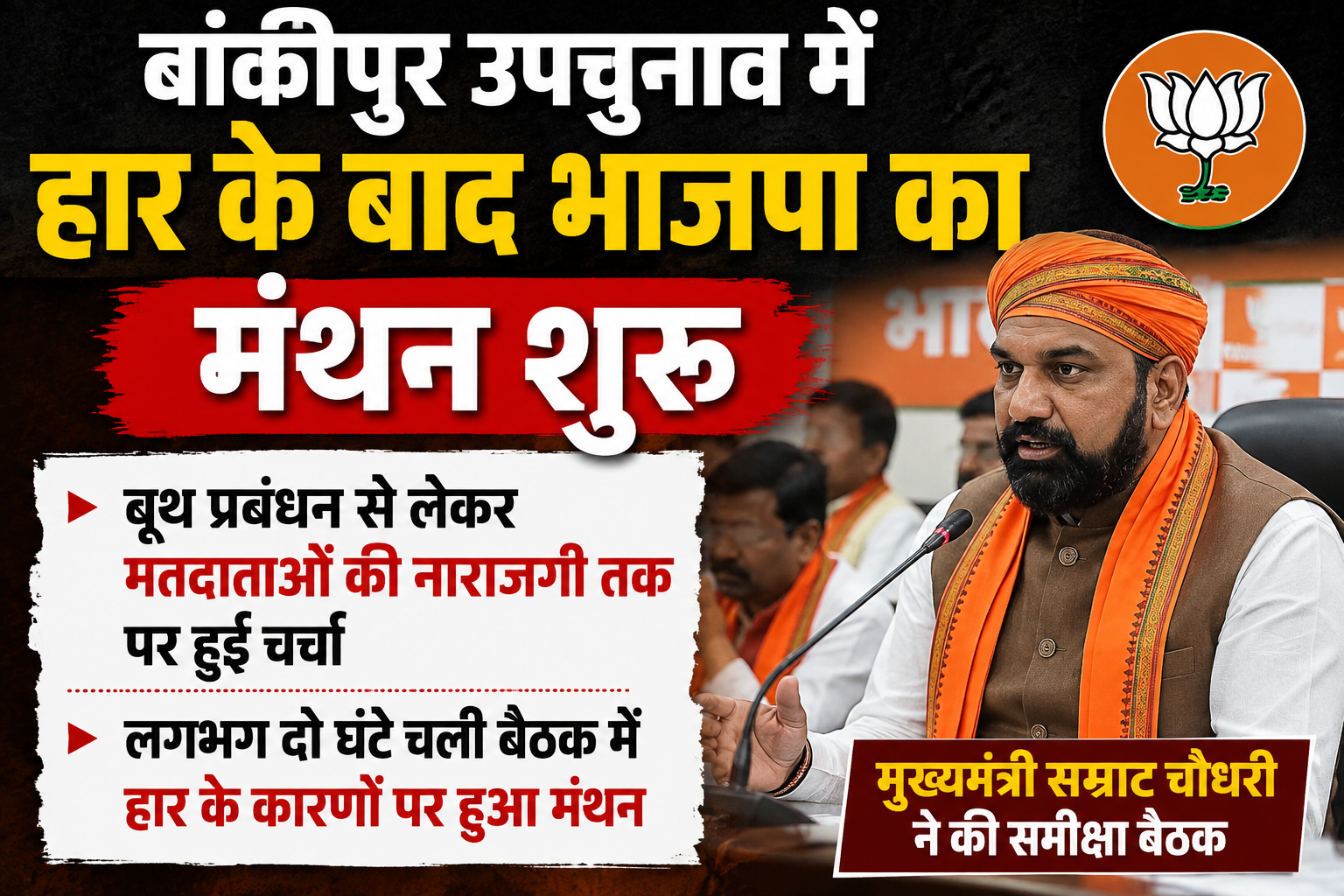
BJP Begins Introspection After Defeat in Bankipur Bypoll; Chief Minister Samrat Choudhary Chairs Review Meeting to Assess Setbacks
Patna: Following its defeat in the Bankipur Assembly by-election, the Bharatiya Janata Party (BJP) has initiated an internal review of its electoral performance. After Prashant Kishor, founder of Jan Suraaj, secured victory in the bypoll, the BJP leadership decided to conduct a detailed assessment of the reasons behind the party's loss. As part of this process, a high-level review meeting was held on Wednesday at the BJP state headquarters under the chairmanship of Chief Minister Samrat Choudhary. The meeting focused on analyzing the causes of the defeat, identifying organizational shortcomings, and formulating strategies for future elections.
The nearly two-hour meeting was attended by all BJP MLAs from Patna district, senior state party leaders, election managers, and key organizational functionaries. The primary objective was to understand why the party lost an important seat like Bankipur and determine what corrective measures should be taken ahead of upcoming elections.
Detailed Analysis of the Election Defeat
During the meeting, party leaders conducted an extensive review of the election results. Leaders and workers shared their experiences from the campaign and discussed the challenges they encountered during the by-election.
According to sources, special attention was given to booth-level management, the effectiveness of party workers, voter outreach, campaign strategy, and local issues that may have influenced the outcome. The state leadership encouraged participants to provide honest and constructive feedback so that the actual reasons behind the defeat could be identified.
Booth Management Came Under Focus
Booth management was identified as one of the most important factors affecting electoral performance. Several leaders suggested that the party should strengthen its organizational presence at every polling booth and clearly define the responsibilities of workers well before polling day.
The meeting also discussed conducting a detailed review of polling stations where the party received lower-than-expected support in order to understand local voting patterns and organizational gaps.
Discussion on Voter Discontent
Some leaders pointed to voter dissatisfaction and unresolved local issues as possible factors contributing to the election result. Representatives from different constituencies emphasized the need to better understand public expectations regarding development, civic amenities, and local governance.
The party leadership acknowledged these observations and stated that maintaining continuous engagement with voters would be an important part of future electoral planning.
Campaign Strategy Reviewed
The meeting also evaluated the campaign strategy adopted during the by-election. Leaders reviewed the effectiveness of public rallies, social media outreach, door-to-door campaigns, and local-level election activities.
Some participants suggested that future campaigns should focus more on constituency-specific issues and tailor political messaging to the needs and expectations of local voters.
Emphasis on Strengthening the Organization
Party leaders stressed that electoral success depends not only on campaign activities but also on a strong organizational structure and active grassroots workers.
Suggestions were made to improve coordination at different organizational levels, recruit more volunteers, and organize regular training programs for party workers to strengthen the party's grassroots network.
Leadership Sought Honest Feedback
During the meeting, the state leadership encouraged MLAs, office-bearers, and election workers to openly express their views. Participants were asked to identify the key reasons behind the party's defeat and recommend areas where improvements were needed.
The purpose of this exercise was not only to understand the reasons for the loss but also to prepare a more effective strategy for future elections.
Focus on Upcoming Elections
The leadership emphasized that lessons learned from the Bankipur by-election would be incorporated into preparations for future electoral contests. Greater attention will be given to strengthening the party organization, expanding grassroots outreach, and maintaining regular engagement with voters.
Leaders noted that every election presents unique challenges and that each result provides valuable lessons for improving future performance.
Political Analysts' Perspective
Political analysts believe that post-election review meetings are a normal part of the democratic process. Such discussions allow political parties to evaluate their campaign strategies, organizational structure, and electoral performance.
Experts also point out that election outcomes are influenced by a combination of political, social, local, and organizational factors. Therefore, it would be inappropriate to attribute the defeat to any single reason alone.
Strategy for Continuous Public Engagement
The meeting also highlighted the importance of remaining actively engaged with the public beyond election periods. Leaders stressed that timely resolution of public grievances, regular interaction with citizens, and prompt attention to local issues could strengthen the party's public support.
Party workers were encouraged to increase outreach efforts in their respective areas and effectively communicate government initiatives and welfare schemes to the people.
Following its defeat in the Bankipur Assembly by-election, the BJP has begun an extensive organizational review. During the meeting chaired by Chief Minister Samrat Choudhary, party leaders discussed booth management, organizational effectiveness, voter feedback, campaign strategy, and various local issues that may have influenced the election outcome.
By collecting detailed feedback from leaders and party workers, the BJP aims to refine its strategy for future elections. Political observers believe that such review meetings are an important part of analyzing electoral outcomes and strengthening party organization ahead of upcoming political contests.


