

Bihar Standardizes Minimum Teacher Matrix for Schools: Grades 1–5 and 6–8 Declared Separate Units; Check the Detailed Student-Teacher Allocation Grid
In a decisive move to overhaul the public schooling system and ensure the ground-level enforcement of the Right to Education (RTE) Act, 2009, the Government of Bihar's Education Department has introduced a landmark regulatory mandate. According to the official directive issued by the Directorate of Primary Education, the allocation and minimum threshold of teachers in government primary and middle schools will now be determined strictly by actual student enrolment data.
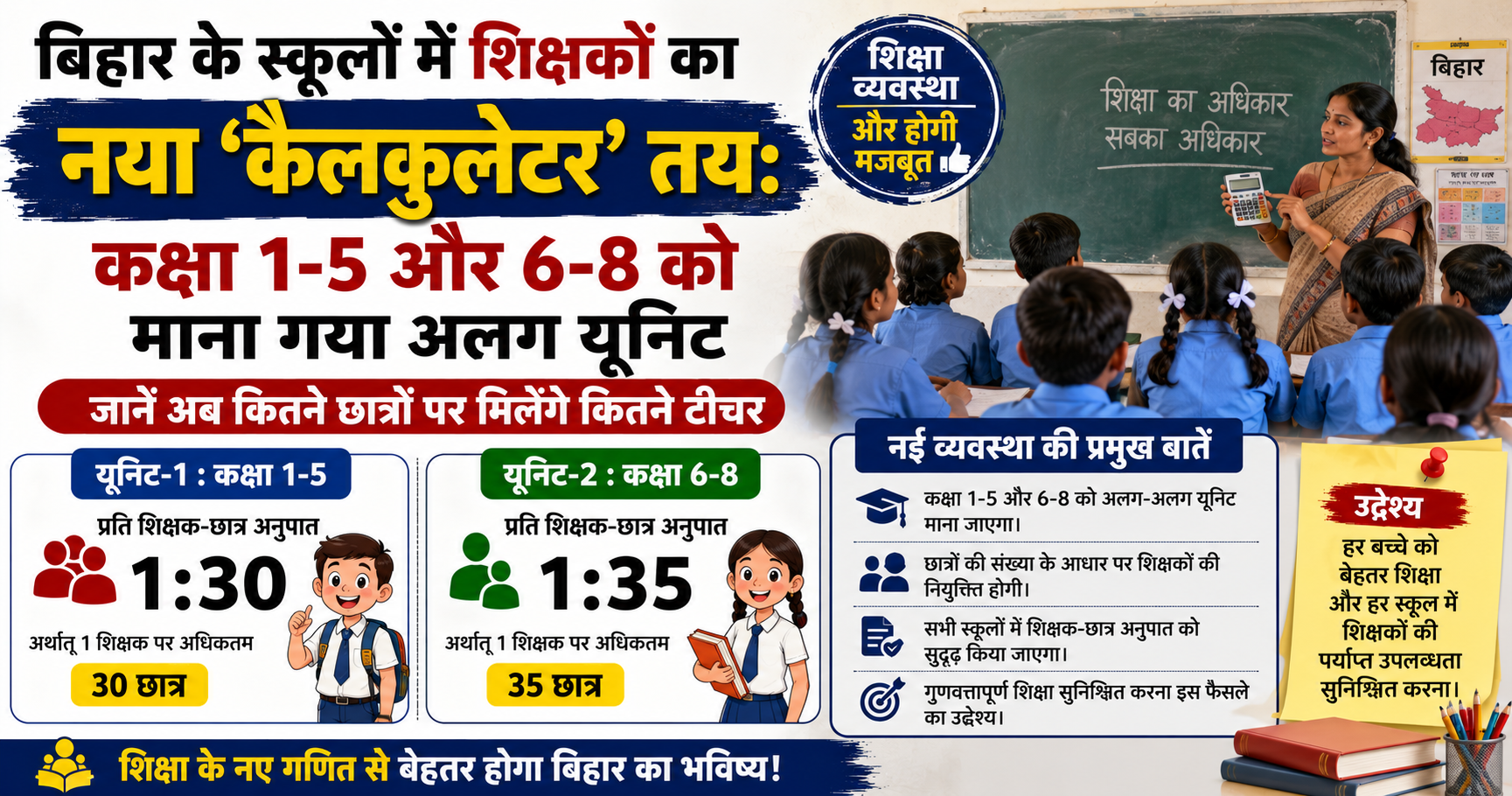
To streamline this process, the department has mandated that for the assessment of teaching staff requirements, Grades 1 to 5 (Primary) and Grades 6 to 8 (Upper Primary/Middle) will be treated as two completely separate educational units. However, to maintain administrative harmony, the entire institution will continue to operate under a single, unified Head Teacher. This structural calibration aligns with the core directives of the National Education Policy (NEP 2020) and statutory RTE norms.
The New Allocation Grid for Primary Schools (Grades 1 to 5)
The Directorate of Primary Education has made it clear that staff deployment in the primary wing will follow a transparent slab-based matrix. Adhering to the national standard of a 30:1 student-teacher ratio (1:30), the newly codified slabs are as follows:
| Total Actual Student Enrolment | Minimum Required Teachers | Additional Administrative Post |
|---|---|---|
| 01 to 60 Students | 02 Teachers | — |
| 61 to 90 Students | 03 Teachers | — |
| 91 to 120 Students | 04 Teachers | — |
| 121 to 150 Students | 05 Teachers | — |
| More than 150 Students | 05 Teachers | + 01 Head Teacher |
Subject-Wise and Grade-Wise Matrix for Middle Schools (Grades 6 to 8)
For Grades 6 to 8, the department has prioritized subject-specific specialization over raw student volume. This ensures that middle school students receive targeted instruction from subject-matter experts. Consequently, every middle school must retain a minimum core faculty representing three primary disciplines.
Mandatory Core Faculty:
Regardless of the minimal size of student enrollment, every functional middle school must have at least one dedicated teacher assigned to each of the following streams:
Science & Mathematics
Social Studies
Language (Primarily Hindi/Regional Language)
Progressive Language Matrix as Enrolment Scales:
As the student census expands within an institution, specialized language vacancies will be systematically released based on the following milestones:
105 to 140 Students: The institution will be allocated a fourth teacher, who will strictly be a specialist in English.
140 to 175 Students: A fifth teaching slot will open, dedicated to Sanskrit or Urdu, tailored to the specific demographic requirements of the area.
Beyond 175 Students: Once enrollment breaks past the 175 mark, an additional general teacher post will be deployed for every 35 additional students.
The Audit Reality: Stark Disparities Uncovered in State Schools
This sweeping policy change follows a meticulous, data-driven audit of public schools conducted across the state by the Education Department. The audit unearthed stark institutional imbalances. In remote rural sectors, singular educators were frequently found managing entire multi-grade institutions alone. Conversely, urban institutions often exhibited a surplus of teaching staff relative to their student density.
The newly formulated guidelines are designed to systematically execute a rationalization process. Teachers will be reassigned across the state based entirely on actual student traffic, infrastructural load (number of functional classrooms), and specific curriculum needs.
Digital Oversight via the 'e-ShikshaKosh' Portal
To insulate this reform from bureaucratic manipulation or paper-shuffling, the entire deployment framework is being digitized. The department has issued stringent orders to all District Education Officers (DEOs) to verify and upload real-time statistics regarding active student rosters, physical classroom counts, and existing staff deployments onto the centralized 'e-ShikshaKosh Portal'.
Classroom Availability as a Constraint: For the first time, structural capacity will serve as a baseline constraint. Staff will not be randomly assigned to institutions that lack the physical brick-and-mortar classrooms to safely seat and group the corresponding student blocks.
Total Transparency: This live digital database will allow the central command in Patna to monitor sanctioned vacancies, active strength, and surplus positions across all 38 districts at the click of a button.
Direct Implications for the Bihar Teacher Recruitment Exam (TRE 4.0)
This structural recalibration will serve as the mathematical foundation for the upcoming Teacher Recruitment Examination (TRE 4.0) to be conducted by the Bihar Public Service Commission (BPSC). The Education Department is currently pulling freshly recalculated vacancy matrices from all districts based on this new formula. The subsequent correction is expected to significantly alter the volume and distribution of vacant seats for primary (1–5) and middle (6–8) school tiers, offering an accurate roadmap for hundreds of thousands of teaching aspirants across the state.
This structural overhaul marks a significant milestone in transforming the quality of public instruction in Bihar. Treating Grades 1–5 and 6–8 as distinct academic units will stabilize daily classroom instruction and ensure that rural children are no longer deprived of specialized subject teachers. Moving forward, the ultimate test of this policy lies in its execution—specifically, how smoothly and transparently the department handles the upcoming human resource rationalization across the state's vast network of schools.