
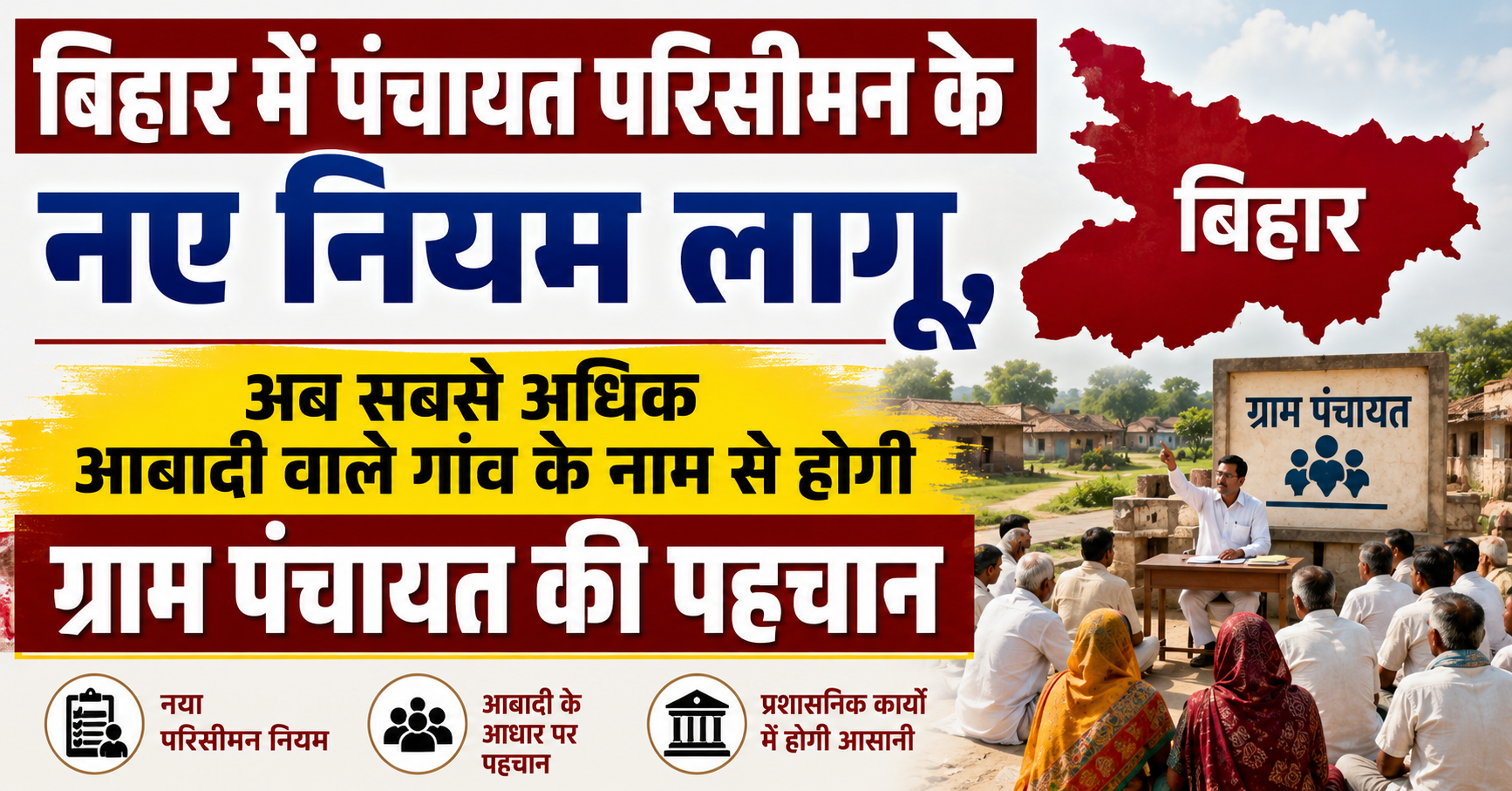
Bihar Introduces New Rules for Panchayat Delimitation; Gram Panchayats to Be Named After the Most Populous Village
Patna: The Bihar government has introduced a major reform in the delimitation of Gram Panchayats (village councils). Under the newly issued guidelines, all Gram Panchayats across the state will undergo delimitation through a revised process. The most significant change is that every Gram Panchayat will now be named after the village with the highest population within its jurisdiction.
The notification issued by the state government has sparked discussions among elected panchayat representatives, rural residents, and administrative officials. The government believes the new system will provide a clearer identity to Gram Panchayats, improve administrative efficiency, and make governance more transparent and organized.
What Is the New Rule?
According to the new guidelines, if a Gram Panchayat consists of several villages, its official name will now be based on the village with the largest population rather than on a historically recognized or smaller village. In other words, the village with the highest number of residents will become the official identity of the entire Gram Panchayat.
For example, if a Panchayat includes five villages and one of them has a significantly larger population than the others, the Panchayat will be renamed after that village.
Why Has This Decision Been Taken?
The government stated that many Gram Panchayats currently carry the names of smaller villages, even though the majority of the population lives in another village. This has often led to confusion in administrative records and government operations.
With the implementation of the new system, Panchayat names will better reflect the demographic reality of their respective areas. This is expected to simplify government administration, census operations, electoral roll preparation, development planning, and the maintenance of official records.
Statewide Delimitation Process
As per the government notification, the delimitation exercise will be carried out across all Gram Panchayats in Bihar in a phased manner. During the process, authorities will examine factors such as geographical boundaries, population, the number of villages under each Panchayat, and other administrative criteria.
Where necessary, Panchayat boundaries may be revised, and in some cases, Panchayats may also be reorganized.
Population Will Be the Primary Criterion
The most important factor in the delimitation process will be the population of individual villages. Officials will analyze the latest available population data and government records to determine which village has the highest population. That village's name will then become the official name of the Gram Panchayat.
The exercise will be based on the latest available demographic data and official government records.
Benefits for Rural Residents
The government expects several advantages from the new policy, including:
A clearer identity for Gram Panchayats.
Greater consistency in official government records.
Reduced administrative confusion.
Faster and more efficient governance.
Easier record management and official correspondence.
Improved implementation and monitoring of development schemes at the Panchayat level.
Impact on Future Panchayat Elections
Experts believe that the delimitation process could also influence upcoming Panchayat elections. If Panchayat boundaries or names change, ward boundaries, electoral rolls, and election preparations may also require revision.
However, the government has clarified that the entire exercise will be conducted strictly in accordance with existing laws and established legal procedures.
Instructions Issued to District Officials
The Bihar government has directed District Magistrates, District Panchayati Raj Officers, and other concerned officials to complete the delimitation exercise within the prescribed timeframe.
Officials have also been instructed to ensure complete transparency throughout the process and to address objections or suggestions received from the public in accordance with the rules.
Experts' Views
Experts associated with the Panchayati Raj system have described the decision as a practical administrative reform. They believe naming Panchayats after the most populous village will strengthen administrative identity and improve the delivery of government schemes.
At the same time, some experts argue that Panchayats with historically or culturally significant names should also take local sentiments into consideration before any changes are made.
Mixed Reactions from Villagers
The government's decision has received mixed responses in rural areas. While many residents have welcomed it as an important administrative reform, others believe that changing long-established Panchayat names could create confusion and affect local identity.
Several Panchayat representatives have suggested that local residents should be consulted before any official name changes are finalized.
Better Implementation of Development Schemes
According to the government, the new delimitation policy will make the implementation of rural development projects more transparent and systematic. Schemes related to roads, drainage, drinking water, housing, education, healthcare, and other public services are expected to benefit from improved administrative coordination.
In addition, Panchayat records, digital databases, and official documents will be updated to reflect the revised administrative structure.
The Bihar government's decision is being seen as a significant administrative reform in the state's Panchayati Raj system. The new delimitation process and the rule of naming Gram Panchayats after the most populous village are expected to make rural governance more organized, transparent, and efficient. However, the success of the initiative will depend on how fairly, transparently, and inclusively the delimitation process is carried out. The coming months will determine how effectively the reform improves local administration and rural development.


