
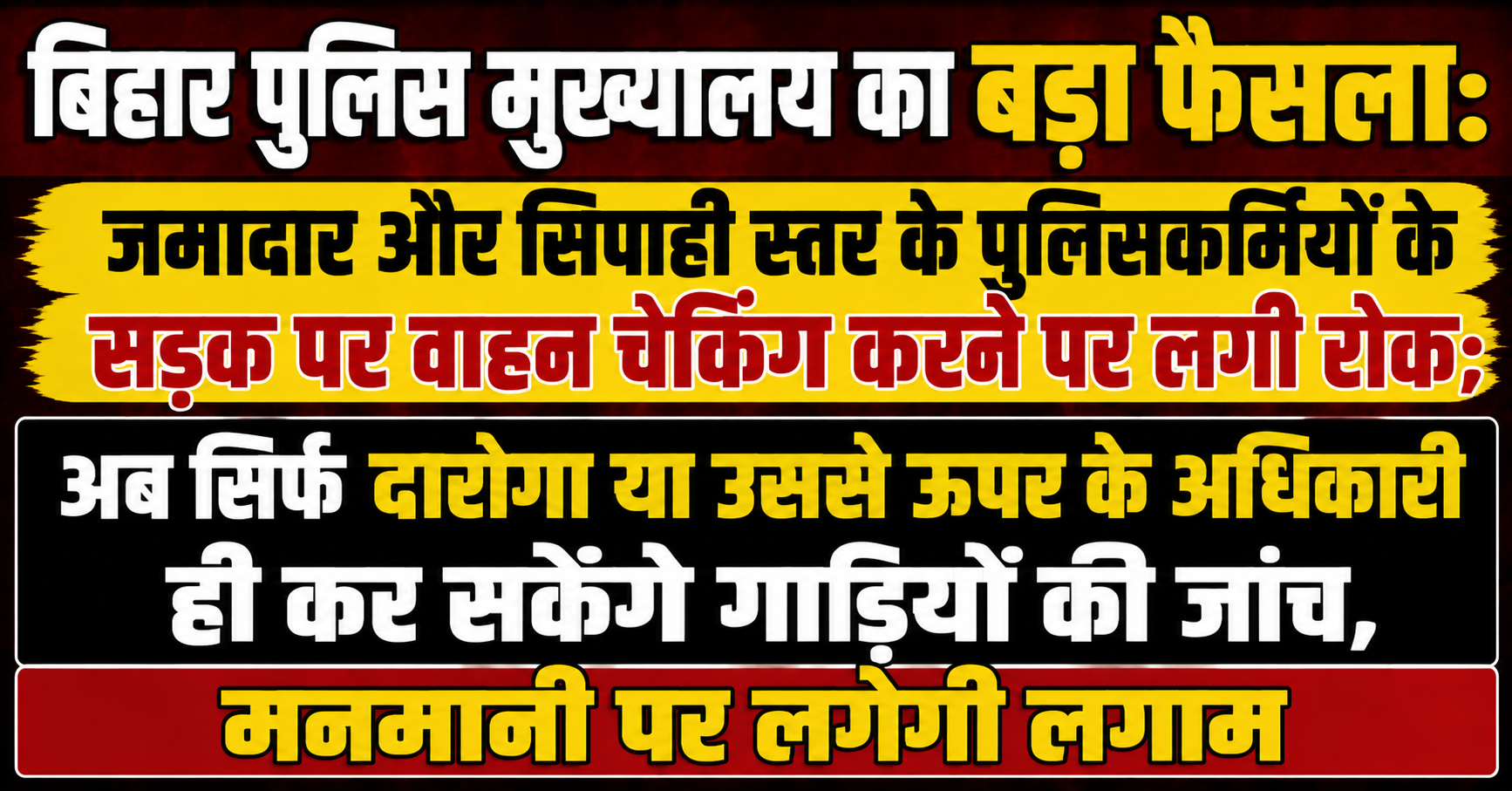
Big Decision by Bihar Police Headquarters: Jamadar and Constable-Level Personnel Banned from Checking Vehicles on Roads; Only Sub-Inspectors or Senior Officers Can Now Inspect Vehicles, Curbing Arbitrariness
To eliminate the troubles faced by ordinary citizens in the name of policing systems and traffic checking, the Bihar Police Headquarters has taken a very strict, significant, and far-reaching decision. Complaints of illegal extortion, unnecessary harassment, and arbitrary stopping of vehicles by police personnel were frequently reported by everyday drivers, bike riders, and vehicle owners. To crack down on all these complaints and indiscipline, the police headquarters has now issued clear directives that Jamadars (ASIs) and Constable-level police personnel will no longer be able to check vehicles on the roads.
According to the new rules, the authority to conduct vehicle inspections across the state will now rest solely with Sub-Inspectors (SI) or officers of higher rank. If any Assistant Sub-Inspector (ASI) or constable is still found checking vehicles on the road, strict departmental action will be taken against them. Let us analyze in detail this historic decision by the Bihar Police, the reasons behind it, the new rules for vehicle checking, and its positive impacts on the public.
Background: Arbitrariness in the Name of Vehicle Checking and Public Complaints
Vehicle checking campaigns are conducted by the police across various districts of the state, especially on the borders of urban and rural areas. However, over the past some time, various irregularities had come to light under the guise of this process.
Allegations of Illegal Extortion and Harassment: Reports were continuously pouring in from many places where lower-level personnel (constables or home guard jawans) would stop vehicles, demand documents, and attempt to issue challans or extort money for minor shortcomings or without any solid reason. This was increasing discontent among general drivers against the police.
Traffic Disruption and Jam Situations: Often, due to untimely and arbitrary stopping of vehicles without the supervision of any senior officer, long traffic jams would form on roads, causing severe inconvenience to the general public. Taking cognizance of all these complaints, the police headquarters has finally taken this major step.
Key Points of the New Directive: Who Got the Authority and Who Is Banned?
Under the new guidelines issued by the Bihar Police Headquarters, the responsibilities of different ranks within the police force have been clearly divided.
Constables and ASIs Completely Banned: Now, no constable or Assistant Sub-Inspector (Jamadar) will be able to independently set up barricades on the road or stop and check vehicles on their own accord. Their operational scope has now been completely excluded from vehicle inspection.
Only SIs or Senior Officers Can Inspect: According to the new rules, the authority to lead a vehicle checking campaign or inspect vehicle papers, boots, and other items on the road will rest solely with Sub-Inspectors (SIs), Inspectors, DSPs, or gazetted officers of higher rank.
Participation in Special Operations: This does not mean that lower-level personnel will no longer be part of the police force; they can certainly be part of any special or joint drive led by senior officers, but they will not be able to conduct independent vehicle checks on roads.
The Police Administration's Intent Behind This Decision
The primary objective of this order by the police headquarters is to improve the image of the police department and restore public trust in the police.
Bringing Transparency: When the command of vehicle checking rests solely with responsible and senior officers (Sub-Inspectors or above), it will bring transparency and automatically curb arbitrariness.
Curbing Corruption: This decision will prove to be an infallible weapon to put a check on complaints of illegal extortion and bribery happening at lower levels. Now, police personnel will think a hundred times before adopting any arbitrary attitude.
Relief for General Public and Drivers
General vehicle drivers, business owners, and ordinary citizens of Bihar have breathed a sigh of relief with this decision.
Freedom from Unnecessary Hassle: Ordinary people will now be free from being stopped and subjected to unnecessary questioning by junior personnel at every intersection or street corner. Journeys will become much smoother and stress-free.
Fear of Law vs. Fear of Police: The public believes that if inspections are conducted within the framework of law and in the presence of senior officers, traffic rules will be followed better and corruption will also end.
Strict Departmental Action for Violating Rules
The police headquarters has implemented this order very strictly and directed the Superintendents of Police (SPs) of all districts to ensure its strict compliance in their respective regions.
Strict Action on Rule Violations: If during a surprise inspection, any constable or ASI is found checking vehicles on the road against the rules, the axe could fall not only on the concerned police officer but also on the local SHO (Station House Officer). Departmental action will be initiated against them immediately.
The decision by the Bihar Police Headquarters to ban Jamadar and constable-level personnel from checking vehicles on roads is a pro-people and reformist step. This order proves that the police administration is sensitive to public grievances and wants to make the policing system more transparent and accountable. If this rule is strictly followed at the grassroots level, illegal extortion on roads and the troubles faced by ordinary citizens will come to an end forever.


