
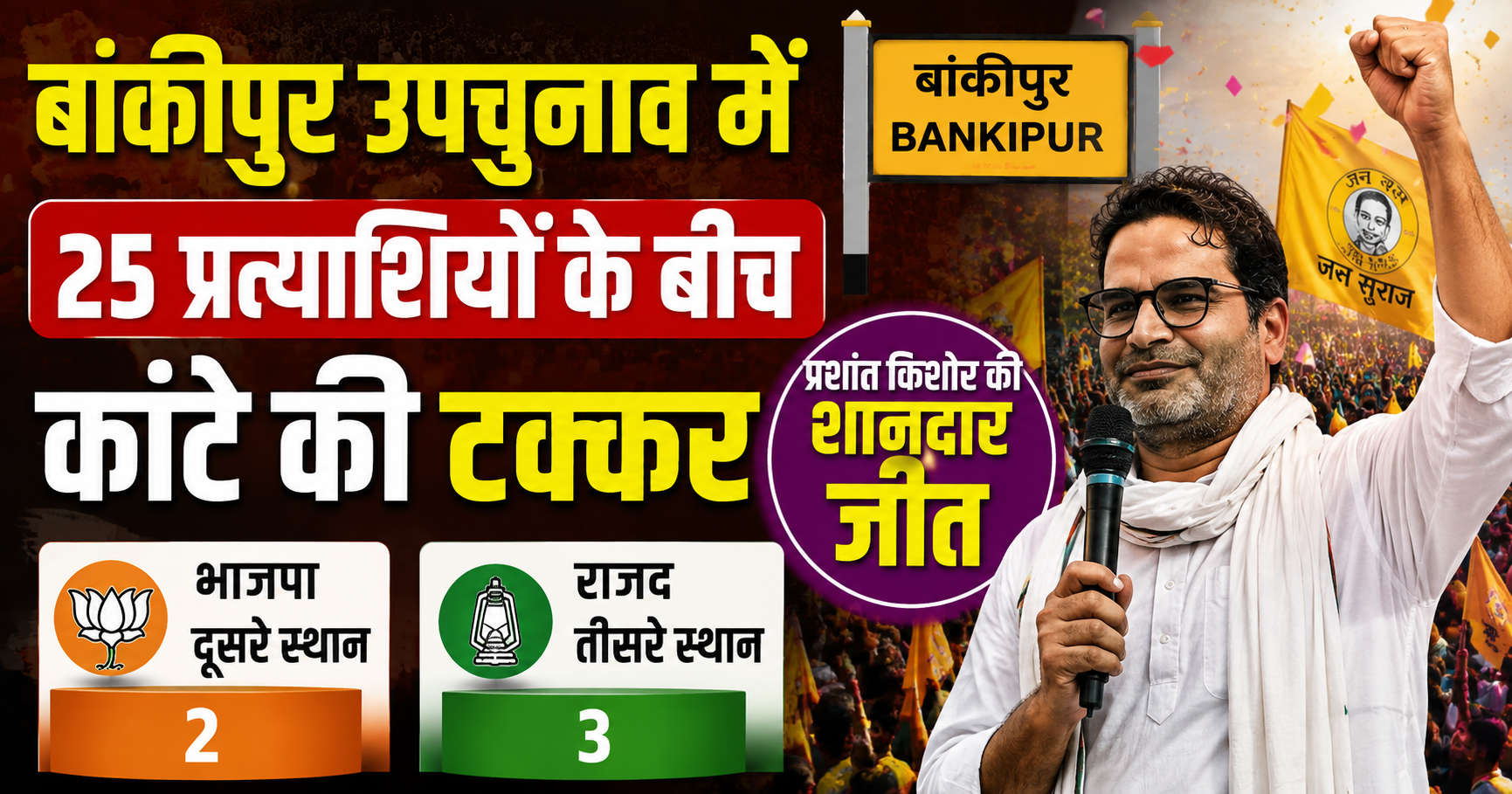
Bankipur By-election Sees Contest Among 25 Candidates; Prashant Kishor Secures Convincing Victory, BJP Finishes Second and RJD Third
Patna: The Bankipur Assembly by-election, one of the most closely watched political contests in Bihar, has delivered several important political messages. A total of 25 candidates, including nominees from Jan Suraaj, the Bharatiya Janata Party (BJP), and the Rashtriya Janata Dal (RJD), contested the election. According to the final results, Prashant Kishor of Jan Suraaj won the seat with 64,151 votes. BJP candidate Neeraj Kumar Sinha secured 44,827 votes, while RJD candidate Rekha Kumari received 14,273 votes. The outcome has sparked widespread discussion about changing political trends and voter preferences in Bihar.
A High-Profile Electoral Battle
The Bankipur Assembly by-election attracted statewide attention from the very beginning. As one of the most politically significant constituencies in Patna, the seat has long held strategic importance in Bihar's political landscape. Consequently, all major political parties invested considerable effort in their campaigns.
Jan Suraaj viewed the election as an opportunity to establish its political credibility. The BJP mounted an extensive campaign in an effort to retain the seat, while the RJD sought to strengthen its presence in the urban constituency. In addition to these major parties, several other political parties and independent candidates also contested the election.
Decisive Victory for Prashant Kishor
According to the official vote count, Jan Suraaj candidate Prashant Kishor secured 64,151 votes, maintaining a consistent lead throughout the counting process and ultimately winning by a comfortable margin.
Political analysts believe the victory represents more than just success in a single constituency. They argue that it has strengthened Jan Suraaj's political position and enhanced the party's visibility in Bihar.
During the campaign, Prashant Kishor focused on issues such as development, transparency, education, healthcare, employment, and urban infrastructure. He also pledged to transform Bankipur into a model Assembly constituency, a promise that became a central theme of his campaign.
BJP Finishes in Second Place
BJP candidate Neeraj Kumar Sinha secured 44,827 votes, finishing second. The BJP treated the election as a high-priority contest, with senior leaders, party officials, and grassroots workers actively participating in an extensive campaign.
Despite these efforts, the final result fell short of the party's expectations. Political observers believe the BJP is likely to review its electoral strategy and organizational approach in preparation for future elections.
RJD Finishes Third
RJD candidate Rekha Kumari received 14,273 votes, placing third in the contest. The result is being viewed as weaker than expected for a party that had hoped to improve its performance in the urban constituency.
Political analysts suggest that the outcome may prompt the RJD to reassess its organizational structure, campaign strategy, and outreach efforts in urban areas.
Twenty-Five Candidates Contested
A total of 25 candidates participated in the by-election. Although the primary contest was widely perceived as being between Jan Suraaj, the BJP, and the RJD, candidates from other political parties and independent contestants also took part in the democratic process.
The Election Commission conducted both polling and vote counting under extensive security arrangements, and the electoral process was completed peacefully.
Indications of Changing Political Priorities
Political observers believe the Bankipur by-election reflects changing voter priorities. Increasingly, voters appear to be placing greater emphasis on development, transparency, accountability, and the credibility of individual candidates.
In urban constituencies, issues such as education, healthcare, employment, traffic management, sanitation, and civic infrastructure emerged as major campaign themes. Analysts believe this trend may strengthen the role of development-oriented politics in future elections.
Possible Impact on Future Assembly Elections
Experts believe the Bankipur verdict could influence campaign strategies for the upcoming Bihar Assembly elections. Political parties are expected to carefully evaluate the lessons from the by-election while selecting candidates, shaping campaign narratives, and determining policy priorities.
Jan Suraaj may view the victory as an opportunity to expand its organizational presence across the state, while the BJP and the RJD are likely to analyze their performances and adjust their future strategies accordingly.
Rising Public Expectations
With the election concluded, public expectations have also increased. Voters now expect their elected representative to deliver visible improvements in development, civic infrastructure, employment opportunities, education, and healthcare.
Political observers note that winning an election is only the first step for any public representative. The greater challenge lies in fulfilling campaign promises and delivering measurable results.
An Important Democratic Message
The Bankipur by-election once again demonstrates that the ultimate decision in a democracy rests with the voters. The result also suggests that political parties and candidates will need to adapt to changing public expectations while formulating their future strategies and policy agendas.
Among the 25 candidates who contested the Bankipur Assembly by-election, Prashant Kishor of Jan Suraaj secured victory with 64,151 votes. BJP candidate Neeraj Kumar Sinha received 44,827 votes, while RJD candidate Rekha Kumari secured 14,273 votes. The outcome is being interpreted as an indication of changing public opinion, evolving priorities among urban voters, and the growing importance of development-oriented politics in Bihar. In the coming months, all major political parties are expected to study the verdict carefully as they prepare for future electoral contests.


