
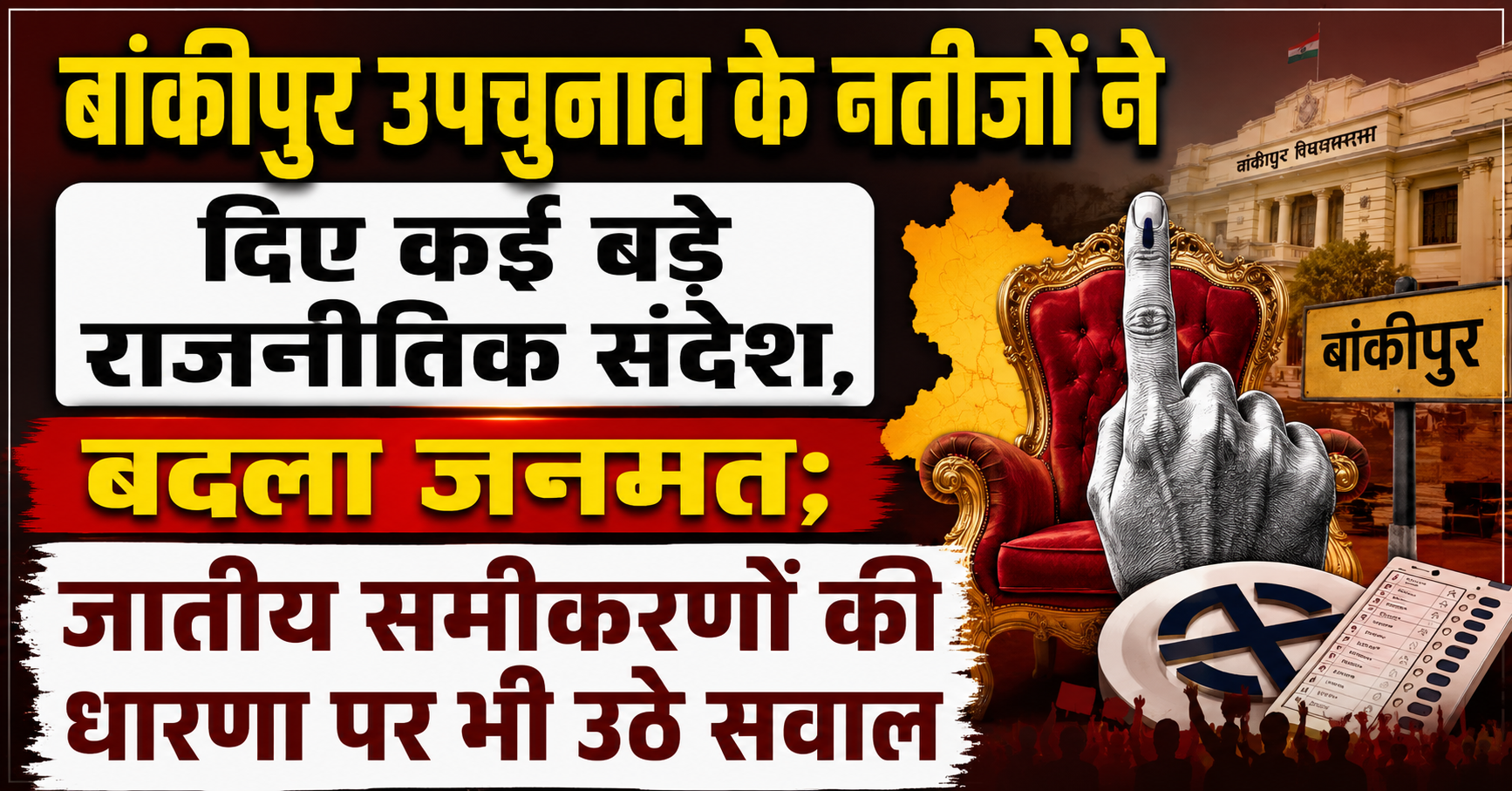
Bankipur By-election Results Send Strong Political Signals; Changing Voter Mood Challenges Traditional Caste-Based Electoral Calculations
Patna: The results of the Bankipur Assembly by-election have proved to be much more than a victory or defeat in a single constituency. They have delivered several significant political messages about the changing mindset of Bihar's voters and their evolving electoral priorities. The outcome indicates that urban voters are increasingly moving beyond traditional political equations and are making their decisions based on development, leadership, accountability, and local issues.
One of the biggest talking points following the by-election has been that BJP candidate Neeraj Sinha failed to secure even as many votes as the margin by which former MLA Nitin Naveen had won the constituency in the previous Assembly election. At the same time, the election outcome has sparked fresh debate over the long-held belief that caste equations remain the decisive factor in Bihar's electoral politics.
The Result Has Changed the Political Narrative
Bankipur has long been regarded as one of Bihar's most politically significant Assembly constituencies. Located in the heart of Patna, the seat has often been viewed as politically influential beyond the boundaries of the constituency itself. The by-election verdict has prompted political parties to reassess their electoral strategies.
Political observers believe the outcome clearly demonstrates that voters are no longer casting their ballots solely on the basis of party loyalty or traditional vote banks. Instead, they are placing greater importance on a candidate's credibility, public acceptance, leadership qualities, and vision for the future.
Questions Raised Over BJP's Performance
The Bharatiya Janata Party (BJP) mounted an extensive campaign for the by-election, with senior party leaders participating in rallies and organizational efforts. Despite these preparations, its candidate, Neeraj Sinha, was unable to deliver the expected performance.
The most striking observation was that Sinha failed to secure even the number of votes equal to the victory margin achieved by Nitin Naveen in the previous Assembly election. Political analysts suggest that this is not merely an individual candidate's setback but also an opportunity for the BJP to introspect. The party may need to recognize that the expectations of urban voters are changing rapidly and that conventional electoral strategies may no longer be sufficient.
Voters Signaled Their Desire for Change
The Bankipur electorate used the by-election to express support for change, indicating a preference for politics centered on development, transparency, and accountability. During the campaign, issues such as employment, education, healthcare, traffic management, drainage, sanitation, and civic infrastructure dominated public discussions.
A significant section of voters believes that elected representatives should remain actively engaged with the public even after elections and work consistently for the development of the constituency. This sentiment was reflected in the voting pattern.
Traditional Caste Equations Face a Challenge
For decades, caste-based electoral calculations have been considered one of the defining features of Bihar's politics. Political parties have traditionally relied heavily on caste arithmetic while selecting candidates and formulating campaign strategies.
However, the Bankipur by-election has challenged that conventional assumption. According to political analysts, many voters appeared to place greater emphasis on the candidate's image, vision, credibility, and commitment to public service rather than caste identity alone.
Experts caution that caste has not disappeared from Bihar's political landscape, but they acknowledge that its influence appears to be weakening, particularly in urban constituencies. If this trend continues, political parties may need to significantly revise their electoral strategies ahead of future Assembly elections.
Youth Played a Significant Role
Young voters emerged as an influential force in the by-election. First-time voters and educated youth appeared to prioritize employment opportunities, quality education, digital public services, transparent governance, and better civic infrastructure.
Political analysts believe that this growing political engagement among young voters could reshape Bihar's electoral landscape in the coming years. Emotional appeals and traditional campaign narratives alone may no longer be enough to secure electoral victories.
Changing Priorities of Urban Voters
Urban voters in constituencies like Bankipur are increasingly focusing on practical governance issues such as infrastructure development, traffic management, sanitation, drinking water supply, healthcare facilities, and employment opportunities.
Consequently, development-oriented governance and administrative efficiency became major themes during the election campaign. Experts argue that political parties that fail to address these evolving expectations may face greater electoral challenges in the future.
A Lesson for All Political Parties
The Bankipur by-election offers important lessons not only for the BJP but for every political party in Bihar. The verdict suggests that voters are no longer satisfied with election promises alone. They expect credible leadership, clear development plans, and measurable outcomes.
Citizens increasingly prefer representatives who remain accessible after elections, regularly interact with the public, listen to local concerns, and actively work toward solving them. This shift has strengthened the appeal of development-focused and accountable politics.
Possible Impact on Future Assembly Elections
Political observers believe that the Bankipur by-election could influence campaign strategies for the upcoming Bihar Assembly elections. Political parties are expected to carefully study the verdict while deciding candidate selection, campaign priorities, and policy messaging.
Development, employment, education, healthcare, transparency, and efficient governance are likely to become even more prominent issues in future election campaigns. Alongside traditional social equations, performance and public trust may gain greater importance.
The Bankipur Assembly by-election has indicated that Bihar's politics may be entering a new phase. Voters appear to be evaluating candidates not only through traditional caste equations or political affiliations but also through the lens of development, governance, accountability, and long-term vision.
The weaker-than-expected performance of BJP candidate Neeraj Sinha, the changing voting pattern compared to the previous election, and the debate surrounding the relevance of caste-based politics have made this by-election politically significant. It remains to be seen how different political parties interpret these signals and adjust their future strategies. If this trend continues, Bihar may witness a stronger shift toward development-driven and performance-based politics in the years ahead.


