
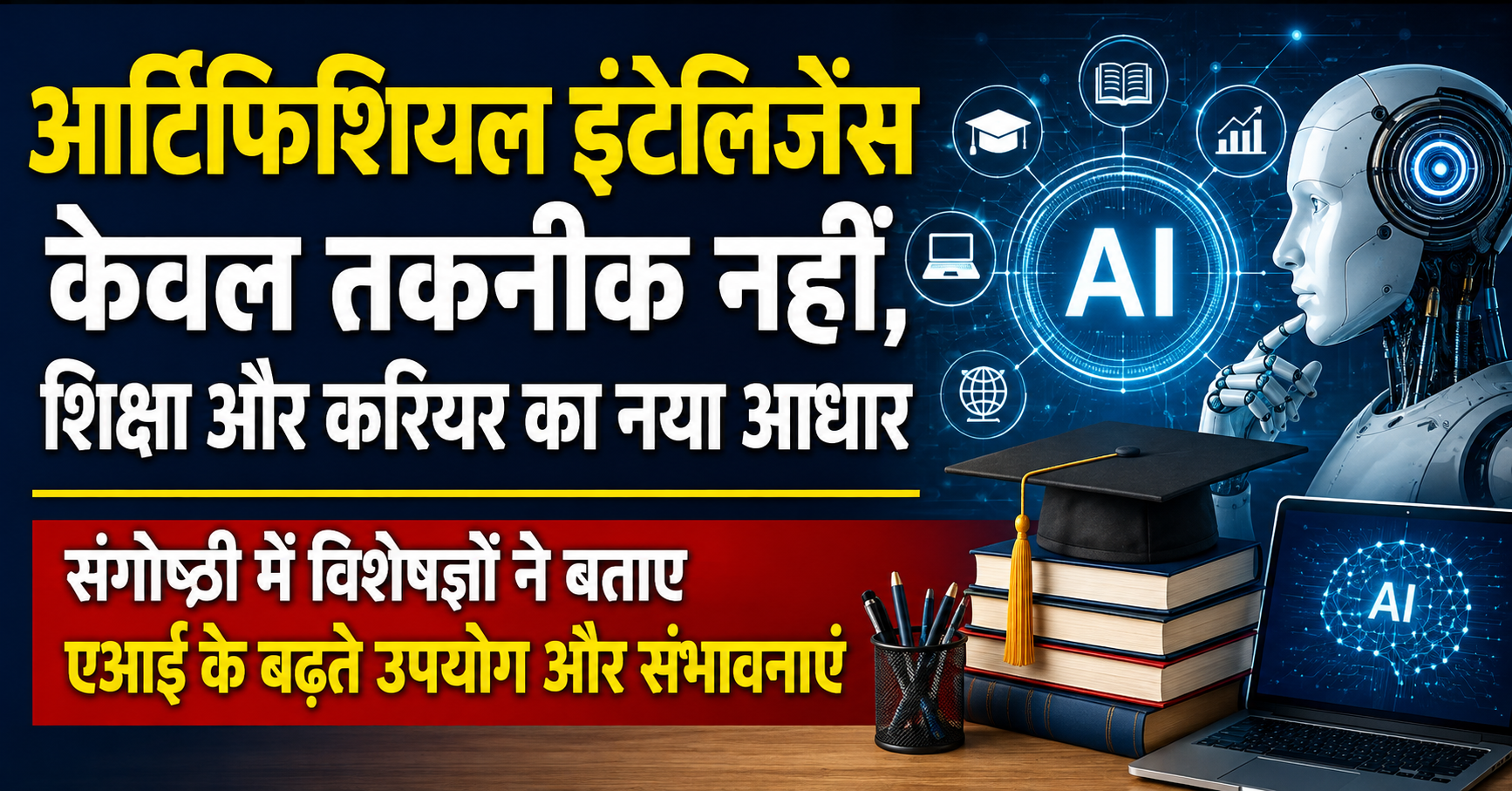
Artificial Intelligence Is No Longer Just Technology; It Is Shaping Education and Careers, Experts Highlight Growing Applications and Future Potential at Seminar
Darbhanga: Artificial Intelligence (AI) is no longer confined to the realm of technology. It is rapidly transforming education, employment, and nearly every aspect of modern society. During a seminar organized on the subject, academicians, technology experts, and students discussed the growing applications of AI, the opportunities it offers, and the challenges that accompany its widespread adoption.
Speakers at the seminar emphasized that Artificial Intelligence is set to become an integral part of everyday life in the coming years. From education and healthcare to agriculture, banking, industry, transportation, and public administration, AI-powered technologies are being adopted across multiple sectors. They noted that understanding AI and developing related skills has become essential for students and young professionals preparing for the future.
AI Is Transforming Education
Experts explained that Artificial Intelligence is reshaping traditional methods of teaching and learning. Students can now access personalized learning resources tailored to their pace, strengths, and academic needs. AI-powered educational platforms help simplify complex subjects, generate practice materials, provide instant language translation, and make learning resources more accessible.
They also stressed that AI should not be viewed as a replacement for teachers. Instead, it serves as a powerful tool that enhances teaching effectiveness, supports educators, and creates a more engaging learning experience.
New Career Opportunities
The seminar highlighted that Artificial Intelligence has created a wide range of new career opportunities. Demand is increasing for professionals skilled in machine learning, data science, robotics, cybersecurity, cloud computing, and AI application development.
Experts said that future success will depend not only on technical knowledge but also on problem-solving abilities, creativity, critical thinking, and innovation. They encouraged educational institutions to integrate AI-related subjects into their academic curricula to better prepare students for emerging industries.
Revolutionizing Healthcare
Discussing AI's role in healthcare, speakers noted that hospitals and medical institutions are increasingly using Artificial Intelligence for early disease detection, medical image analysis, drug research, patient monitoring, and clinical decision support.
AI-powered systems enable doctors to make faster and more accurate diagnoses, improving treatment quality and enhancing patient care.
Expanding Role in Agriculture
The seminar also focused on the growing importance of AI in agriculture. Experts explained that modern AI technologies allow farmers to forecast weather conditions, analyze soil quality, monitor crop health, detect plant diseases, and optimize irrigation systems.
These innovations are helping increase agricultural productivity, reduce production costs, and promote more efficient use of natural resources.
AI in Banking and Financial Services
Artificial Intelligence is also transforming the banking and financial sectors. Experts pointed out that AI is being widely used in digital payments, online banking, fraud detection, customer support, credit assessment, and financial risk management.
These technologies are making banking services faster, more secure, and more transparent while improving the overall customer experience.
Challenges Also Discussed
The seminar examined not only the benefits of AI but also the challenges associated with its rapid adoption. Experts highlighted concerns regarding data privacy, cybersecurity, ethical use of AI, misinformation, algorithmic bias, and changes in employment patterns.
They stressed that Artificial Intelligence must be developed and implemented responsibly to ensure its benefits reach all sections of society while minimizing potential risks.
Encouraging Students to Develop AI Skills
Speakers encouraged students to use Artificial Intelligence not merely as a tool for completing assignments or examinations but as a platform for learning, research, innovation, and creativity.
They emphasized that instead of fearing technological advancements, young people should embrace them by continuously updating their knowledge and acquiring new skills. Lifelong learning and adaptability, they said, will be the key to future success in an increasingly technology-driven world.
Responsibility of Educational Institutions
The seminar also highlighted the responsibility of schools, colleges, and universities to modernize their academic programs in line with technological advancements. Experts recommended introducing courses, workshops, and practical training in Artificial Intelligence, data science, and digital technologies.
They noted that early exposure to these fields would better prepare students for future challenges and enhance their global competitiveness.
Broader Impact on Society and the Economy
According to the speakers, the influence of Artificial Intelligence will extend far beyond the technology sector. It is expected to reshape industries, governance, judicial systems, transportation, media, business, and everyday social interactions.
They stressed the importance of collaboration among governments, educational institutions, industries, and civil society to promote the responsible, ethical, and inclusive use of AI.
Looking Ahead
The seminar concluded that Artificial Intelligence is poised to become one of the most important drivers of future development. If students acquire AI-related skills at an early stage and educational institutions provide adequate resources and training, India can strengthen its position as a global leader in technological innovation.
Experts concluded by stating that Artificial Intelligence is not a substitute for human intelligence but a powerful tool that complements and enhances human capabilities. Its ultimate purpose is to improve efficiency, foster innovation, solve complex problems, and contribute to overall social and economic development. For these reasons, AI is increasingly being recognized not merely as a technological advancement but as a fundamental pillar of education, employment, innovation, and the future economy.


