
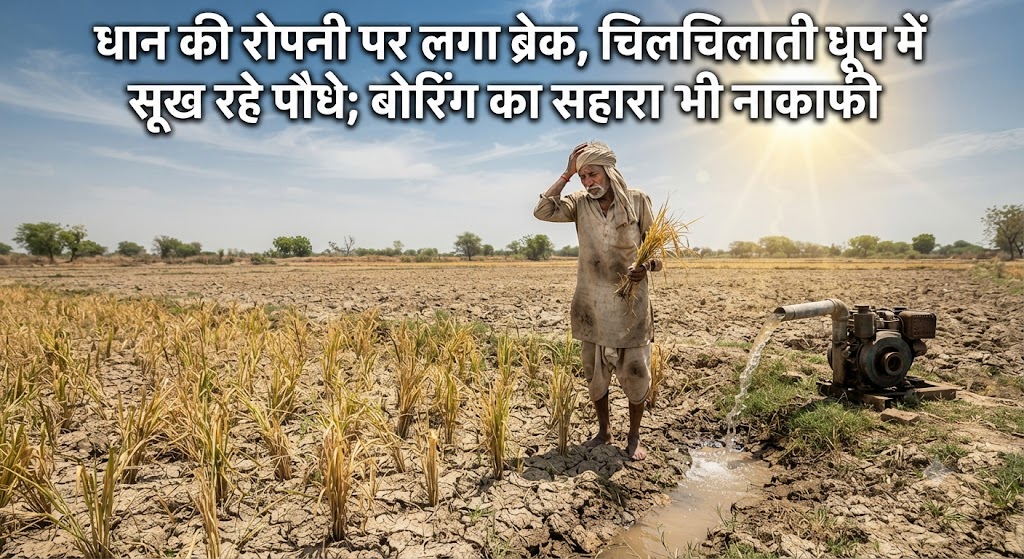
Farmers Distress Due to Monsoon’s Absence; Paddy Transplantation Halted, Seedlings Withering in Scorching Heat; Irrigation via Borewells Proves Insufficient
SAHAKUND (Bhagalpur): In the Sahakund block of Bhagalpur district and its surrounding rural areas, farmers are currently gazing anxiously toward the sky. Despite the month of Sawan (monsoon season) being close, the absence of monsoon rains coupled with scorching sunshine has etched deep lines of worry on the faces of the farmers. Paddy transplantation, which should have been in full swing by now, has come to a complete standstill due to the lack of rainfall. Farmers who prepared paddy nurseries by taking loans or using their savings now see them turning yellow and withering in the fields under the intense heat.
Fire from the Sky, Cracks in the Fields
Paddy cultivation depends primarily on water. Typically, by this time, fields should have been lush with water, and women and men workers should have been seen planting paddy saplings. However, this year, the situation is the exact opposite.
Parched Fields: Due to the lack of rain, moisture in the fields has completely evaporated, leading to deep, wide cracks in the soil.
Stunted Plant Growth: The relentless sun and hot winds have halted the growth of paddy seedlings prepared in nurseries. The plants have not only remained stunted but have also started turning from green to yellow and brown.
Missing the Optimal Window: According to agricultural experts, paddy seedlings should be transplanted into fields within 21 to 25 days. If this window is missed, the plants fail to develop sufficient tillers, ultimately leading to a massive decline in yields.
Reliance on Borewells and Pumps, Yet Ineffective
In response to the adverse weather, some affluent and progressive farmers have started transplantation using private borewells and diesel pump sets. However, this effort is proving to be a "drop in the ocean."
Farmers report that they run pump sets throughout the night to fill their fields with water, but the intensity of the sun by midday is so severe that all the water evaporates, and the fields dry up again. Due to the rapid drying of the soil, even the newly transplanted saplings have begun to wilt, causing both the farmers' hard work and money to go to waste.
Mounting Economic Burden on Farmers
Most farmers in the Sahakund area belong to small and marginal categories, whose livelihoods depend entirely on agriculture. This drought-like situation has broken their economic backbone.
Expensive Diesel: Continuous use of pump sets requires large quantities of diesel, which has multiplied the input costs of farming several times over.
Labor Crisis: Due to the inability of water to stay in the fields, laborers are reluctant to perform transplantation, as planting saplings in dry, hard soil is extremely difficult.
Debt Trap: Many farmers had taken loans from moneylenders or banks for fertilizers, seeds, and plowing. Now, with the fear of crop failure, they are deeply anxious about how they will repay their debts.
Advice from the Agriculture Department and Farmers' Demands
Observing the current situation, the Agriculture Department has advised farmers to take precautionary steps. Experts suggest avoiding large-scale transplantation until sufficient rainfall occurs. They have advised light irrigation during the evening hours to save the seedlings.
Meanwhile, the farmers of Sahakund have pleaded for immediate assistance from the State Government and the district administration. Their key demands include:
Diesel Subsidy: The government should immediately announce a diesel subsidy for farmers so they can save their crops using borewells.
Uninterrupted Power Supply: Uninterrupted power supply of at least 12 to 15 hours should be ensured via agricultural feeders so that electric motor pumps can be utilized.
Declaration of Drought-Affected Area: If there is no significant rainfall in the next few days, the block should be surveyed and declared drought-hit, and farmers should be provided with appropriate compensation.
Awaiting the Mercy of the Rain Gods
For the farmers of Sahakund, the current period is nothing short of a trial by fire. Agriculture is not just a business; it is the backbone of the rural economy. If the paddy crop is affected, it will directly impact not only the farmers' kitchens but will also lead to a surge in food prices in the markets. Now, the farmers' last hope rests with the Rain Gods and government intervention. It remains to be seen whether the monsoon will be kind in the coming days or if the farmers will face another devastating drought.


