
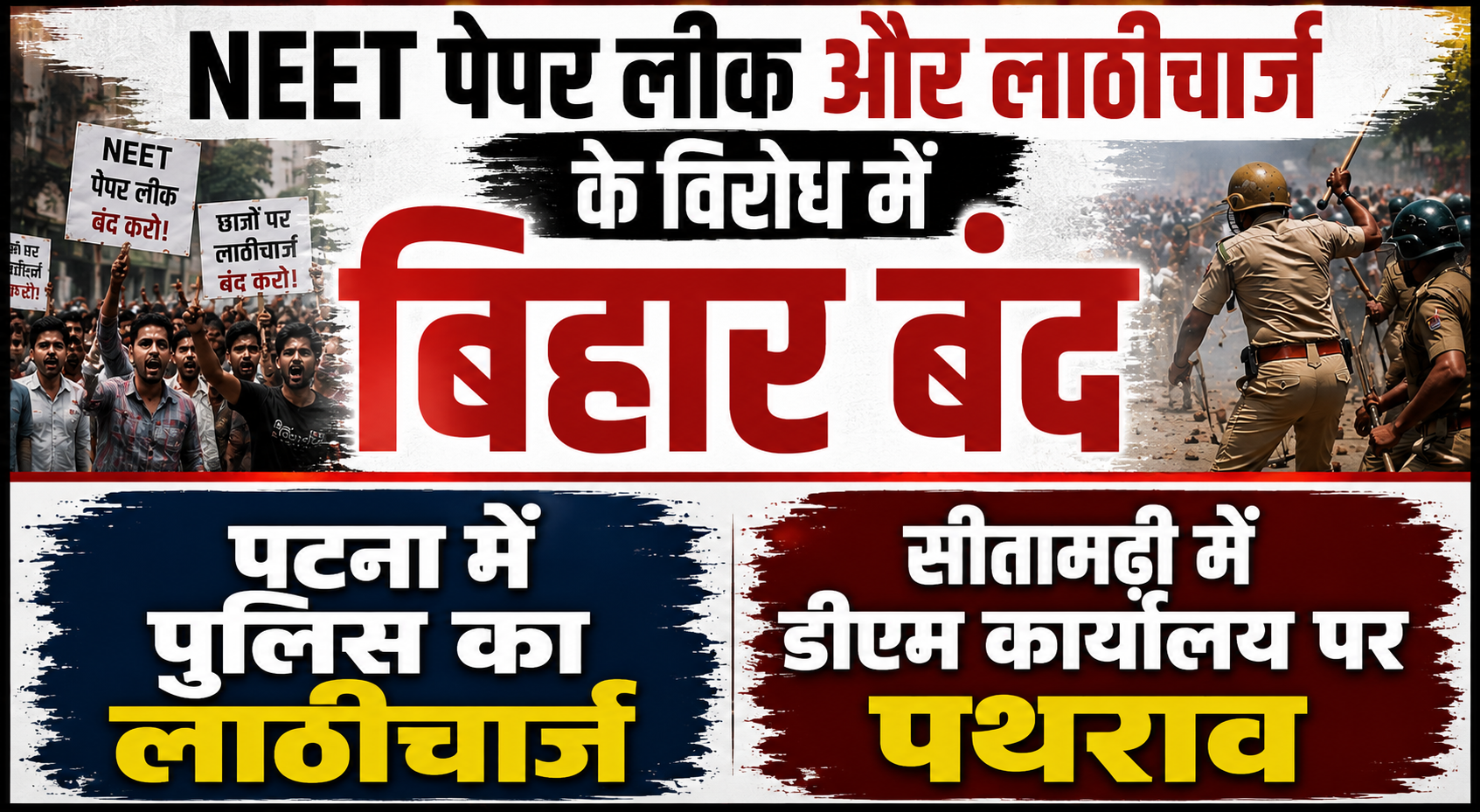
AISA Calls Statewide Shutdown Over Alleged NEET Paper Leak and Police Baton Charge; Police Use Force in Patna, Stone Pelting Reported at Sitamarhi DM Office
Patna: A statewide shutdown (Bihar Bandh) called by the All India Students' Association (AISA) on Saturday over the alleged NEET paper leak and the police baton charge on student protesters had a widespread impact across Bihar. The bandh received support from the Rashtriya Janata Dal (RJD) and several other opposition parties. Thousands of students took to the streets in Patna, Sitamarhi, Muzaffarpur, Darbhanga, Chhapra, Lakhisarai, Gaya, and several other districts. Demonstrations turned violent in many places, prompting police intervention. In Patna, police resorted to a baton charge to disperse protesters, while in Sitamarhi, heavy stone pelting was reported outside the District Magistrate's (DM) office during clashes between demonstrators and security personnel.
From early morning, members of AISA and other student organizations gathered at major intersections, government offices, railway stations, and highways across the state. Carrying banners and placards, they demanded a fair and transparent investigation into the alleged NEET paper leak, strict action against those responsible, and comprehensive reforms in the country's examination system. Protesters argued that the alleged irregularities had undermined the future of millions of students who had spent years preparing for one of India's most competitive entrance examinations.
In the state capital, demonstrations began at key locations, including Dak Bungalow Square, Gandhi Maidan, Ashok Rajpath, and other important areas. Hundreds of students occupied roads, raised slogans against the government, and demanded justice for NEET aspirants. Traffic movement came to a standstill in several parts of the city, causing major inconvenience to commuters, office-goers, students, and emergency services. Police initially attempted to persuade protesters to vacate the roads, but tensions escalated when the crowd refused to disperse. As the situation deteriorated, police carried out a baton charge to restore order.
The protest in Sitamarhi witnessed even greater tension. Demonstrators marched toward the District Magistrate's office, where police attempted to stop them. According to eyewitnesses, the confrontation quickly escalated into stone pelting, creating panic in the area. Police deployed additional personnel to regain control and strengthened security around government offices and other sensitive locations to prevent further disturbances.
The Bihar Bandh also disrupted public transportation across the state. Bus services were affected in several districts, while protesters stopped vehicles and appealed to commuters to support the shutdown. Security arrangements were tightened around railway stations, government buildings, and other strategic locations. District administrations had already deployed additional police personnel and executive magistrates in anticipation of possible unrest.
Leaders of AISA and other student organizations stated that the movement was aimed solely at protecting the interests of students. They alleged that the reported examination irregularities had severely damaged the credibility of the examination system and jeopardized the future of millions of aspirants. They demanded a transparent and time-bound investigation into the alleged paper leak, strict legal action against those responsible, and sweeping reforms to ensure greater transparency and security in future examinations.
The Bihar Bandh also triggered strong political reactions. The Rashtriya Janata Dal (RJD) and several opposition parties expressed support for the students' demands, arguing that maintaining the integrity of competitive examinations is the government's responsibility. Opposition leaders criticized the authorities for failing to address students' concerns promptly, claiming that this had contributed to the growing unrest. Leaders of the ruling alliance, however, appealed for peace and urged demonstrators to avoid violence and damage to public property.
The Bihar Police significantly strengthened security arrangements across the state. Additional police forces, riot control units, and senior officers were deployed in sensitive districts. The police headquarters continuously monitored the situation and instructed district administrations to remain on high alert. Authorities also intensified monitoring of social media platforms to prevent the spread of rumors and misinformation that could further inflame tensions.
Commercial activities were also affected by the shutdown. Many markets remained partially closed, while several businesses delayed opening due to security concerns. Traffic disruptions and interruptions in public transport caused difficulties for thousands of residents carrying out their daily activities.
Education experts emphasized that maintaining the credibility of national-level competitive examinations such as NEET is essential. They recommended strengthening question paper security, enhancing digital surveillance, improving cybersecurity, and ensuring greater accountability at examination centers to prevent similar controversies in the future.
For now, the state administration continues to closely monitor developments across Bihar. Based on reports from different districts, police and civil authorities remain engaged in maintaining law and order. Student organizations have indicated that if their demands are not addressed with concrete action, they may intensify and expand their protests in the coming days.


