
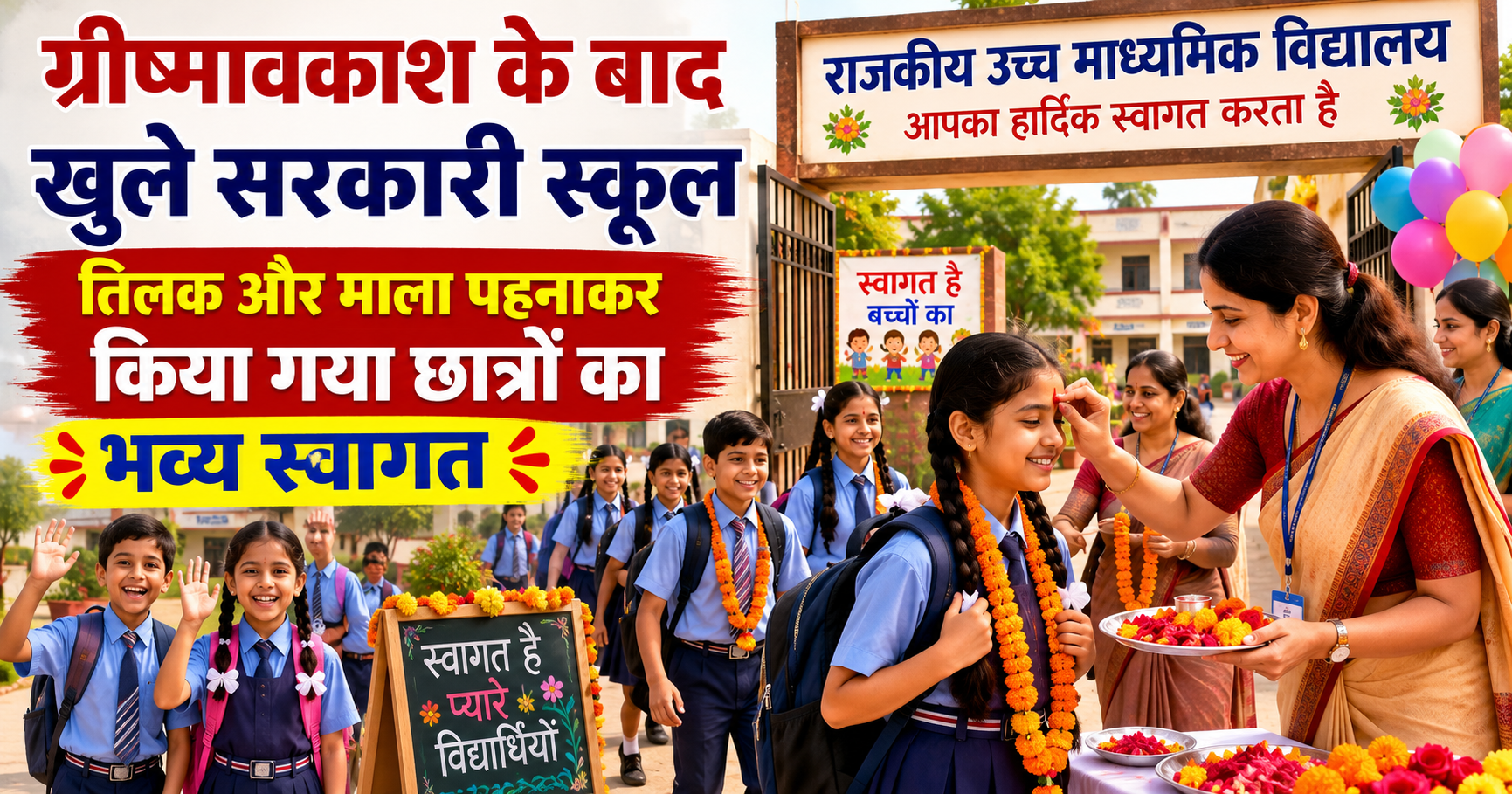
A Festive Return to Government Schools After Summer Vacation; Children Welcomed with Sandalwood Tilak and Flower Showers
Date & Location: June 22, Darbhanga (Bihar)
Special Campaign: State-wide launch of 'Welcome Week' following directives from the Education Department.
Transformed Landscape: Government schools decorated with balloons and flowers, mirroring elite private institutions.
Strategy: No academic pressure during the first week; focus shifts to sports and storytelling to build a student-friendly bond.
Weather Alert: To counter severe heat and humidity, schools will operate in morning shifts until June 30.
Special Correspondent, Darbhanga
Breaking the month-long silence of the summer vacation, when the bells rang across government primary, middle, and senior secondary schools in the Darbhanga district on Monday morning, the scene was far from ordinary. This was not just another routine reopening day; it was a vivid demonstration of the sweeping transformation underway in Bihar's public education system. In strict compliance with directives from the State Government and the Education Department, an unprecedented 'Welcome Week' (Back to School Week) kicked off across the district.
A festive atmosphere enveloped schools across various blocks, including Kewati, Baheri, Jale, Manigachhi, Hayaghat, Bahadurpur, and the Laheriasarai urban area. Right from the early hours of Monday, groups of teachers stood at the school entrances holding platters filled with rose petals, flower garlands, and traditional sandalwood paste. As the young students walked onto the campuses with backpacks slung over their shoulders, teachers warmly greeted them, applying a traditional sandalwood tilak on their foreheads, placing garlands around their necks, and showering them with flower petals.
Rivaling Corporate Schools: The New Face of Public Education
It has been a historical trend that when government schools reopen after an extended break, student attendance in the initial days remains dismally low. Children often exhibit a reluctance to return to the classroom, or in rural areas, they lose academic continuity due to seasonal agricultural work or domestic chores. To fundamentally dismantle this pattern and shift mindsets, the Directorate of Primary Education, Bihar, greenlit this specialized campaign under the defining theme: "Every Child Welcomed, Every Dream Honored."
Under the direct supervision of the District Education Officer (DEO) of Darbhanga, school principals across all blocks were given explicit instructions to give their campuses a vibrant makeover. On Monday morning, arriving students found their school premises decorated with colorful balloons, mango leaf torans (festooned archways), and bright charts bearing welcome messages. The headmaster of a middle school in a remote rural pocket of Darbhanga remarked, "Initially, the children froze, completely taken aback by the grand setup. But the moment we applied the tilak and showered them with petals, their faces lit up with pure joy. Such a grand reception was previously a luxury reserved only for expensive private schools."
Inspiring Melodies in the Morning Assembly Set an Energetic Tone
The first day back was not limited to gate welcomes; the morning assembly (Chetna Satra) was deliberately restructured to be emotionally engaging and highly motivating. In line with the department's protocol, public address systems and sound equipment were set up across all schools, broadcasting inspiring and energetic melodies early in the morning to welcome the children.
Following the morning prayers, teachers addressed the students, reassuring them that school is not a place for rote memorization of textbooks but a launchpad to turn their dreams into reality. Reunited with their classmates, friends, and favorite teachers after the long break, the children appeared visibly thrilled. The excitement doubled during lunchtime as a special menu of hot, nutritious mid-day meals was served, adding to the day's celebratory mood.
The Education Department's Masterstroke: A 6-Day 'Welcome Week' Roadmap
Re-engaging children with mainstream academics after a long holiday can be a steep uphill task. To address this challenge effectively, the Education Department formulated a 'Special Playbook' consisting of a systematic, stress-free routine implemented across all schools in Darbhanga from June 22 to June 27:
Reflection and Dialogue (Monday):
Following the heartwarming reception on day one, the first two periods were entirely devoid of formal textbook teaching. Teachers arranged the students in circles for informal chats, asking them how they spent their summer vacations. The children shared anecdotes and essays on themes like "What I Saw" and "My Experience, My Learning" in their own raw, unpolished words, successfully shedding their initial hesitation.
Boarding the 'Maths Express' (Tuesday & Wednesday):
The focus for the second and third days shifted toward making mathematics—a subject traditionally feared by many—highly engaging. Schools are organizing mathematical games, number puzzles, and oral rapid-fire quizzes. The top three fastest-responding children are being crowned the class's 'Stars of the Day,' with their names proudly written on the blackboard.
The 'Reading Express' and the Magic of Storytelling (Thursday & Friday):
To enhance language proficiency and reading skills, specialized sessions will run on the fourth and fifth days. Principals and senior faculty members will narrate inspiring life stories of national icons like Dr. APJ Abdul Kalam, Mahatma Gandhi, and Babasaheb Ambedkar. This will be followed by loud-reading sessions to help students perfect their pronunciation and comprehension.
Parent-Teacher Meeting and Recognition Ceremony (Saturday):
The welcome week will culminate on June 27 with a grand Parent-Teacher Meeting (PTM). Attendance is mandatory across all schools on this day. Teachers will sit down with parents to discuss regular student attendance, the Mid-Day Meal (MDM) scheme, and various state welfare benefits. Additionally, children who maintained perfect attendance through the week, along with their proactive parents, will be publicly honored on stage.
Tackling the Heatwave: Administrative Alertness
While enthusiasm ran sky-high across schools, the severe heatwave, intense humidity, and Loo (hot summer winds) currently sweeping through Darbhanga and North Bihar have kept the local administration on high alert. Prioritizing student health and safety above all else, the Bihar Education Department enacted a crucial administrative intervention.
Official Directive:
The state government has extended the previously mandated morning-shift schedule for schools until June 30. Currently, all government schools in Darbhanga are strictly operating from 6:30 AM to 12:30 PM.
Furthermore, the district administration has issued a stern directive to all school managements to ensure an uninterrupted supply of clean, cold drinking water on campus. First-aid kits have been stocked with ORS packets and essential life-saving medicines to ensure immediate medical attention if any child falls ill due to the heat. Closing schools by 12:30 PM allows children to head home safely, avoiding the most punishing hours of the afternoon sun.
Social and Educational Impact: Winds of Grassroots Change
Reports coming out of rural pockets of Darbhanga, such as Jale, Manigachhi, and Alinagar, indicate that this initiative has had a profound, positive psychological impact on local communities. Several parents, many of whom are daily-wage laborers or small-scale farmers, grew emotional, noting that they had never before witnessed government school teachers putting garlands around their children's necks or performing an auspicious welcome ritual for them.
Historic Surge in Attendance: On the very first day, a majority of schools in Darbhanga recorded an attendance spike of 20 to 25 percent compared to standard reopening days, marking the campaign's initial major victory.
Curbing Dropout Rates: Post-vacation periods are notoriously vulnerable windows where children from marginalized backgrounds drop out to assist in household labor. This festive welcome acted like a magnet, drawing them back into the educational fold.
Fostering an Emotional Bond: The traditional Indian welcoming method of tilak, garlands, and flowers effectively stripped away the old, fear-driven aura of government schools where discipline was often synonymous with strictness. Children are now beginning to view their school as an extension of their home.
The heartening scenes emerging from the government schools of Darbhanga are not a mere single-day gimmick or an empty formality. Instead, they stand as living proof of a deep qualitative and structural overhaul taking root within Bihar's public education framework. If the state machinery continues to hold the hands of these young minds with the same level of empathy, warmth, and dedication, the day is not far when the allure of private schools will pale in comparison, and public institutions will reclaim their position as the strongest pillars for building the nation's future.


