
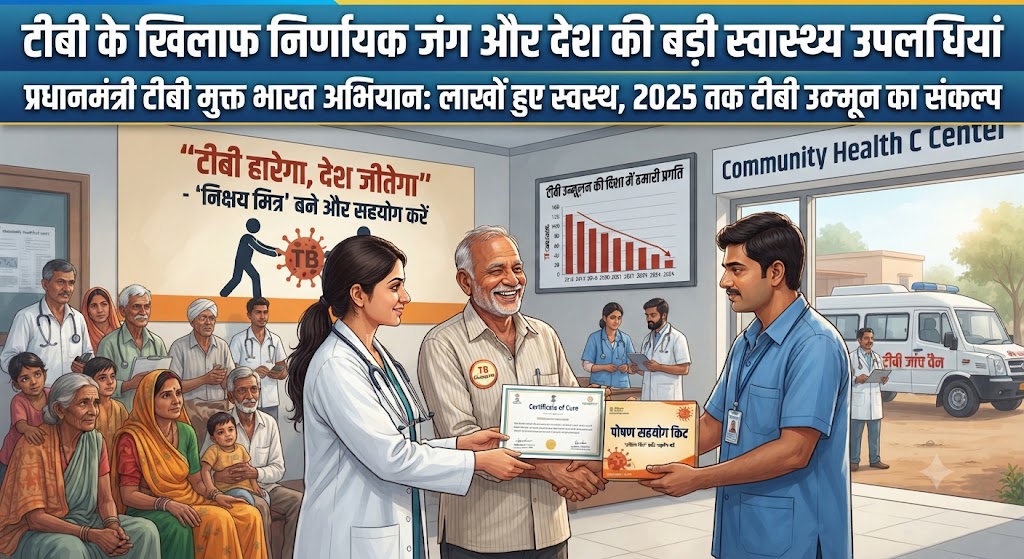
A Decisive Battle Against TB and the Country's Major Health Achievements
New Delhi, Special Correspondent: Continuous, major, and stringent steps are being taken by the Government of India under the National Tuberculosis Elimination Programme (NTEP) to make the country tuberculosis (TB) free. To eradicate a severe and infectious disease like TB from its roots, the government has transformed it from a mere medical scheme into a nationwide 'Jan Andolan' (people's movement). According to data from the World Health Organization's (WHO) Global TB Report, India has recorded a significant decline in new TB cases and deaths over the past few years, which is proof that the country is moving in the right direction.
Background and Objectives of the Programme (The Journey of NTEP)
In 2020, the government renamed the 'Revised National Tuberculosis Control Programme' (RNTCP) to the National Tuberculosis Elimination Programme (NTEP). Its primary objective is to completely eliminate the TB disease from the country five years ahead of global targets (the year 2030). This programme is primarily built on four strong pillars:
Detect: Timely and high-quality screening of suspected patients.
Treat: Providing modern and effective medicines to patients.
Prevent: Stopping the transmission of infection and protecting high-risk groups.
Build: Strengthening the healthcare infrastructure and administrative support.
Major Achievements: Data and Relieving News
According to recent government data and global reports, the policies being implemented against TB in India are proving to be extremely effective:
Rapid Decline in TB Cases: Compared to the year 2015, the rate of new TB cases in the country has dropped by approximately 21%. This decline is occurring at nearly twice the pace of the global average decrease.
Sharp Reduction in Mortality Rate: During the same period, a decline of 25% to 28% has also been recorded in the statistics of deaths caused by TB.
Treatment Coverage: The treatment coverage for TB patients in the country has increased to 92%, saving the lives of a greater number of patients.
Nikshay Portal and Case Notification: Tracking of patients has been simplified through the Nikshay digital platform. In the years 2023, 2024, and 2025, more than 2.5 million TB cases were registered consecutively, which has greatly helped bridge the gap in finding 'missing cases'. With increased participation from private sector hospitals and doctors, there has also been a record growth in notifications from the private sector.
Pradhan Mantri TB Mukt Bharat Abhiyan and 'Nikshay Mitra' Initiative
To provide social and nutritional support to TB patients alongside medical assistance, the Pradhan Mantri TB Mukt Bharat Abhiyan was launched by President Droupadi Murmu:
Nikshay Mitra Scheme: Under this initiative, capable citizens, public representatives, corporate institutions (under CSR), and non-governmental organizations adopt TB patients by becoming 'Nikshay Mitras'.
Nutritional Support: Adopted patients are regularly distributed nutritious food kits so that the impact of medicines on their bodies is enhanced and recovery is accelerated. Lakhs of patients have received community support under this scheme.
Latest Technology and 100-Day Intensive Campaign
To further sharpen the process of TB elimination, the government has taken several technological and practical steps:
BPaLM Regimen: For the treatment of drug-resistant TB, the government has included the BPaLM regimen—comprising bedaquiline, pretomanid, linezolid, and moxifloxacin—which significantly shortens treatment duration and is safer and more effective for patients.
Use of Artificial Intelligence (AI): AI-driven technology is now being utilized for the rapid screening of TB. Digital readings of chest X-rays and AI systems capable of estimating infections from cough sounds have simplified screening even in remote areas.
100-Day Intensive Campaign: The Ministry of Health periodically runs special 100-day TB elimination campaigns. Under this, house-to-house screenings are conducted in high-risk areas, urban wards, and densely populated settlements.
The National Tuberculosis Elimination Programme (NTEP) has proven in India that if political will, robust technological intervention, state-of-the-art medical practices, and public participation (Jan Andolan) are combined, any epidemic can be overcome. Although the challenge has not ended entirely, the pace with which India has reduced TB cases and deaths makes it clear that the country is rapidly advancing toward its goal of a healthy, strong, and 'TB-Free India'.


