
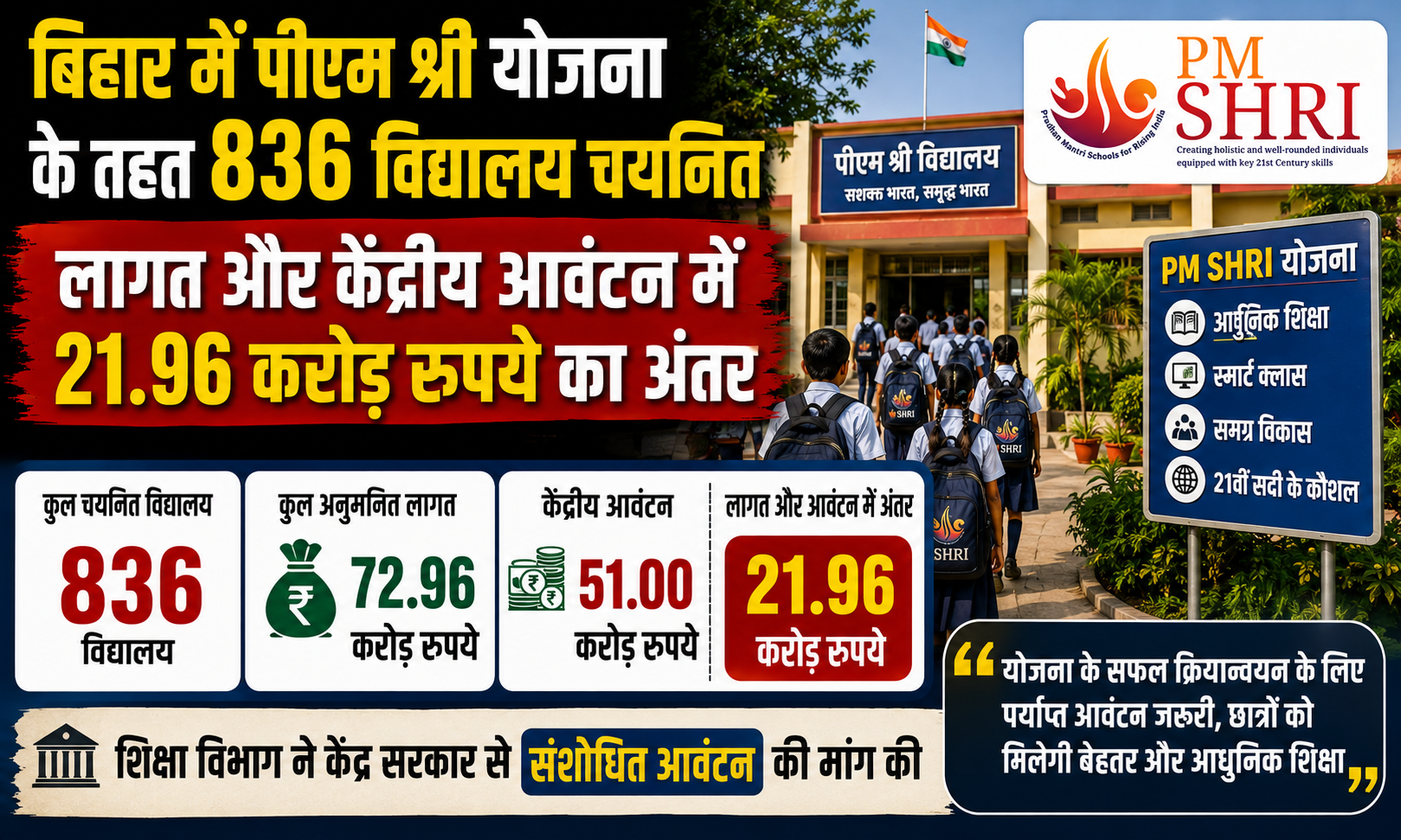
836 Schools Selected Under PM SHRI Scheme in Bihar; Education Department Seeks Revised Central Allocation After ₹21.96 Crore Funding Gap
Patna: A significant financial issue has emerged in the implementation of the PM SHRI (Prime Minister Schools for Rising India) Scheme in Bihar, which aims to improve the quality of school education and modernize government schools. According to an assessment by the state's Education Department, there is now a funding gap of ₹2,196.06 lakh (approximately ₹21.96 crore) between the amount expected from the Central Government under the scheme and the actual project cost.
To address this shortfall, the Education Department has written to the Central Government requesting a revision of the financial allocation under the PM SHRI Scheme.
Officials believe that bridging this gap in time will help ensure that the proposed infrastructure and educational development projects in the selected schools are completed on schedule, allowing students to benefit from modern learning facilities.
836 Schools Selected Under the Scheme
A total of 836 government schools in Bihar have been selected under the PM SHRI Scheme. These institutions are to be developed into model schools in line with the objectives of the National Education Policy (NEP) 2020, offering high-quality, inclusive, and technology-enabled education.
The selected schools are expected to be equipped with smart classrooms, digital learning resources, modern science and computer laboratories, upgraded libraries, sports facilities, safe drinking water, hygienic sanitation infrastructure, green campuses, and facilities that are accessible to students with disabilities.
What Is the PM SHRI Scheme?
The PM SHRI (Prime Minister Schools for Rising India) Scheme is a flagship initiative of the Government of India aimed at transforming selected government schools into centers of excellence.
The program focuses not only on improving physical infrastructure but also on promoting innovative teaching methods, digital education, skill development, environmental sustainability, and the holistic development of students.
Its objective is to create model schools that can serve as benchmarks and inspire improvements across the broader government school system.
Why Has the Funding Gap Emerged?
According to officials from the Education Department, the gap has arisen because the actual cost of implementing the scheme has exceeded the original estimates.
Factors such as rising prices of construction materials, higher costs of digital equipment, infrastructure upgrades, and other administrative expenses have increased the total project expenditure.
As a result, there is now an estimated funding shortfall of ₹2,196.06 lakh between the approved central allocation and the revised project cost.
Request for Revised Allocation
In view of this financial gap, the Bihar Education Department has submitted a detailed proposal to the Central Government seeking a revised allocation under the scheme.
The department believes that if the additional funds are approved, all planned development works in the selected schools can be completed without financial constraints, ensuring both quality implementation and timely completion.
These facilities are intended to create a more engaging and future-ready learning environment.
In Line with the National Education Policy
The National Education Policy (NEP) 2020 places strong emphasis on integrating technology, innovation, and experiential learning into school education.
The PM SHRI Scheme is considered an important initiative in achieving these objectives by helping students develop critical thinking, creativity, digital literacy, problem-solving skills, and practical knowledge.
Benefits for Teachers
Along with infrastructure development, the scheme also focuses on the professional development of teachers.
Educators will receive training in modern teaching methodologies, digital tools, classroom technology, and innovative instructional practices. This is expected to improve the overall quality of teaching and create more interactive and student-centered classrooms.
A New Dimension for Bihar's School Education
Education experts believe that effective implementation of the PM SHRI Scheme could significantly transform Bihar's school education system.
Modernized government schools with upgraded infrastructure and digital facilities are expected to provide a better learning environment for students while strengthening public confidence in government-run educational institutions.
The initiative is also expected to accelerate the adoption of technology-driven and experiential learning across the state.
Importance of Timely Financial Support
Experts point out that the success of large-scale educational development programs depends heavily on the timely availability of financial resources.
A substantial gap between sanctioned funds and actual project costs can affect both the pace and quality of implementation. This is why the Bihar Education Department has sought a revision of the central allocation to prevent delays and ensure smooth execution of the scheme.
The implementation of the PM SHRI Scheme in Bihar is progressing with 836 government schools selected for transformation into modern model institutions. However, the Education Department has identified a funding gap of ₹2,196.06 lakh (approximately ₹21.96 crore) between the approved central allocation and the revised project cost.
The department has therefore requested the Central Government to revise the allocation. If the additional funding is approved, it is expected to accelerate the development of smart classrooms, digital learning infrastructure, modern laboratories, upgraded school facilities, and high-quality educational resources, helping prepare students for the demands of a rapidly evolving future.


