
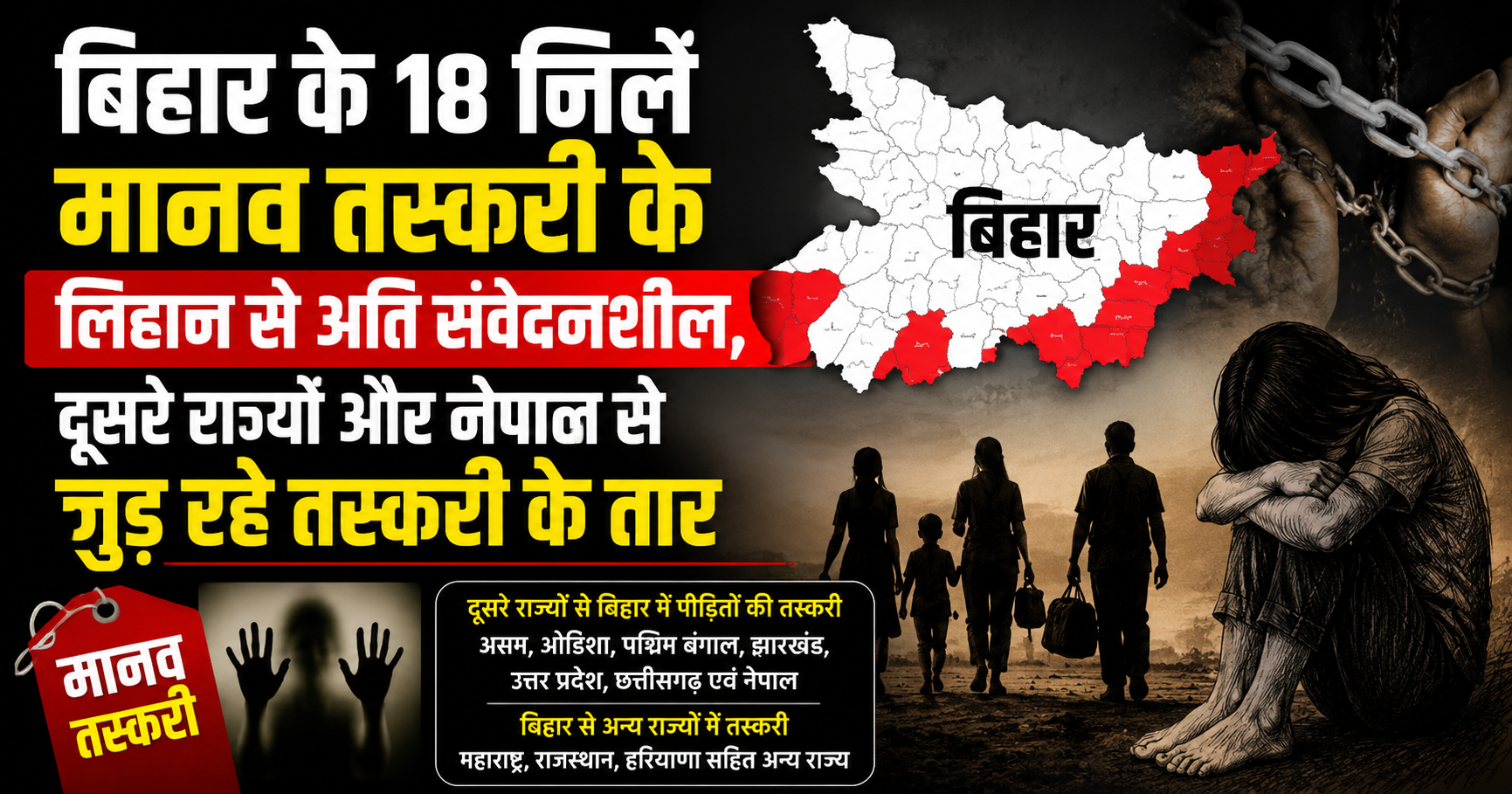
18 Districts in Bihar Identified as Highly Sensitive to Human Trafficking; Links Found to Other States and Nepal
Patna: Human trafficking has once again emerged as a serious concern in Bihar, with 18 districts identified as highly sensitive from the perspective of trafficking. According to the details available, cases involving the trafficking of victims into Bihar from Assam, Odisha, West Bengal, Jharkhand, Uttar Pradesh, Chhattisgarh and neighboring Nepal have been identified. At the same time, cases have also been reported in which people from Bihar were taken to states such as Maharashtra, Rajasthan and Haryana. The situation indicates that Bihar is not only a source state for trafficking but may also be used as a transit route in several cases.
Human trafficking networks often lure people with promises of employment, higher wages, domestic work, marriage, education and better opportunities. Young people and children from economically weaker families and rural areas are particularly vulnerable. In many cases, families are assured that their children or relatives will receive good jobs in another city. However, after reaching the destination, victims may be forced into bonded labour, domestic work, sexual exploitation or other forms of abuse.
Growing Challenge in Border Areas
Bihar's geographical location makes it particularly vulnerable to human trafficking. The state shares a long and largely open border with Nepal, while several districts are connected to Uttar Pradesh, Jharkhand and West Bengal. This can make it easier for trafficking networks to move people from one state or country to another.
Border areas are especially vulnerable because employment-related migration networks can sometimes be misused by traffickers. Apart from cases involving victims entering Bihar from Nepal, authorities may also have to investigate cases in which people from Bihar are taken to Nepal or other parts of India. Such cases require coordination among agencies at the interstate and international levels.
Studies have also highlighted Bihar and Uttar Pradesh as important areas in the context of human trafficking and identified the Nepal border as a significant factor in the trafficking landscape.
Trafficking Networks Extending from Bihar to Maharashtra, Rajasthan and Haryana
Migration from Bihar to other states for employment can create opportunities for trafficking networks. A large number of workers travel to other states in search of jobs. Some gangs allegedly exploit this situation by taking people outside the state under the pretext of providing employment.
Cases involving people being taken to states such as Maharashtra, Rajasthan and Haryana have raised concerns about possible trafficking networks. Victims may face underpayment, forced labour, restrictions on movement and threats.
The situation can be even more serious in the case of children. They may be taken to small factories, roadside eateries, shops, households or other parts of the unorganized sector for work. Since many children are far from their families and villages, they may have little opportunity to seek help.
False Employment Promises Becoming a Major Tool
Promises of employment are considered one of the most common methods used by traffickers. In rural areas, traffickers often target people who urgently need jobs and money. They are promised good salaries along with food and accommodation in another city.
However, once the victim reaches another state, the situation can change completely. In some cases, phones are taken away, contact with family members is restricted and victims are threatened if they try to leave. In certain cases, wages may be withheld and victims may be prevented from returning home.
Human trafficking is not limited to physical exploitation. It can involve economic exploitation, forced labour, sexual exploitation, child labour and other forms of abuse.
Trafficking of Children Remains a Major Concern
Child trafficking has remained a longstanding concern in Bihar. Organizations working for child protection have documented efforts to rescue and rehabilitate children affected by trafficking.
Children are often taken away from their homes after being promised jobs or a better future. In many cases, parents may not know where their children are actually being taken. Poverty, lack of education and limited employment opportunities can increase the vulnerability of families.
Experts believe that special attention should be given to children who have dropped out of school and those belonging to economically weaker families. Awareness campaigns at the panchayat level, monitoring school attendance and investigating suspicious placement agencies could play an important role in preventing trafficking.
Missing Persons Cases Also Raise Concerns
Cases involving missing children and adults are also important in trafficking investigations. In March 2026, the National Human Rights Commission took cognizance of reports concerning a large number of missing persons in several states, including Bihar, and sought reports from the concerned authorities.
However, not every missing-person case can be considered a human trafficking case. At the same time, experts believe that the possibility of trafficking should not be ignored while investigating cases involving children and women who remain missing for extended periods.
Strengthening Anti-Human Trafficking Units
Efforts are also being made to strengthen the police mechanism against human trafficking in Bihar. In July 2026, the Bihar Police leadership indicated plans to establish Anti-Human Trafficking Units in all women's police stations across the state.
The objective is to improve the identification of trafficking cases, protect victims and strengthen mechanisms for their rehabilitation. Bihar Police has also conducted special operations against trafficking networks in the past, including efforts to rescue minors and other victims and take action against people allegedly involved in trafficking.
Police Action Alone Cannot Stop Trafficking
Experts believe that police action alone will not be enough to eliminate human trafficking. Employment, education, skill development and social awareness are equally important.
On August 8, 2026, the Bihar government also emphasized employment and skill development as important tools to combat human trafficking, linking economic insecurity with vulnerability to trafficking and stressing the need to expand employment opportunities.
If young people in rural areas have access to local employment and skill-development opportunities, their dependence on unknown agents promising jobs in other states may decrease. Panchayats and local administrations should also develop mechanisms to verify employment agents and share information about suspicious placement agencies.
Greater Vigilance Needed at Railway Stations and Borders
Breaking trafficking networks requires increased surveillance at railway stations, bus terminals and border areas. Traffickers may move victims in groups from one location to another. Therefore, better coordination among police, railway authorities, transport departments, child protection units and non-governmental organizations is essential.
Coordination becomes particularly important in cases involving the Nepal border. Once a victim is identified, the process of safely bringing the person back, providing legal assistance and reconnecting them with their family becomes a crucial part of the response.
Rehabilitation of Victims Is Equally Important
People rescued from trafficking often face major challenges when attempting to return to normal life. Many victims continue to experience psychological, economic and social difficulties long after being rescued. Therefore, simply conducting a rescue operation and sending victims back home is not enough.
Victims need safe shelter, legal assistance, psychosocial support, education and employment opportunities. In the case of children, special attention must be given to their return to school and the economic condition of their families.
The identification of 18 districts in Bihar as highly sensitive to human trafficking is a serious warning for the state. The possible trafficking routes connecting Assam, Odisha, West Bengal, Jharkhand, Uttar Pradesh, Chhattisgarh and Nepal with Bihar, as well as routes from Bihar to states such as Maharashtra, Rajasthan and Haryana, indicate that the problem may have an interstate and, in some cases, international dimension.
Combating human trafficking will require more than police action. Employment generation, education, skill development, surveillance in border areas, effective tracing of missing persons and rehabilitation of victims must all receive equal attention.
Strong coordination among the police, administration, panchayats, schools, railway authorities, social organizations and the public can help weaken trafficking networks.
Most importantly, people need to remain alert to false employment promises, suspicious agents and attempts to take children away from their families. Early identification and timely reporting can be among the most effective ways to prevent potential victims from falling into the hands of traffickers.


