
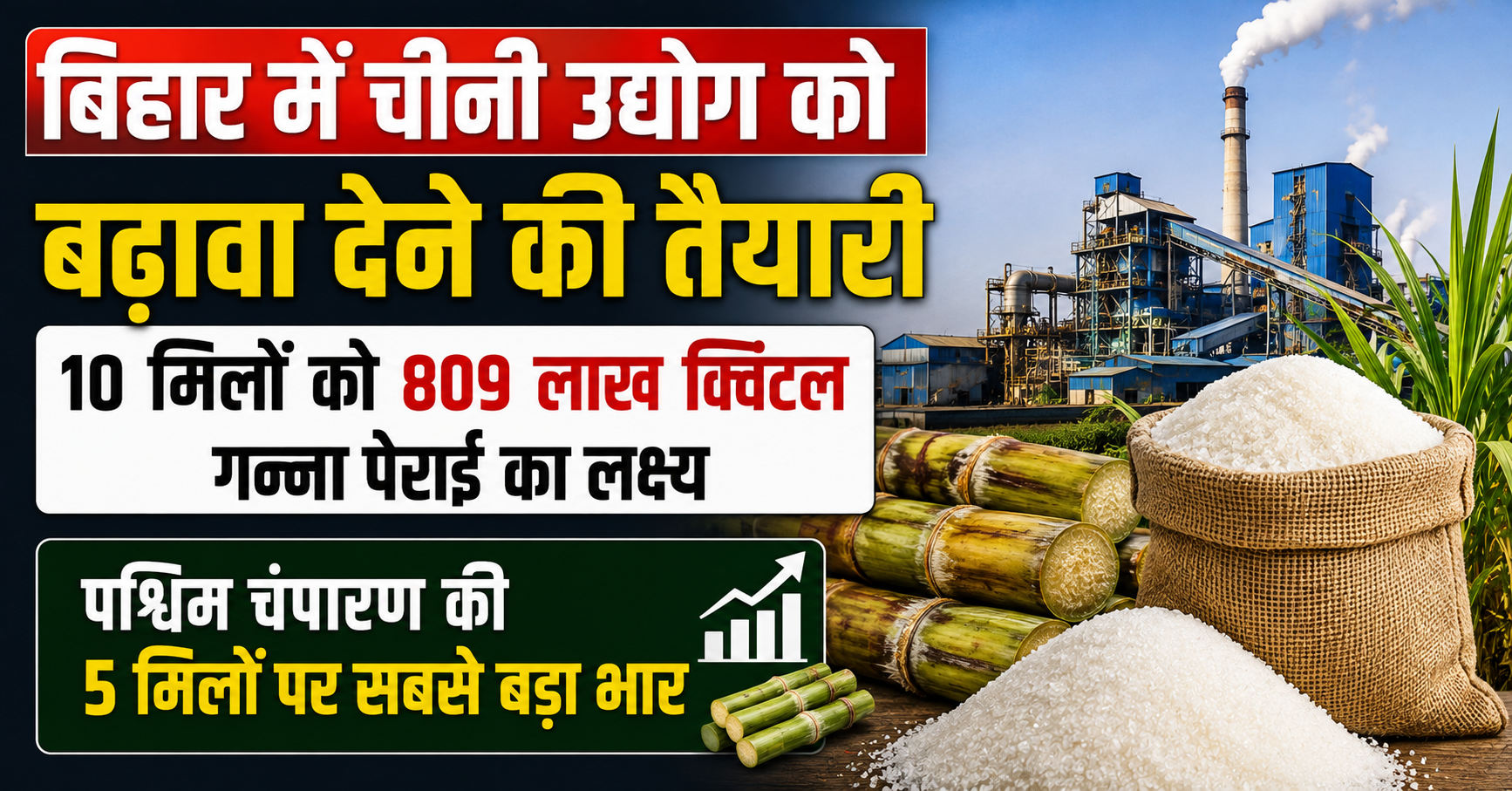
10 Operational Mills to Crush 809 Lakh Quintals; West Champaran Gets Largest Share
Patna: Bihar has set an ambitious target for the 2026-27 sugarcane crushing season as the state steps up its focus on the sugar industry and seeks to expand sugarcane cultivation. The state’s 10 operational sugar mills have been collectively assigned a target of crushing 809 lakh quintals of sugarcane during the upcoming season.
The target is aimed not only at increasing sugar production but also at making better use of the capacity of operational sugar mills, expanding sugarcane cultivation and strengthening the rural economy.
West Champaran has been given the largest share of the target. The district’s five operational sugar mills have collectively been assigned a target of 526 lakh quintals of sugarcane crushing.
The development is significant because the same five mills crushed slightly more than 569 lakh quintals of sugarcane collectively during the 2025-26 season. The difference between last season’s actual crushing and the new target indicates that the latest target-setting exercise has been based on a broader strategy rather than simply previous crushing figures.
One of the major reasons behind the increase in the overall target is the decision to set sugarcane cultivation targets even for districts where there are currently no operational sugar mills.
A portion of the sugarcane produced in these districts is expected to be supplied to nearby sugar mills, while the remaining crop could be used by the jaggery industry.
809 Lakh Quintals Crushing Target for 2026-27
The Bihar government has set a combined target of 809 lakh quintals for the state’s 10 operational sugar mills for the upcoming crushing season.
The target is part of a broader strategy to expand sugarcane cultivation, improve farmers’ incomes, strengthen the sugar industry and create additional opportunities in the jaggery sector.
Sugarcane is an important cash crop and has a direct connection with the rural economy. Greater sugarcane production provides farmers with a market for their crop while ensuring a regular supply of raw material for sugar mills.
Bihar’s sugarcane industry is concentrated largely in northern and northwestern parts of the state, with West Champaran continuing to remain one of the most important sugarcane-producing regions.
West Champaran Gets Target of 526 Lakh Quintals
The five sugar mills in West Champaran have collectively been assigned a target of crushing 526 lakh quintals of sugarcane in the 2026-27 season.
This represents a significant portion of Bihar’s overall target of 809 lakh quintals and highlights the continuing importance of West Champaran in the state’s sugar industry.
The district has a substantial area under sugarcane cultivation, providing local sugar mills with a large supply of raw material.
During the 2025-26 crushing season, the same five mills reportedly crushed slightly more than 569 lakh quintals of sugarcane collectively.
The new target-setting exercise, however, appears to have taken into account the broader expansion of sugarcane cultivation beyond traditional sugar-mill catchment areas.
Sugarcane Cultivation to Expand to Districts Without Sugar Mills
One of the most important aspects of the new strategy is the expansion of sugarcane cultivation to districts where no sugar mills are currently operating.
Several districts in Bihar have farmers cultivating sugarcane despite the absence of a local sugar mill. In such areas, farmers may have limited options for selling their produce, while transportation costs can also become a challenge.
The government’s decision to set cultivation targets in these districts is aimed at encouraging farmers to grow more sugarcane and increasing overall production.
However, transporting sugarcane from districts without local mills to nearby processing facilities could become a major logistical challenge.
Efficient transportation arrangements and stronger links between farmers and nearby sugar mills will therefore be important for the success of the initiative.
Part of the Crop Will Go to Sugar Mills, Rest to Jaggery Industry
The new strategy also places emphasis on the jaggery industry as an alternative market for sugarcane.
It may not be practical to transport the entire sugarcane crop produced in districts without sugar mills to distant processing units. Therefore, some of the crop can be supplied to nearby sugar mills, while the remaining sugarcane can be used locally for jaggery production.
This could provide farmers with an additional market for their produce and reduce their dependence solely on sugar mills.
Jaggery production can also create opportunities for small-scale entrepreneurs and rural businesses. Small processing units and traditional crushers can be used to produce jaggery at the local level.
New Opportunity for Farmers
Sugarcane is an important cash crop for farmers. If procurement and payment systems are efficient, it can become a more attractive agricultural option.
Including districts without sugar mills in the cultivation plan could provide farmers in those regions with an additional crop option.
However, farmers will continue to focus on three key issues: the price of sugarcane, timely payment and availability of a reliable market.
If these areas are strengthened, the government’s plan to expand sugarcane cultivation could deliver better results on the ground.
Sugar Mills Will Need to Improve Capacity
Achieving the target of 809 lakh quintals will require the 10 operational sugar mills to function efficiently throughout the crushing season.
Before the season begins, mills need to complete maintenance and repairs of machinery and ensure that technical systems are ready for continuous operation.
Any major technical breakdown during the crushing season could affect the processing of sugarcane and create difficulties for farmers waiting to supply their crop.
Therefore, preparations at sugar mills will be an important factor in determining whether the state can achieve its target.
Transportation of Sugarcane Will Be a Major Challenge
Expansion of sugarcane cultivation will also increase the need for efficient transportation.
Farmers located far from sugar mills may have to transport their crop over longer distances. Since freshly harvested sugarcane needs to reach processing facilities within a reasonable period, transportation delays can affect its quality and create losses.
The government and sugar mills will therefore need to strengthen transportation arrangements.
Collection centres and better links between farmers and nearby mills could help reduce transportation difficulties.
Jaggery Industry Could Get a Major Boost
The use of surplus sugarcane for jaggery production could create new economic opportunities in rural Bihar.
Jaggery has demand in Bihar as well as in other parts of the country. If the state improves production quality, packaging and marketing, locally produced jaggery could potentially reach larger markets.
Small jaggery producers may require better equipment, technical training and access to organized markets.
Sugarcane can be used not only for producing sugar but also for jaggery, khandsari and other products. Expanding these activities could help create a broader sugarcane-based economy.
Impact on Rural Employment
The sugarcane industry generates employment beyond farming.
Activities such as planting, harvesting, transportation, sugar-mill operations, jaggery production and related businesses support thousands of workers.
If sugarcane cultivation expands and the 809-lakh-quintal crushing target is achieved, rural economic activity could increase significantly.
Districts without sugar mills could particularly benefit from new opportunities in jaggery production, transportation and small-scale processing.
Better Coordination Will Be Essential
Setting a target is only the first step. Achieving it will require coordination between the agriculture department, sugar industry authorities, sugar mills, farmers and local administrations.
Farmers will need timely access to quality planting material, technical advice and agricultural support.
Sugar mills will need to prepare their machinery and procurement systems in advance. Transportation arrangements will have to be strengthened, while timely payment to farmers will remain a key priority.
Without these supporting systems, simply increasing the crushing target may not result in a proportional increase in actual production and processing.
2026-27 Season Could Be Important for Bihar’s Sugar Industry
The 2026-27 crushing season could prove important for Bihar’s sugar industry.
The state has set a combined crushing target of 809 lakh quintals for 10 operational sugar mills, with the five mills in West Champaran receiving the largest combined target of 526 lakh quintals.
A notable feature of this year’s planning is the inclusion of districts without operational sugar mills in the sugarcane cultivation strategy.
Sugarcane produced in these areas can partly be transported to nearby sugar mills, while the remaining crop can be utilized by local jaggery producers.
If farmers receive reliable markets, fair prices, timely payments and efficient transportation facilities, the initiative could help expand Bihar’s sugarcane sector.
Overall, the government’s strategy appears to go beyond increasing sugar production. It seeks to build a wider sugarcane-based rural economy involving farmers, sugar mills, jaggery producers, transporters and rural workers.
The major challenge now will be to implement the plan effectively and ensure that the ambitious crushing and cultivation targets translate into tangible benefits for farmers and the wider rural economy.


