
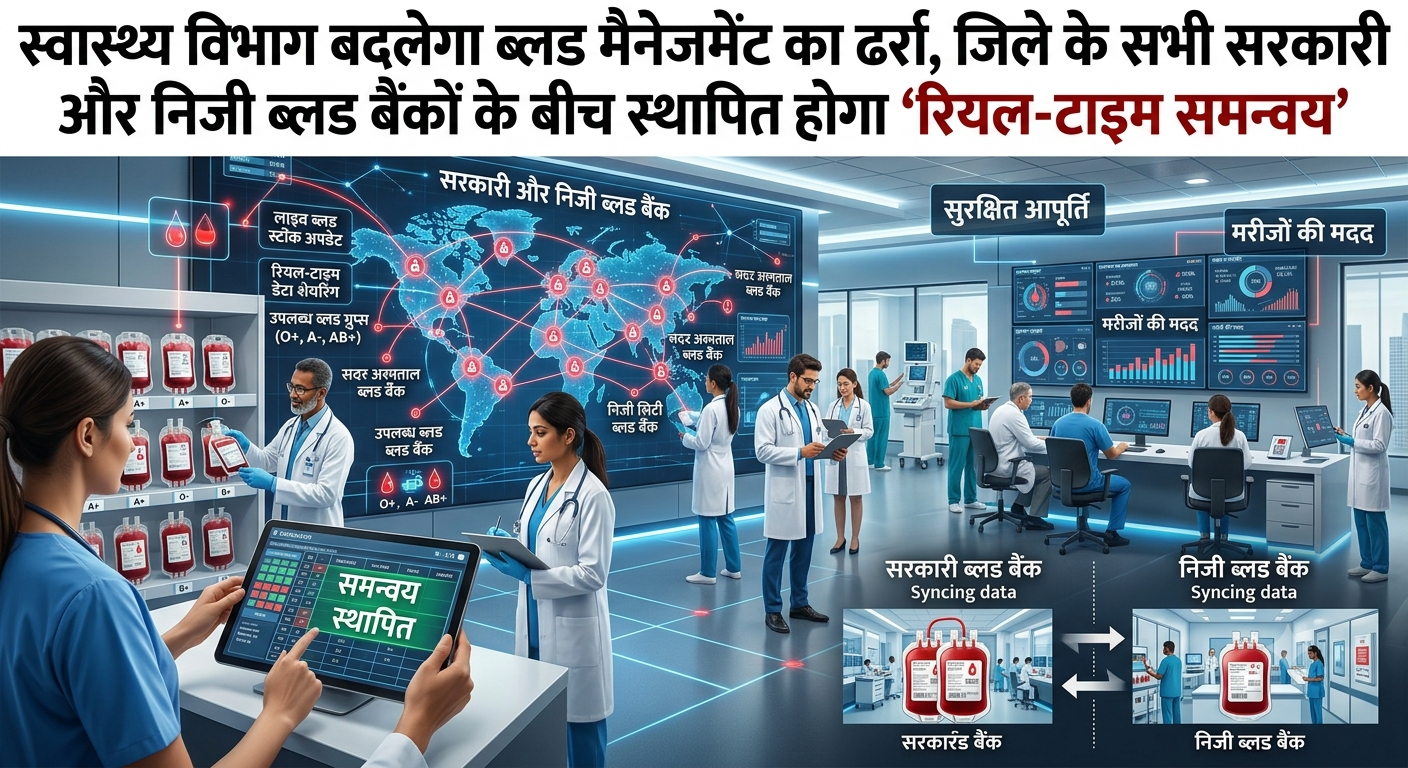
'Real-Time Coordination' to Be Established Across All Government and Private Blood Banks in the District
In a bid to prevent patients from running pillar to post for blood during emergencies and to rescue them from the clutches of illegal middle-men, the Health Department is poised to take a revolutionary step. Sadar Hospital, considered the backbone of the district's healthcare system, has drafted a highly critical and sensitive blueprint. Under this plan, all functional government, semi-government, and private blood banks operating across the district will be integrated into a unified shared network.
The primary objective of this coordination is to bring absolute transparency to blood availability in the district. Now, during major accidents, deliveries, or critical illnesses, patients' relatives will no longer have to circle from one hospital to another. Through this centralized system anchored by Sadar Hospital, a single click will reveal exactly how many units of a specific blood group are available at any bank in the district.
Connecting Blood Banks via a Digital Grid: How Will It Work?
Drafted under the direct supervision of the Civil Surgeon and the Blood Bank In-Charge at Sadar Hospital, the entire framework of this plan is based on digital integration. Until now, government and private blood banks operated completely independent of each other, leaving a massive void in data synchronization.
Centralized Software and Mobile App:
Sadar Hospital is set to launch a specialized digital dashboard and software interface. It will be mandatory for all licensed private and government blood banks in the district to update their daily opening and closing stock on this system.
Seamless Sharing of 'Blood Components':
It is frequently observed that a patient might only require specific components like platelets or plasma rather than whole blood. Under this coordinated model, if the platelet separator machine is functional at Sadar Hospital and a private blood bank faces a deficit, the components can be seamlessly transferred without paperwork delays.
Patients to Be Freed from 'Blood Crises' and Exploitative Middle-men
The biggest impact of this move by Sadar Hospital will be felt by the illegal blood rackets and middle-men who exploit families in distress by selling diluted or contaminated blood at exorbitant prices.
3 Major Benefits of This Coordination Framework:
Instant Management of Rare Blood Groups: Negative blood groups (such as $O-$, $AB-$, and $A-$) are notoriously rare. With this network active, if a patient admitted to a private hospital requires $O-$ negative blood, Sadar Hospital can instantly track its location across the grid and reserve it immediately.
Relaxed Replacement Policies: During emergencies, poor patients often do not have an immediate blood donor available among relatives. Under the new coordination, hospitals can exchange blood units on credit, under the condition that a replacement donor will be provided later.
Relief for Thalassemia and Anemia Patients: Children who require blood transfusions every 15 days will benefit immensely from this continuous availability tracker.
The District Blood Bank Network: At a Glance
The estimated database and operational architecture designed to connect the various centers under this new ecosystem are structured below:
| Blood Bank Category | Connected Centers in the Network (Projected) | Primary Responsibility |
|---|---|---|
| Main Hub (Sadar Hospital) | 01 (Nodal Center) | Monitoring, cross-verifying, and auditing data district-wide |
| Private Medical Colleges & Hospitals | 03 to 05 | Supporting critical care requirements and component therapies |
| Private Charitable Blood Banks | 04 to 06 | Maintaining buffer stock via voluntary donation camps |
| Red Cross Society | 01 | Providing backup storage during disasters and extreme emergencies |
Strict Action Against Non-Compliant Private Blood Banks
The Sadar Hospital administration has clarified that this coordination grid is mandatory, not optional. The Civil Surgeon's office is convening a high-level meeting with all private blood bank operators in the district shortly.
The Drug Inspector (DI) will also be part of this regulatory enforcement. Any private blood bank found hesitating to share its inventory data on this centralized network, or intentionally displaying falsified stock records, will face strict legal action. This includes the cancellation of their licenses under relevant sections of the Drugs and Cosmetics Act and the Disaster Management Act.
Furthermore, private entities are being strictly instructed that they cannot overcharge patients under the guise of processing fees. Blood and its sub-components must be provided strictly at the standardized rates fixed by the government.
To expand this network beyond hospitals, the administration is linking the grid directly with the general public. Sadar Hospital is developing a comprehensive 'Living Donor Directory' within this platform. This directory will archive the verified contact numbers and blood groups of local youths, social organizations, and NGOs who are ready to volunteer for on-call blood donations immediately.
This initiative by Sadar Hospital has been widely welcomed by the community. Medical professionals believe that by dismantling commercial competition among blood banks and replacing it with a spirit of collective service, blood-deficit mortality figures in the district can be brought down to 0%.


