
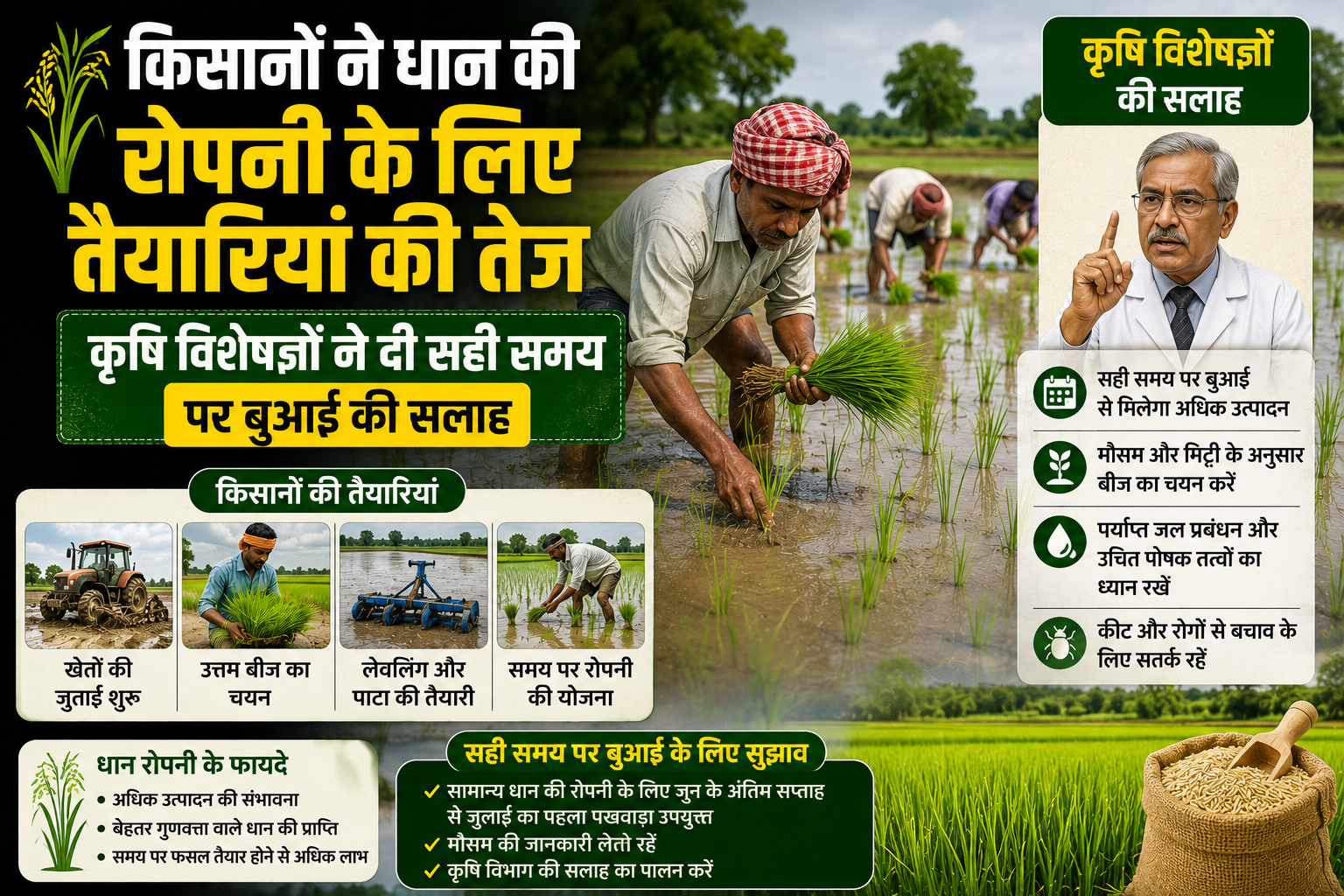
Farmers Accelerate Preparations for Paddy Transplantation; Agriculture Experts Advise Timely Sowing
Following intense summer heat and a prolonged wait, gathering clouds and the activation of the monsoon have brought smiles to the faces of farmers in Akbarnagar and its neighboring rural areas. Agricultural activities across the region have suddenly intensified for the cultivation of Paddy, the primary crop of the Kharif season. Farmers are working day and night to plow fields, tend to nurseries, and prepare the main agricultural plots.
The roar of tractors in the countryside and farmers working with traditional plows indicate that if the monsoon stays favorable this time, a bumper harvest of paddy is on the cards. Meanwhile, agricultural experts have issued essential technical guidelines and advisories for farmers to ensure scientific and timely paddy transplantation.
Active Monsoon Sparks Fresh Hope Among Farmers
In Akbarnagar, Sultanganj, and the adjacent Diara (riverine) and plains under the Bhagalpur district of Bihar, agriculture depends heavily on monsoon rains. Recent pre-monsoon showers and the initial monsoon downpour have restored moisture to the soil, acting as an elixir for the paddy crop.
Rush to Prepare Seedlings: The paddy seedlings (mori) that farmers sowed in nurseries about 15 to 20 days ago are now fully mature. The height and health of the saplings are currently looking excellent.
Field Preparation: With the monsoon turning active, farmers have plunged into puddling (kado) their fields. Water is being retained in the fields, and the soil is being leveled into mud using tractors or bullocks so that the roots of the transplanted saplings can easily hold onto the soil.
Expert Opinion: "Timely Transplantation Will Boost Production"
Experts from the Akbarnagar Block and District Krishi Vigyan Kendra have issued a special roadmap for farmers. Agricultural scientists have explicitly stated that "time management" is the most critical factor in determining final paddy yields.
Age of Seedlings
According to agricultural experts, paddy seedlings should be transplanted ideally when they are 21 to 25 days old.
"Often, farmers delay transplantation waiting for the seedlings to grow larger, planting 35 to 40-day-old saplings instead. This reduces the tillering capacity of the plants, directly decreasing the per-acre yield. Therefore, as soon as the seedlings develop 4 to 5 leaves, they must be moved to the main field."
Row-to-Row Distance (Line Sowing)
Experts have advised farmers to practice row (line) transplantation instead of traditional random methods. The distance from row to row should be kept at 20 centimeters, and plant-to-plant distance should be 15 centimeters. This layout ensures proper airflow and sunlight penetration, minimizing pest infestations and making weeding hassle-free.
Focus on Choosing Advanced and Resilient Varieties
Farmers across various villages in Akbarnagar—including English Chichraun, Bhavnathpur, Pain, and Sriramanagar—are prioritizing advanced and hybrid paddy varieties that require less water and mature quickly this season.
Short-Duration Varieties: For drought-prone patches or areas with low rainfall, scientists have recommended varieties like Sahbhagi, Sukhadhan, and Prabhat, which mature and are ready for harvest within 110 to 115 days.
For Flood-Prone (Diara) Areas: Since a vast portion of Akbarnagar lies along the Ganga river basin (Diara) and faces flood vulnerabilities, water-resistant varieties like Swarna Sub-1 have been chosen. This particular variety survives and remains undamaged even after being completely submerged in water for 12 to 14 days.
Fertilizer Management and Integration of Organic Farming
The Department of Agriculture has strongly advised farmers against the indiscriminate use of chemical fertilizers. To maintain soil health, balanced proportions of Nitrogen, Phosphorus, and Potash are recommended.
Importance of Zinc: 'Khaira disease' is a common problem in paddy crops caused by zinc deficiency. Experts recommend mixing 10 kilograms of Zinc Sulfate per acre directly during the time of transplantation.
Organic Fertilizers: Applying well-decomposed cow dung manure or vermicompost during field preparation enhances the water retention capacity of the soil, keeping the crop safe from drying up during gaps between monsoon rains.
Farmers Watch Power Supply and Canal Systems Closely
Even though the monsoon is active, given the inherent unpredictability of Indian weather, farmers in Akbarnagar do not want to rely solely on rains. They have requested the local administration and electricity board to ensure at least 16 to 18 hours of uninterrupted power supply to rural areas during this peak farming season so that tubewells and pumpsets can be deployed if irrigation gaps emerge. Furthermore, demands to clean local irrigation canals and water channels are gaining traction to ensure rainwater moves smoothly into farmland.
Key Highlights of Kharif Paddy Cultivation (At a Glance)
| Agricultural Activity | Ideal Parameter / Standard | Special Expert Advice |
|---|---|---|
| Age of Seedlings | 21 to 25 Days | Avoid transplanting older seedlings; it stunts tillering capacity. |
| Transplantation Method | Line Transplantation | Keep row-to-row gap at 20 cm and plant-to-plant at 15 cm. |
| Fertilizer Management | Balanced (NPK + Zinc) | Mandatorily apply Zinc Sulfate to prevent Khaira disease. |
| Best Variety for Diara | Swarna Sub-1 | Best choice for waterlogged or flood-prone river beds. |
tion represents the biggest annual bet for the farmers here. The timely arrival of the monsoon coupled with institutional guidance from agricultural experts has infused fresh energy into the farming community. If the weather behaves favorably and a steady supply of urea and other essential inputs is maintained, the green fields of Akbarnagar will soon harvest prosperity for its households. For now, the providers of food are dedicating their sweat and toil to transform the earth into a blanket of green.


